

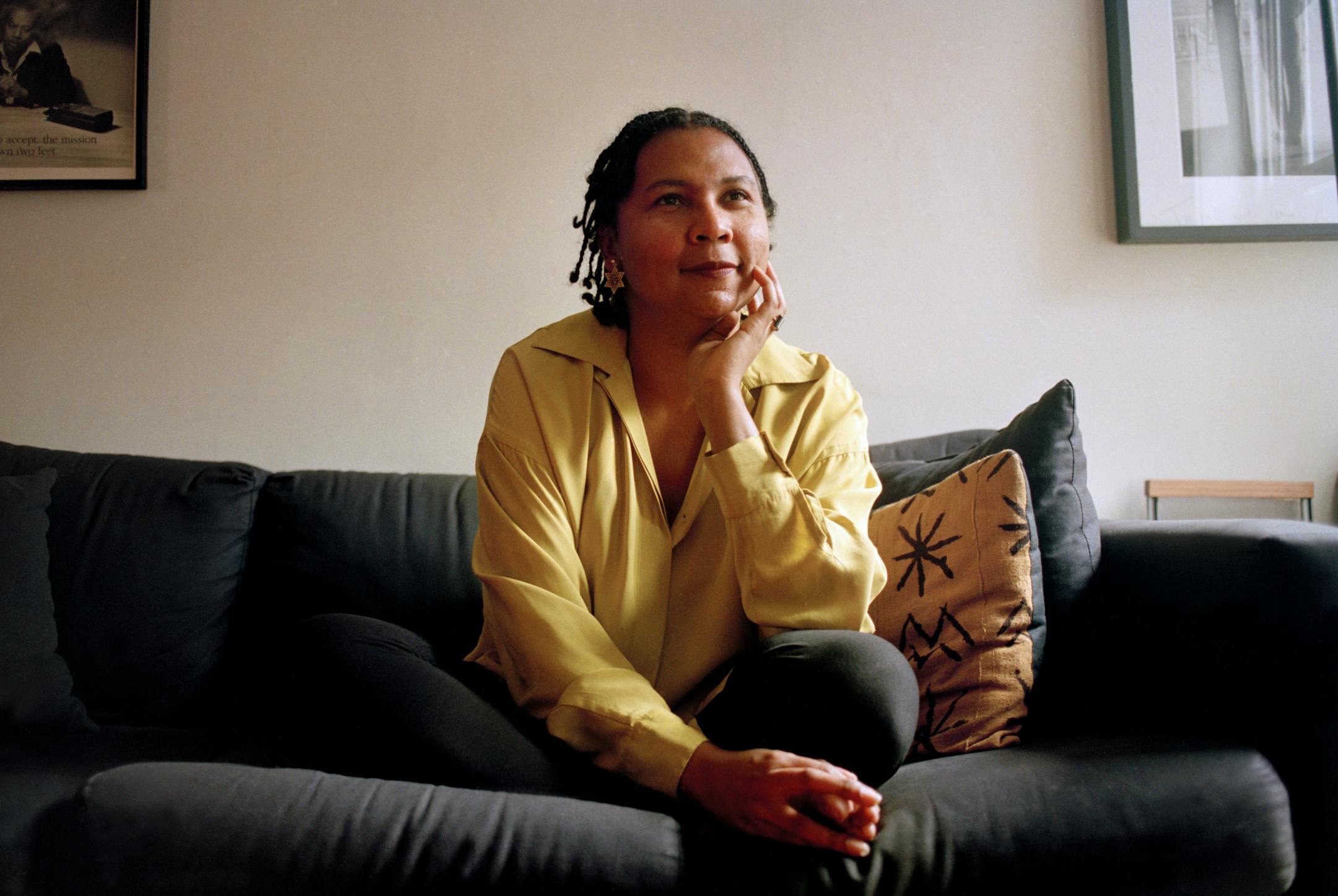
When I asked Kimala Price about the impact bell hooks, the Black feminist scholar and pioneer who died last month at age 69, had on her life, she paused.
"I'm a Black woman of a certain age," said Price, an associate professor of women's studies at San Diego State University and the co-director of the school's Bread and Roses Center for Feminist Research and Activism. "I discovered her when I was in college. I was in college late '80s, early '90s. We're talking undergraduate years. It was the perfect time for me to discover her."
It was a familiar reflection. Over the last few weeks, I've watched people, especially Black, Indigenous, people of color women, mourn the passing of hooks in public and profound displays. In my own world, Black women who followed her words remain in mourning.
A friend of mine told me hooks taught her how to think. Another colleague corrected a national publication on Twitter when it capitalized hooks' name, something hooks — born Gloria Jean Watkins before she adopted a pen name in honor of her great-grandmother — did not condone. Another friend, also a Black woman, posted on Facebook an image of a stack of books written by hooks and added that she "didn't have the right words" to discuss the icon's legacy. For the uninitiated, hooks taught at many universities including Yale, where she was a professor in the '80s, and was the author of notable works, including "Feminism is for Everybody" and "ain't i a woman."
In the days after her death, I heard Black, Indigenous and people of color women speak of a figure who had challenged the status quo and helped them discover themselves by reimagining our collective confines of Black history — boundaries that have historically eliminated Black women — in unapologetic dialogue.
"I can really say bell hooks allowed me to find my voice as a Black feminist writer and as a Black feminist educator," said Zenzele Isoke, director of graduate studies in the Department of Gender, Women, and Sexuality Studies at the University of Minnesota. "And I really mean that. I remember I saw her talk in 1998 and I had read one of her books, I think it was 'ain't i a woman.'
"Just the way in which she wrote, the clarity in which she wrote, the way in which she was fearless and critiquing things that were harmful to Black women, whether it was the feminist movement or whether it was aspects of the Black civil rights movement, where she showed how Black women were used as props for both of those groups, both of those social movements. She showed me how to find a voice and a perspective that was unique to Black women and didn't have to be secondary to the ideologies of white feminism or Black nationalism or even Black racial liberalism."
Isoke told me she'd taught her children about hooks, her legacy and her voice.


