

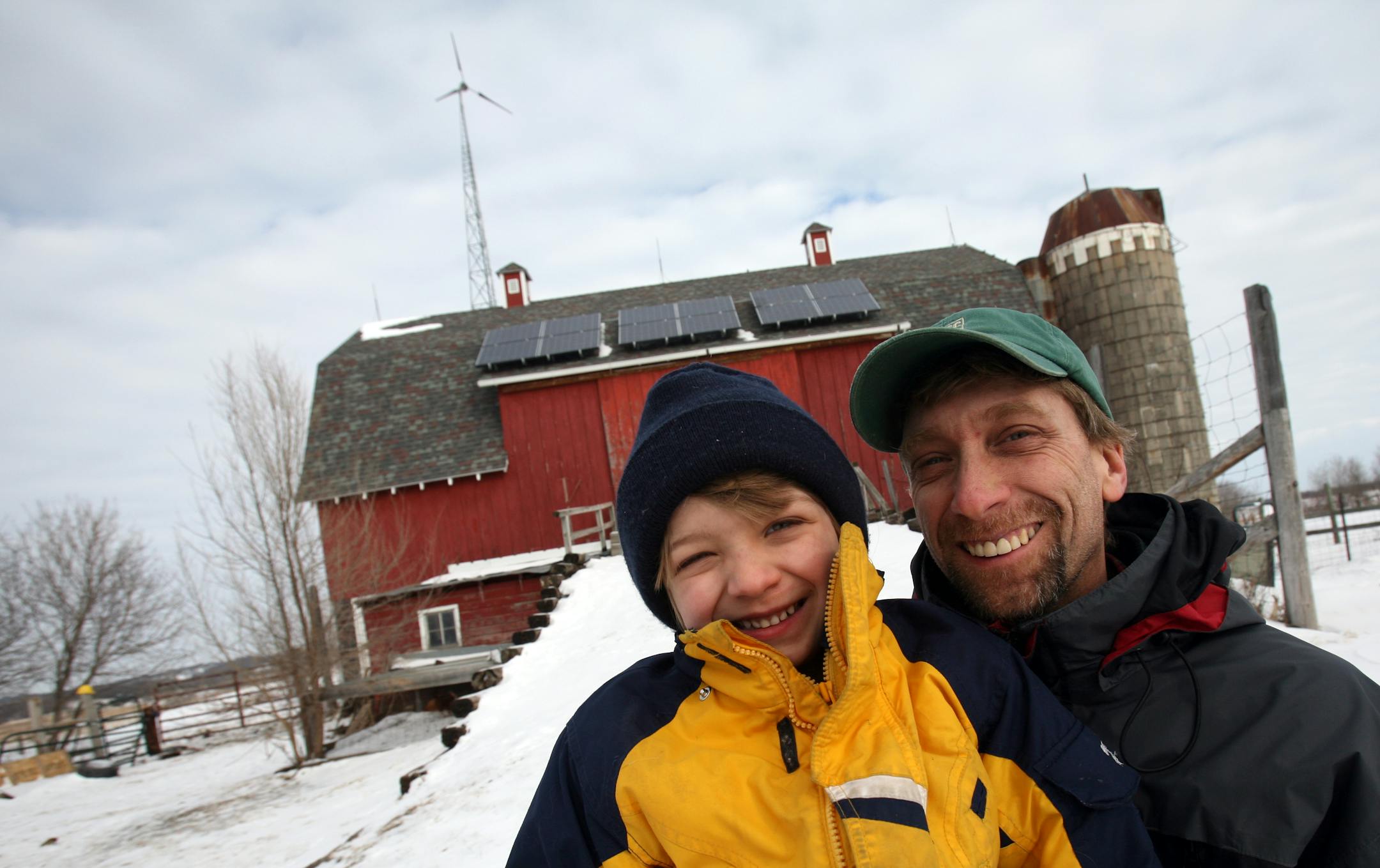
When Peter Hark walks outside his house, just watching the blades turn on his new wind turbine gives him a sense of satisfaction that has little to do with shrinking his electricity bill.
Hark and his wife, Mary Jo Cristofaro-Hark, expect to generate much of their own power by harnessing the breeze, but they estimate it could be 25 years before they recoup the $35,000 it cost to erect the 115-foot turbine and a set of solar panels on their 10-acre hobby farm in northern Rice County.
"In the long run, we might break even," said Hark, who is among a growing number of Minnesotans who have invested in "small wind," an industry tag for turbines rated at less than 100 kilowatts.
For Hark and many other small turbine owners, spinning the blades isn't primarily about saving money. Instead, customers ranging from dairy farmers to the School of Environmental Studies in Apple Valley are buying them as a way to make a hands-on contribution to the environment while spreading the word about wind power.
"It doesn't necessarily make good economic sense. It makes great environmental sense," said Clare Palmquist, who installed a wind turbine in December with her husband, Dean Marshik, on their fifth-generation dairy farm in Pierz in central Minnesota.
Roughly 7,000 Americans bought small wind systems in 2006, and the industry has grown by 14 to 25 percent a year since 1990, according to the American Wind Energy Association. In Minnesota, Wind Turbine Industries, a Prior Lake manufacturer, has seen annual sales of its 20-kilowatt turbines -- which generate enough electricity for two or three homes -- go from half a dozen a decade ago to nearly 50 in 2007.
"Small wind is the major factor in raising public acceptance of renewable energy," said Ron Stimmel, an advocate with the American Wind Energy Association. "It's the same statement as having a flagpole in your yard."
Many of the Prior Lake turbines go to farmers in Minnesota and nearby states, but perhaps a third are exported to destinations such as Northern Ireland and Italy, Turek said.
And buyers increasingly include rural residents who have at least an acre of land and ample wind to turn the blades on the turbines, which are much smaller than the behemoths found on commercial wind farms.
"We're seeing more and more individuals that are interested in buying a tower and putting up a turbine and making a statement," said Doug Wogstad, general manager of Winkelman's Environmentally Responsible Construction in Brainerd.


