

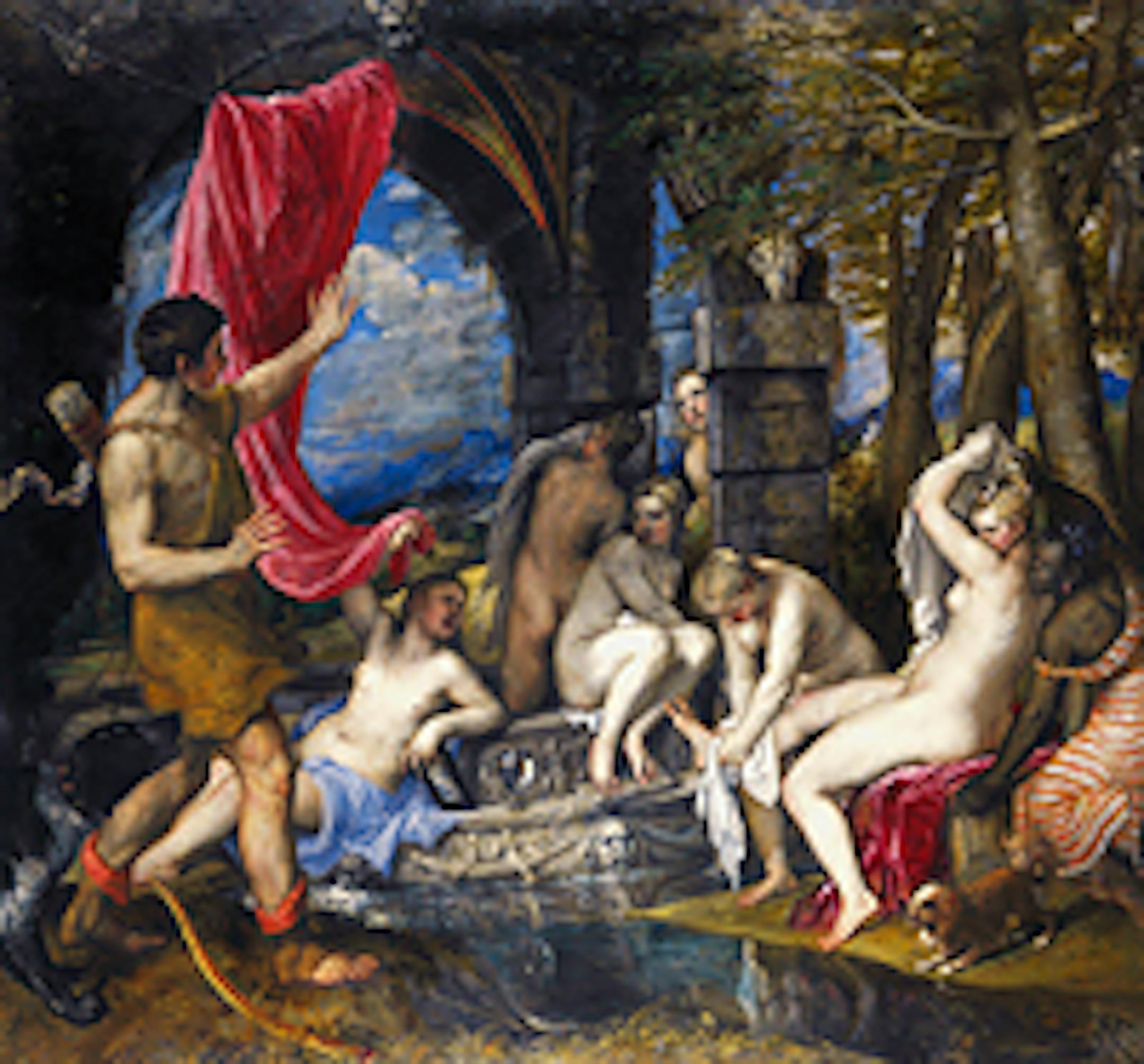
Lustrous flesh, exquisite drawing, expressive gestures, brilliant color -- no wonder the art in "Titian and the Golden Age of Venetian Painting" has been coveted by royalty and celebrated for centuries. There are just 13 paintings and a dozen drawings in the exhibit, which opens Sunday at the Minneapolis Institute of Arts, but they're big, pricey and glamorous. The star attractions are "Diana and Actaeon" and "Diana and Callisto," which hadn't left the British Isles in more than 200 years and are unlikely to visit again. They depict nymphs cavorting nude with the goddess Diana in woodland glades where humans get into big trouble. Here, the story and details behind "Diana and Actaeon."
'DIANA AND ACTAEON'
The scene: Actaeon, a young hunter, stumbles into a woodland grotto where the goddess Diana is bathing with her nymphs. Horrified at the intrusion, Diana transforms Actaeon into a stag who is chased and killed by his own dogs. Painted around 1556 and drawn from Ovid's "Metamorphoses," a Roman story-poem popular in the Renaissance, Titian's work shows the frailty of human life and the caprice of fate.
Actaeon reacts in horror, his eyes on the stag skull atop the pillar that symbolizes his fate. His faithful hunting dog will soon become his killer. A brilliant crimson sheet adds color and drama. The lion's head signifies Spain's King Philip II, for whom the work was painted. Diana's half-moon tiara identifies her as goddess of the moon. Deer hides in the trees remind us that she's also goddess of the hunt. Diana's yapping lapdog adds a human touch in an amusing standoff with Actaeon's huge hound.
Titian made changes as he worked -- the column was originally a tree trunk. Black people were a common sight in Venice, and painters often included them for the beautiful contrast of flesh tones. Tilted fountain and other distortions of perspective and scale imply a world gone awry.

