
Arrow doesn't always fly as true as the crow flies

Hunting crows using a bow can be challenging, both to get within range of them and then to hit the moving target.

For the Minnesota Star Tribune
March 23, 2008 at 6:06AM
00105-047.06 Bowhunting: Archer watches winged for game with bow up and flu flu arrow on the string. Hunt, birds, flight, fly, crows.
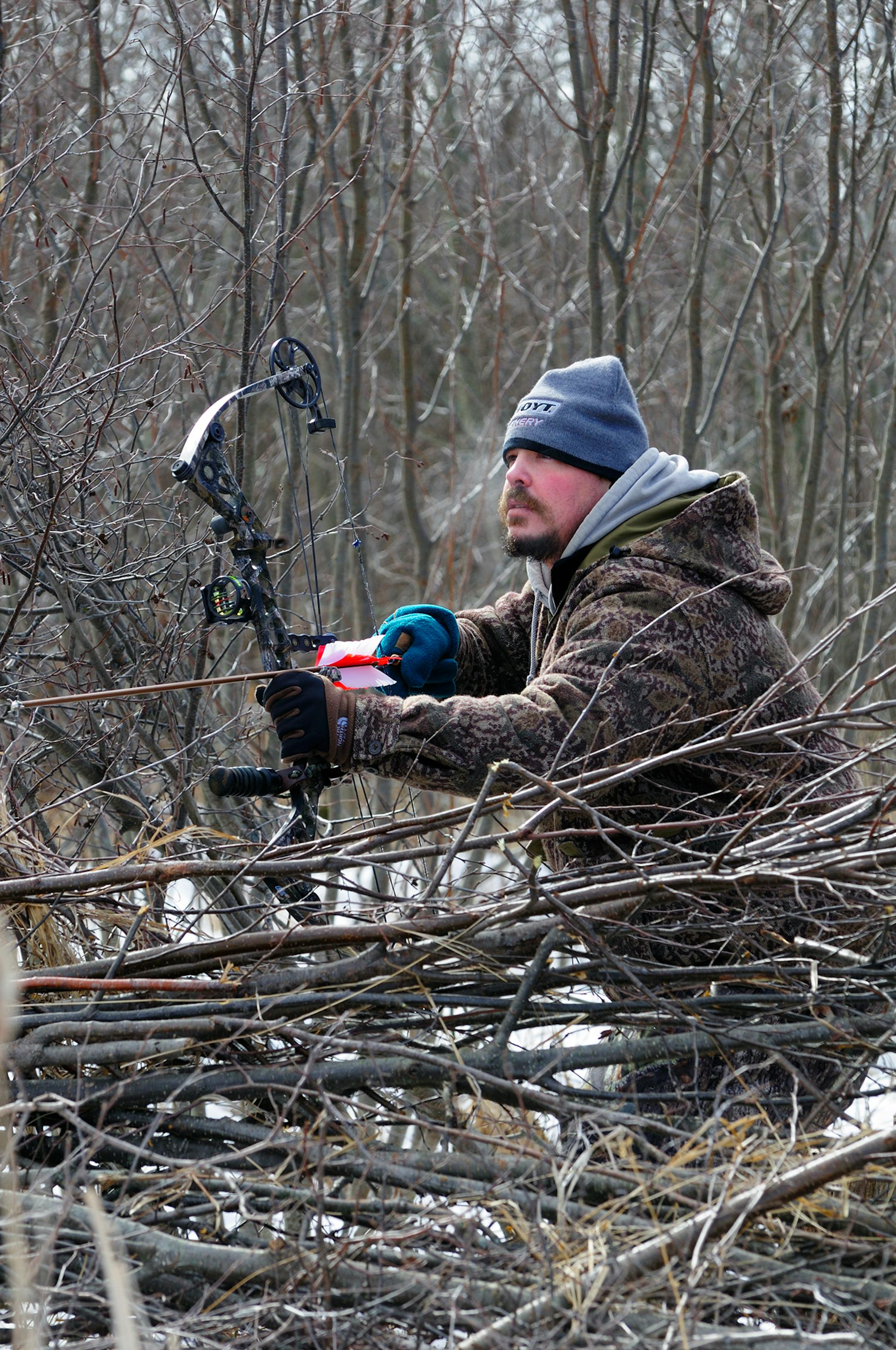
Dan Beraldo of Brainerd was poised to loose a “flu-flu’’ arrow as crows approached to calls made by his hunting partner, Bill Marchel. Flu-flu arrows have oversized fletching that reduces the distance arrows travel, making them easier to recover. (Photo By Bill Marchel/The Minnesota Star Tribune)

BRAINERD, MINN. - To a bird in flight, the sizzling wings of a diving falcon is a terrifying sound. In the life of birds, the jetlike swish is an auditory signal that demands immediate action; get to cover, or get killed.

A flu-flu arrow shot from a bow emits a similar swishing sound.

So, when Dan Beraldo of Brainerd let fly a flu-flu arrow at a fast-retreating crow during a recent hunt, I had to wonder what the big black bird thought when the red-and-white-feathered arrow sizzled past.

"I swear that crow thought your arrow was a falcon," I said to Dan. "The crow was looking over its shoulder. If only our flu-flu arrows were as accurate as a hunting falcon."

In Minnesota, the crow hunting seasoned opened March 1 surrounded by little fanfare. My crow hunting escapades date to a time when my friends and I were so young we needed to persuade one of our parents to drop us off outside of town. At the time there was no closed season on crows. My friends and I often hunted crows at the local landfill, where we sometimes used discarded refrigerator boxes as makeshift blinds.

Most often we hunted crows with shotguns; sometimes we employed varmint rifles.

But during last week's crow hunt, Dan and I carried only our bows and flu-flu arrows. It was the first time either of us had hunted crows using archery equipment, so we weren't sure just what to expect.

What is a flu-flu arrow? It's an arrow fletched with oversized or spiral-wrapped feathers. Flu-flu arrows fly straight and fast for about 30 yards, then rapidly slow down.

The large fletching dramatically reduces the distance the arrow flies, and that's a decided benefit when it's time to retrieve your arrow after shooting at a game bird in flight.

I made my flu-flu arrows using six uncut feathers and a standard fletching jig. When shot upward at a 45-degree angle they travel about 70 yards. Flu-flu arrows can also be purchased at most archery pro shops.

A few days before our crow hunt, I had built a crude blind out of surrounding vegetation about 20 yards from the carcass of a road-killed deer. Migrating crows had been feeding on the remains, and I hoped that constructing the blind ahead of time would allow the wary birds to become acclimated to its presence.

To accommodate two archers hoping to fling arrows at flying crows, the blind needed to be larger and more exposed than if we had been bearing shotguns.

It was cold, clear and calm when Dan and I arrived at the blind roughly a half-hour before sunrise. In the gray light of dawn we could hear the crows announcing the coming day.

We placed a few crow decoys near the deer carcass and settled into the blind.

Shortly after, three crows appeared, winging toward us. But the birds were high, and, as I had feared, they spotted us before flying to within bow range.

"The crows must come in low from the left or right if we are going to get some shooting," I said to Dan as we watched the departing birds. "I built this blind with that in mind."

A bit later, a crow sounded to our left. The bird was low, and I could tell by its excited four-caw call that it was committed and coming in.

Dan drew his bow. When the crow appeared in front of the blind it spotted us and flared, its broad wings grabbing for air. Dan released a flu-flu arrow, and we watched as it zipped just over the departing crow's back.

"That was close," Dan said with a grin.

During periodic lulls Dan and I shared stories of more traditional bow hunts; elk in Oregon, mule deer in North Dakota, whitetails in Minnesota.

At one point, the call of a crow interrupted our conversation. It was close and coming from behind us. Just as I grabbed my bow we spotted the crow coming in low. I came to full draw, and when the crow was above me I stood and shot. My arrow missed to the right, although it appeared I had allowed the correct lead.

By midmorning the action slowed. We had shot at and missed seven crows, and many others had flown past out of bow range. I couldn't help but feel a bit disappointed, not because our arrows didn't connect, but because I had hoped for more shot opportunities.

"Let's do this again," Dan said as we retrieved our arrows.

The crow-hunting season in Minnesota ends March 31. The second season begins July 15. Crows may be hunted without a license, and there is no daily or possession limit.

Bill Marchel is a wildlife photographer and an outdoors columnist. He lives near Brainerd, Minn.

about the writer

about the writer

BILL MARCHEL