

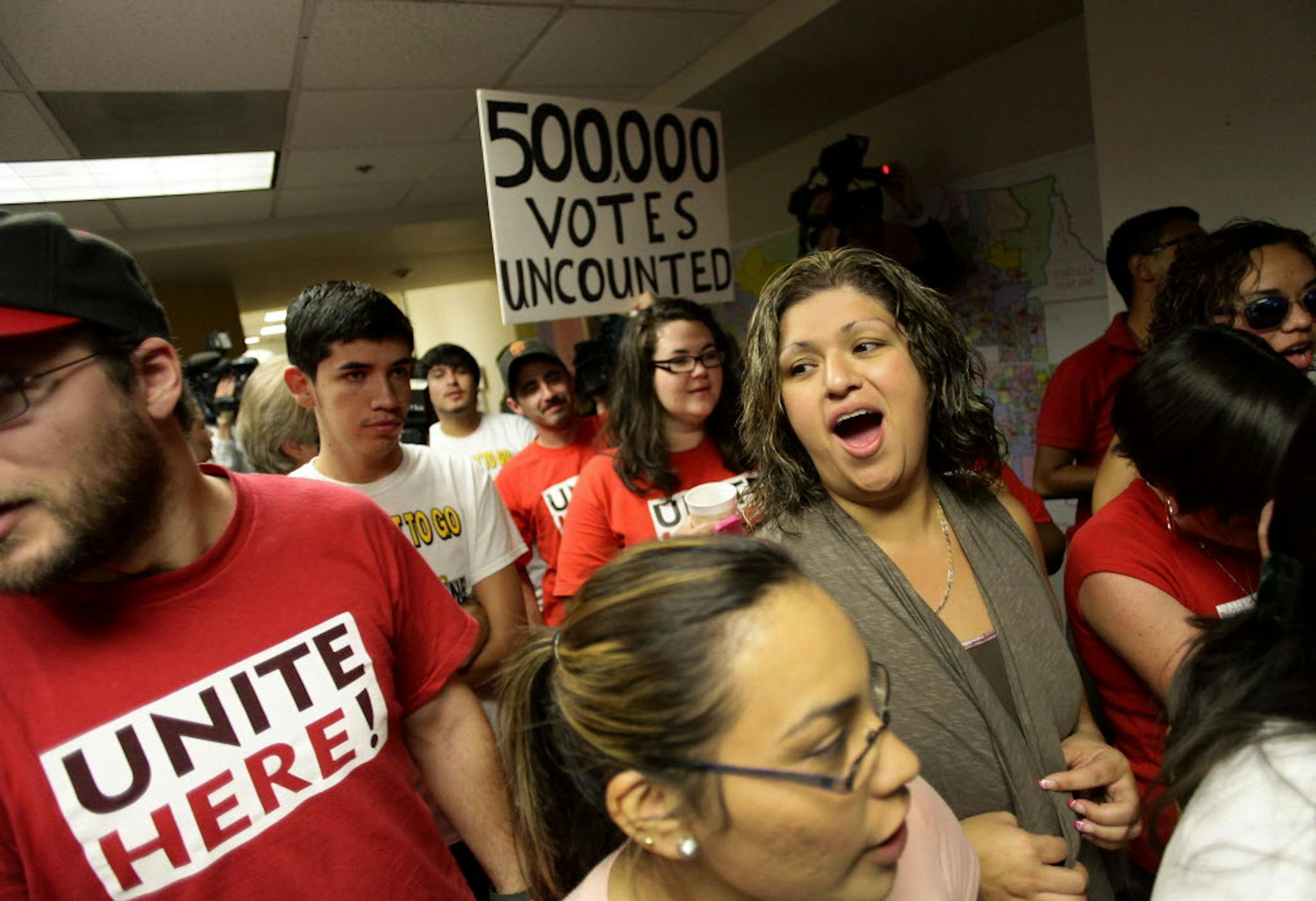
Two weeks after the election, the ballots are finally counted in Arizona. The delay -- more than half a million were uncounted on Election Day -- left community organizers who registered a record number of Latino voters in Arizona reeling with suspicion and raised questions about the integrity of the electoral process in the state.
A crush of hundreds of thousands of early mail-in ballots received a few days before Election Day is partly to blame for the delay, election officials said. Maricopa County recorder's officials were inundated with 200,000 early mail-in ballots just on Election Day. Statewide, more than 600,000 ballots were left uncounted that day -- out of about 2.2 million Arizona ballots cast during this year's election.
Still, Latino advocates and leaders remain suspicious and contend election officials should have been prepared. They said they still don't have a clear picture as to why counting took so long and said the delay feeds a perception of discrimination given Arizona's history of intentional voter suppression of minority members. For example, literacy tests were once used to keep Spanish-speakers and Navajos from voting.
"It creates this sense of illegitimacy," said Rodolfo Espino, assistant professor of political science at Arizona State University. "It could be something really innocent going on here, or something really egregious going on here. Regardless, it's a problem that needs to be addressed."
Results announced on or just after election night remained unchanged, although it took days for three congressional races to be decided. All of them were won by Democrats, who will replace Republicans as a majority in the state's congressional delegation come January. It was only Wednesday afternoon that one of the winners, Kyrsten Sinema, was able to find out the number of votes that put her ahead of her opponent, Vernon Parker, a Republican, in the race for Arizona's 9th District -- "10,251," she announced on Twitter. "Thank you."
Secretary of State Ken Bennett insisted "the system is not broken," saying it took just as many days to count the votes four years ago. Still, he acknowledged that the state could do better, joining a growing chorus of elected officials, civil rights advocates and community organizers calling for a faster way to tally the ballots.
"Speed is not our No. 1 goal. Accuracy is our No. 1 goal. But that doesn't mean we can't think of a way to speed up the process," Bennett said.
Ideas and plenty of criticism have been floating around since the exact number of ballots left to be counted after the polls closed -- 631,274 -- came to be known. This week, Democrats called for a bipartisan inquiry to scrutinize some of the issues raised by voters and campaigns, such as the fragmentation of the election process -- run independently by each of the state's 15 counties -- and the difficulties some voters who signed up to vote by mail seemed to have had in differentiating sample ballots from real ones.


