

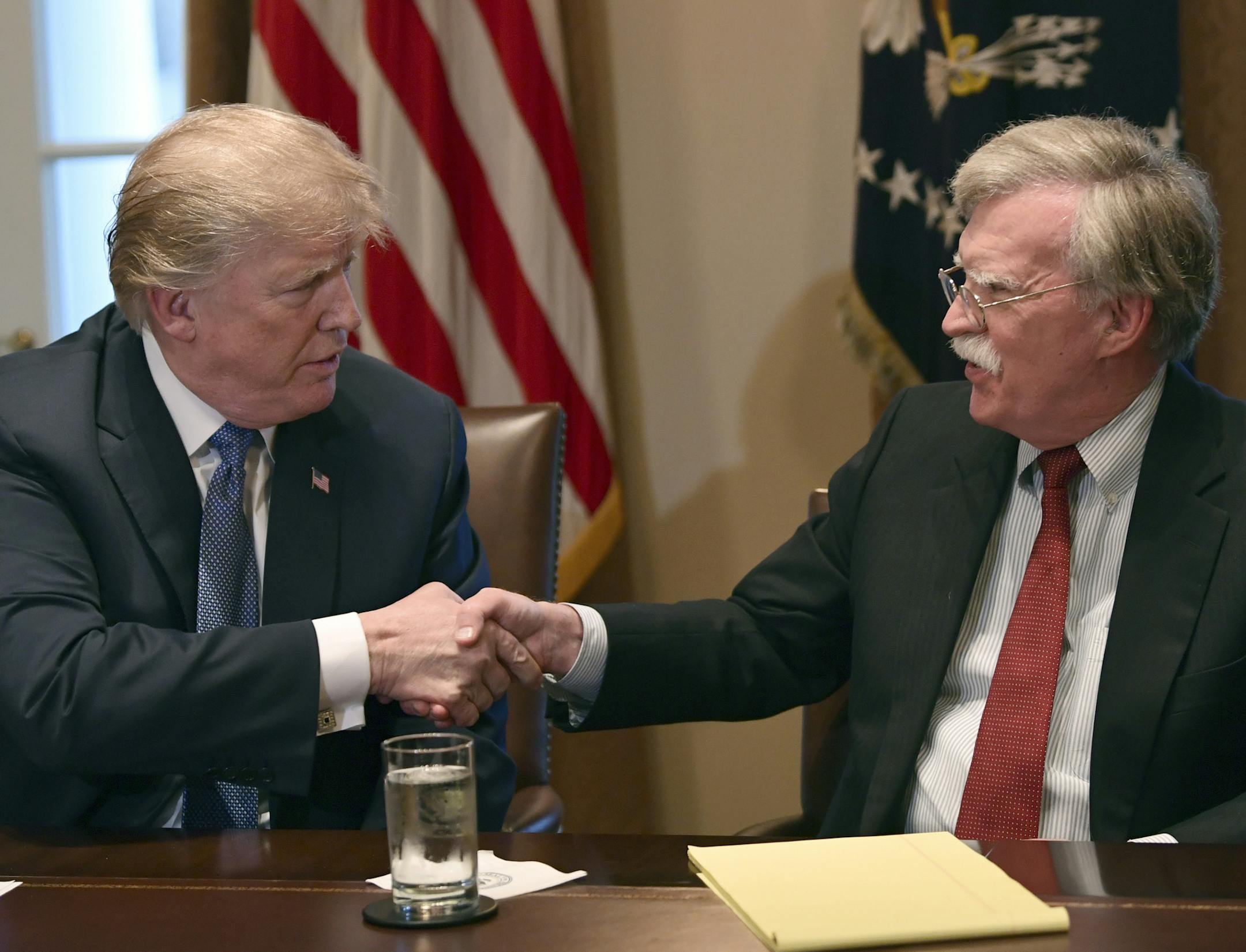
President Donald Trump finally did it. On Thursday, he pulled the plug on next month's big summit with North Korea's leader, Kim Jong Un. In sadness, but not anger, Trump said Kim's insults were too much for now. That said, he left the door open for a future meeting.
Why did get Kim get cold feet and resume that anti-U.S. rhetoric?
North Korean apparats tell us that their dear leader is skittish about negotiations after Trump's national security adviser, John Bolton, suggested the "Libya model" for ridding the Hermit Kingdom of its nuclear program. As vice foreign minister Kim Kye Gwan said of Bolton last week, the North does not "hide our feelings of repugnance towards him."
This is also the view of many South Koreans, as the Washington Post reported this week. Trump, too, got the memo. Last week he made it clear that he was not seeking "the Libya model," a successful arms control negotiation sealed in the aftermath of the 2003 invasion of Iraq, which he conflated with his predecessor's humanitarian intervention in 2011.
It's understandable why autocrats shiver when they consider the fate of Libya's former dictator, Moammar Gadhafi. After giving up his nuclear program, he had a few years in the good graces of the West. But in the tumult of the Arab Spring, Europe and America would not allow him to slaughter his people en masse after he promised to do just that in a televised speech.
But the 2011 U.S. and European intervention into Libya was not a result of the arms control deal that Gadhafi struck. If the terms of that bargain are the reason for Kim's cold feet, then there wasn't much of a chance for peace on the Korean Peninsula in the first place. After all, what is the point of these high-level talks if the complete, verifiable and irreversible denuclearization of North Korea is not on offer?
What's more, the U.S. can promise Kim not to invade his country. The U.S. can entice Kim with cash and trade. The U.S. can perform all kinds of diplomatic acrobatics and pretend this tyrant is a statesman. But no one can guarantee that one day the North Korean people will not rise up against him. The Soviet Union had a nuclear arsenal that could destroy the world dozens of times over, but even that regime eventually met its end after Boris Yeltsin decided holding the empire together wasn't worth the repression required.
And this is exactly why Bolton is valuable. The fact that the North Koreans despise him is a good thing for American interests. Back when Bolton was undersecretary of state in George W. Bush's first term, he used to keep framed copies of Iranian and North Korean propaganda sheets that denounced him. For Bolton, the furious insults of dictators were badges of honor.


