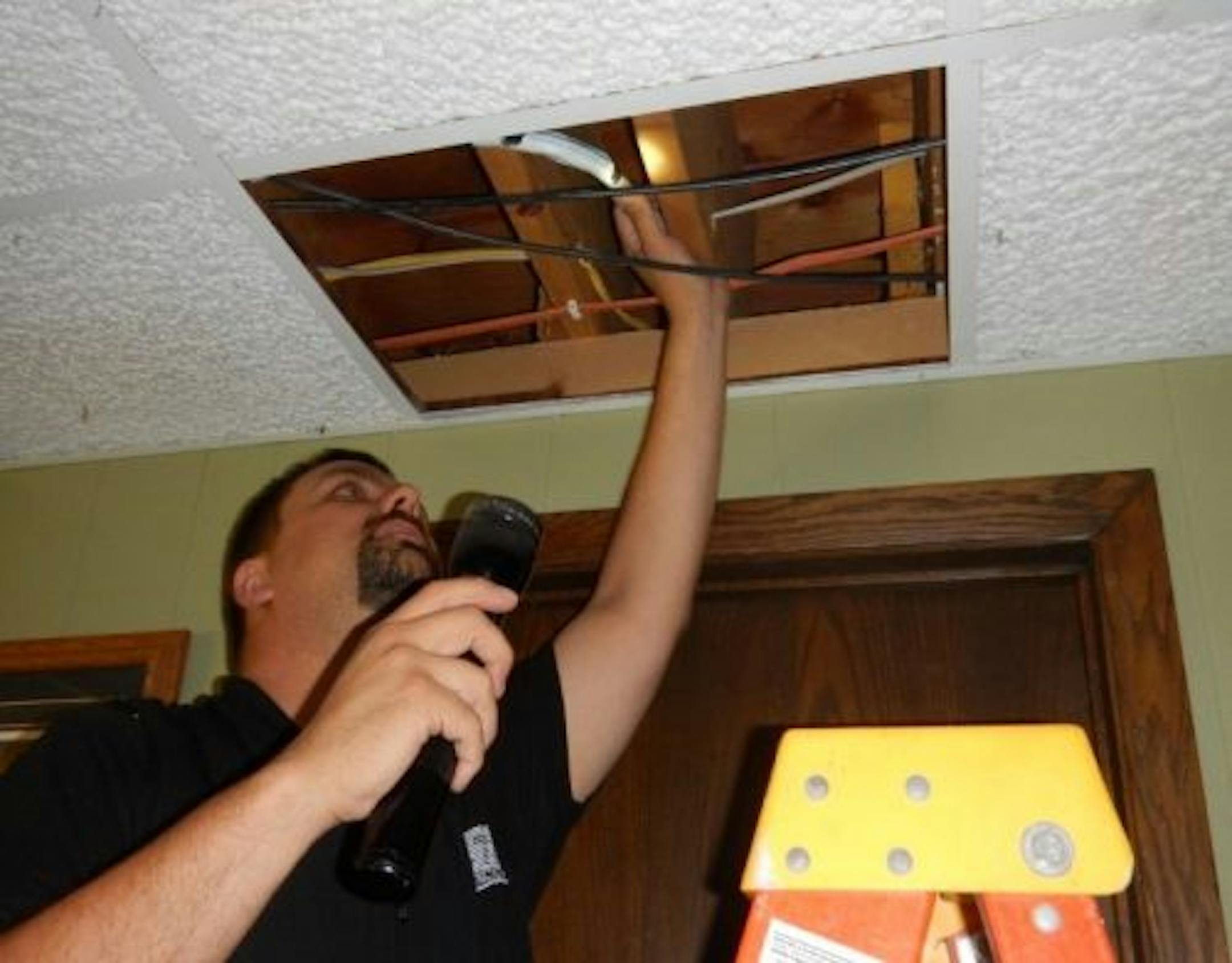
I'm going to cut right to the chase: home inspectors are not required to move ceiling panels. There. You can stop reading now and go about your day if you're only looking for the answer to this question.
And now the long answer. As much as I hate to admit this, not every one of our clients is happy with our service. We do get complaints, and we usually settle them amicably. We don't want unhappy customers, so we go out of our way to make sure we don't have them. I renewed our company's focus on happy customers and excellent customer service about two years ago, after reading Delivering Happiness: A Path to Profits, Passion, and Purpose. The author, Tony Hsieh, founded Zappos and sold it to Amazon in 2009 for over $1.2 billion. A large part of the success of Zappos was a focus on making customers happy.
A recent complaint
We recently had a client hire us to inspect a 95-year-old home in Saint Paul. It was a long inspection and we wrote a long inspection report, filled with recommendations for maintenance, repairs, and safety upgrades. While we encourage all of our clients to attend the home inspection, this client either could not or chose not to attend.
One of the items that we listed in our inspection report was the presence of some two-prong outlets. While the presence of two-prong outlets is not a defect, it does indicate older wiring that won't accommodate a three-prong plug. We made a recommendation to consider upgrading to three-prong outlets, along with a link to my blog post that describes the process involved in doing this: http://structuretech1.com/converting-two-prong-outlets/.
After buying the home, the new owner hired an electrician to upgrade these two-prong outlets. The electrician determined that there was a small amount of knob & tube wiring present in the ceiling of the basement, which is likely why the two-prong outlets had never been upgraded. This was discovered after removing basement ceiling tiles in a basement with very low headroom; so low that the ceiling tiles were nearly impossible to remove. In fact, the existing ceiling tiles got mangled in the process of being removed; thankfully not by us.
Our client contacted us after this, very upset that we had not identified the presence of knob & tube wiring above the dropped ceiling in the basement. In this particular case, discovering the knob and tube wiring would have required a great deal of luck and ninja-like skills in lifting one of the three available panels that gave access to the knob and tube wiring.
Is it reasonable to expect that we should have found this wiring?
Home Inspection Standards of Practice and ceiling panels
First, let's take a look at home inspection Standards of Practice (SOP), starting with the SOP set forth by the American Society of Home Inspectors. Section 2.2.A says that the inspector shall "inspect readily accessible, visually observable, installed systems and components listed in this Standard." Section 13.2.A.1 says that the inspector is NOT required to determine "the condition of systems and components that are not readily accessible."