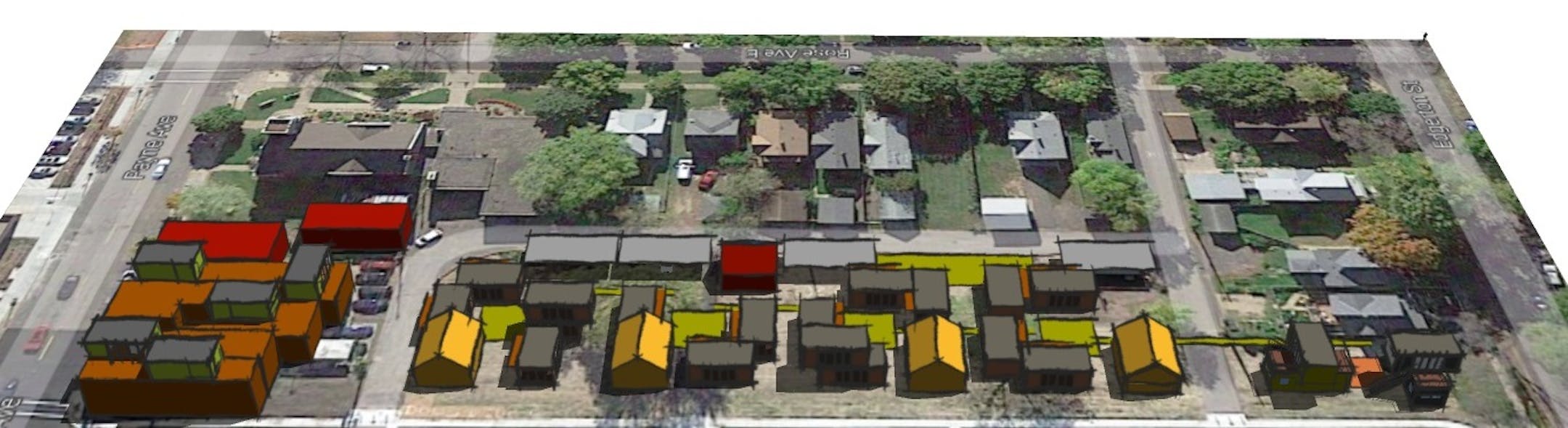
Will the "tiny house movement" ever be big in Minnesota? A development project on St. Paul's East Side may go a long way toward answering that question.
The concept of downsizing to homes of as little as 100 square feet for environmental, financial, social and even spiritual reasons is gaining traction in the United States, especially on the East and West coasts, where real estate costs have become prohibitively expensive for many would-be homeowners. Fans say "tiny living" offers an alternative that challenges traditional notions of how much space one really needs and encourages living in a sustainable way.
The tiny house movement has some particularly enthusiastic supporters in the architecture community, where there's a competition of sorts to design appealing, cost-effective, environmentally friendly tiny homes.
One of the movement's pioneers, Geoff Warner of St. Paul-based Alchemy Architects, has teamed with the Robert Engstrom Cos., the city of St. Paul and an East Side nonprofit developer to propose a tiny house cluster as a demonstration of how such homes could spur development of affordable for-sale housing.
The effort got a major boost late last year when the Metropolitan Council awarded it $100,000 in transit-oriented development grant money. The site on the southwest corner of Payne and Maryland avenues is adjacent to the high-frequency No. 64 Metro Transit bus line, which connects downtown St. Paul with the emerging Payne Avenue business and entertainment corridor, the Phalen Retail Center and Maplewood Mall.
Warner and Jay Nord, a project manager with the Minneapolis-based homebuilder Robert Engstrom Cos., said this week they hope the demonstration could spark state and national interest in the potential of tiny homes for urban settings.
"I think more and more people are realizing you don't need to have huge spaces to have really nice spaces," said Warner, developer of the Weehouse prefabricated tiny home concept.
"Baby boomers are looking to downsize, and at the other end of the spectrum, there's a genuine commitment among millennials to live 'mortgage-lite' and 'material-lite,' " Nord added. "I think this project will appeal to both."