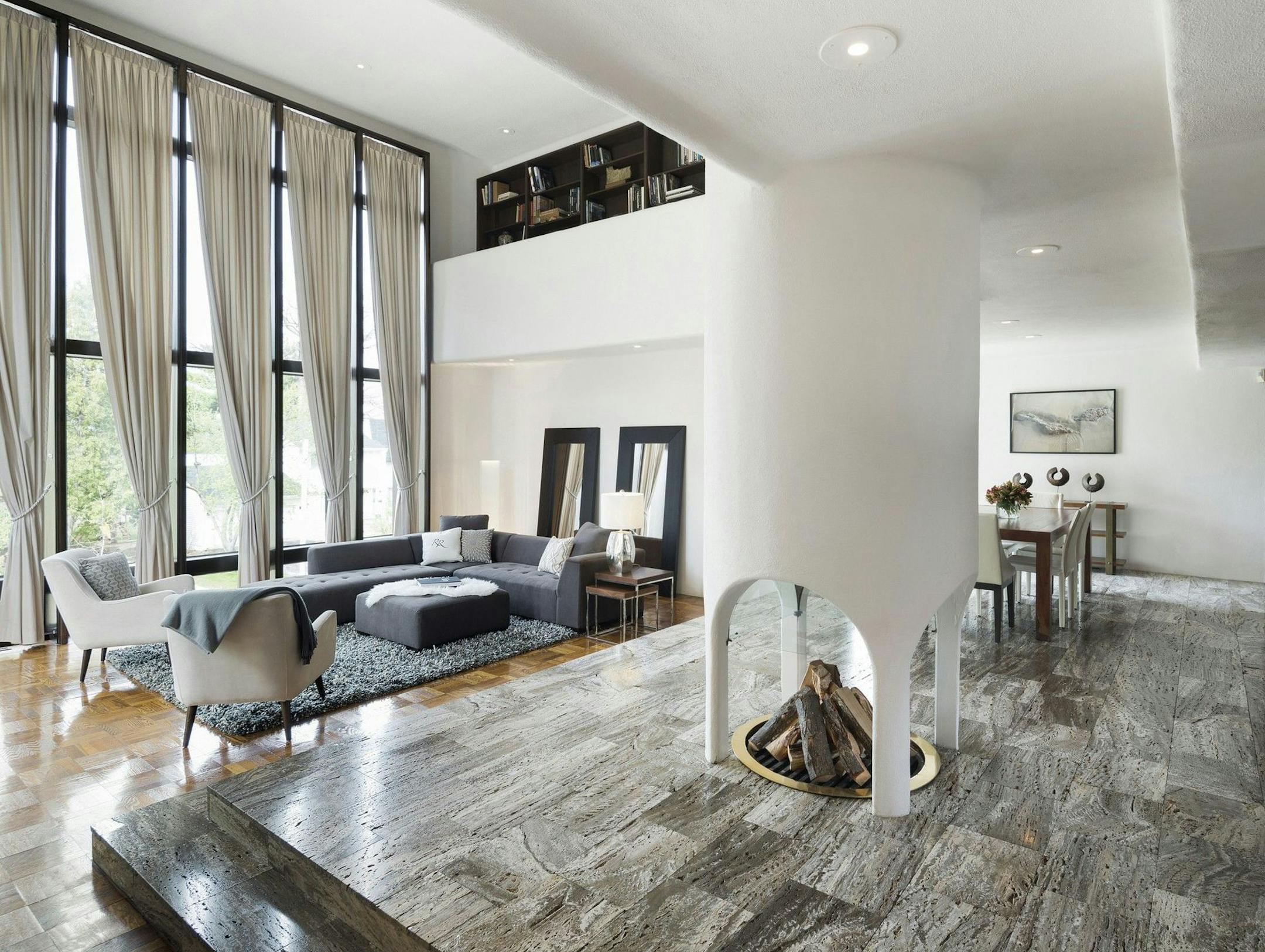
The modern-style house on a quiet leafy street in southwest Minneapolis has a mysterious air. Tall and tucked into its site, it resembles a geometry diagram, with squares jutting out, a bank of soaring narrow windows and a windowless turret that resembles a white grain silo.
Walk up the winding stone steps to the front door, and you're not quite sure what to do next. The double door has no knobs or handles, and there's no sign of a knocker or doorbell.
Then you spot a sculptural metal circle, like a Ferris wheel with bells hanging from it, near the entrance. The bells herald your arrival, but the only way to enter the house is to be welcomed in by someone on the other side of the door.
Architect Benjamin Gingold designed the distinctive house for himself and his family in the late 1950s. Completed in 1959, it was so unusual that it attracted attention from the New York Times and Progressive Architecture magazine.
The 4,220-square-foot house spans four levels and boasts many dramatic features, including a living room with 18-foot ceilings, a travertine stone raised platform with an arched cylindrical fireplace, and abundant mahogany paneling and built-ins.
Then there's the staircase inside that turret: a four-story spiral lit by a circular skylight with a curving handrail that "winds like the peel of an orange from top to bottom," as Gingold described it, according to "Minnesota Modern" by local architectural historian Larry Millett.
Gingold, a Yale-trained architect who did mostly commercial projects, also taught at the University of Minnesota under Ralph Rapson. In his house, he combined Bauhaus influences with architectural ideas he absorbed during a sabbatical in Greece, particularly on the island of Mykonos. There's even a touch of Spanish architect Antonio Gaudi in the tile mosaic master bath with double brass sinks, a circular shower and a door behind the tub that opens to reveal a fireplace in the hallway.
The combination was irresistible to Bouky Labhard when she and her late husband bought the house in 1970. A native of Greece who studied architecture in Switzerland, Labhard and her Swiss-American husband, Fred, were moving to the Twin Cities, with two young daughters in tow, for Fred's job with Toro Corp.