

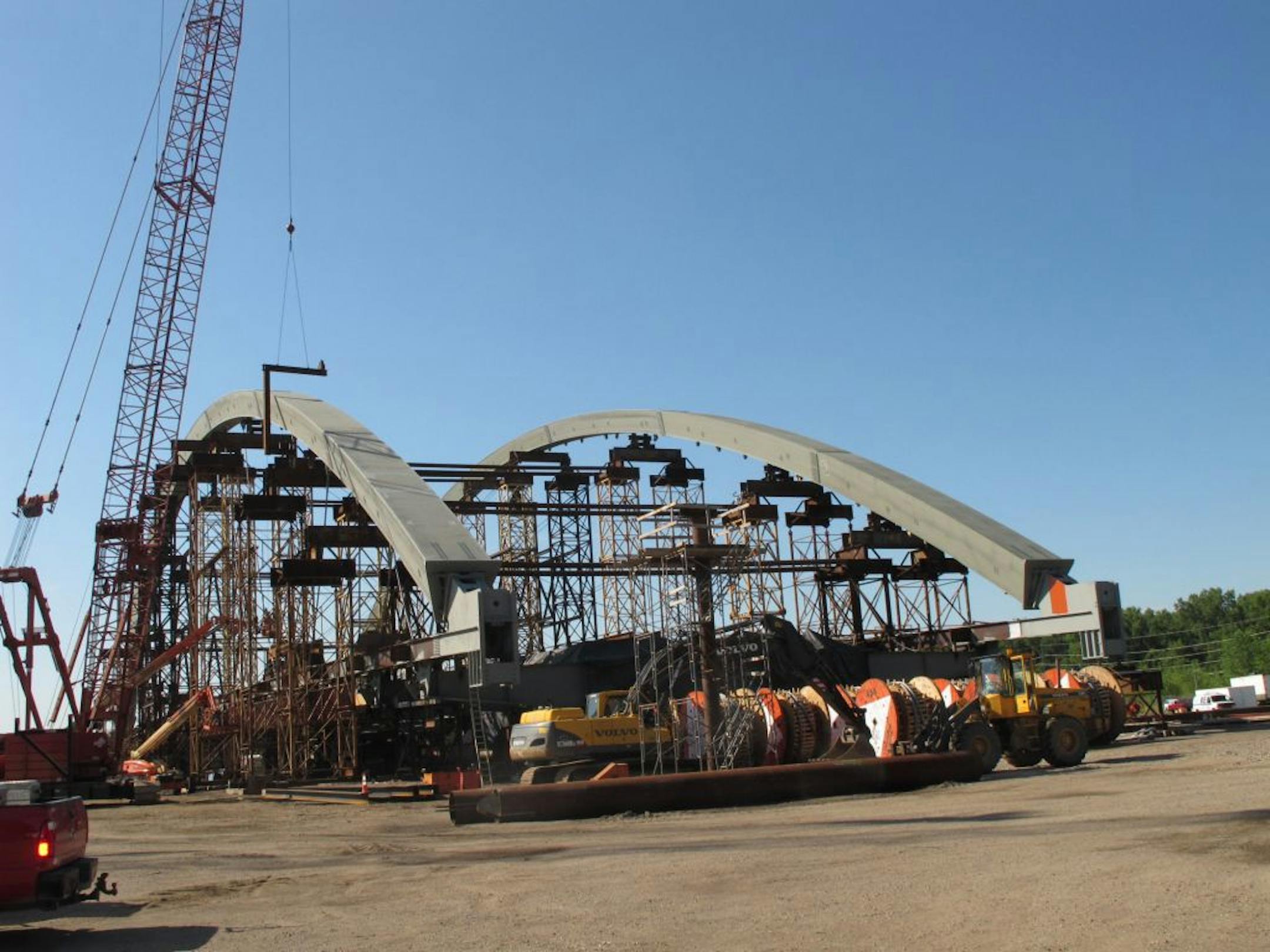
The twin arches of the new Hastings bridge stand tall amid temporary scaffolding as workers bolt together the massive 545-foot main span in a riverside staging area.
Construction was on schedule last week to float the 6.6 million-pound arch-and-steel beam deck on eight barges about half a mile down the Mississippi River in early September. The span will be hoisted into place between two piers. Temporary steel beams will undergird each arch until the 104-foot-wide span is anchored in place by concrete tie girders.
The $120 million structure will be the longest free-standing arch bridge in North America, says the Minnesota Transportation of Department (MnDOT). The work started in the fall of 2010. Weather permitting, it will open to four lanes of traffic by December 2013.
A curious fact about the hollow, trapezoid-shaped arches is that iron workers and huge cranes built them downward from the 98-foot-high apex. Each arch is made of seven steel segments, each weighing about 110,000 pounds. They were built in Eau Claire, Wis., and trucked to the staging area near the Hastings lock and dam.
"We started in the middle and go down both ways," said Tom Villar, MnDOT construction manager. "You cut your errors in half instead of starting at the end [bottom] and going across" the arch.
Reducing variance in main span dimensions is crucial, Villar said, because the bridge is being built with a tolerance of about a quarter-inch in how everything fits together. To keep the arches and deck aligned at the right elevation and position, surveyors appear at 3 a.m. each day (to avoid metal-expanding sunlight). They shoot laser beams from 20-foot towers, one near each of the span's four corners, to ensure it's still lined up. If not, jacks move the span minute amounts vertically or horizontally, Villar said.
To keep the arches from shifting, each connection between the 110-foot-long arch segments is secured with 770 big bolts, Villar said on a hot, sweaty morning last week.
The arch segments are supported by jacks and scaffolding set in place by two cranes, one of which is 170 feet tall and can lift 300 tons. Iron workers like Joe Kabes are lifted on boom platforms to use high-impact air wrenches to tighten the one-inch thick bolts and nuts holding the segments together. The workers spell each other every 50 to 100 bolts, depending on the heat.


