

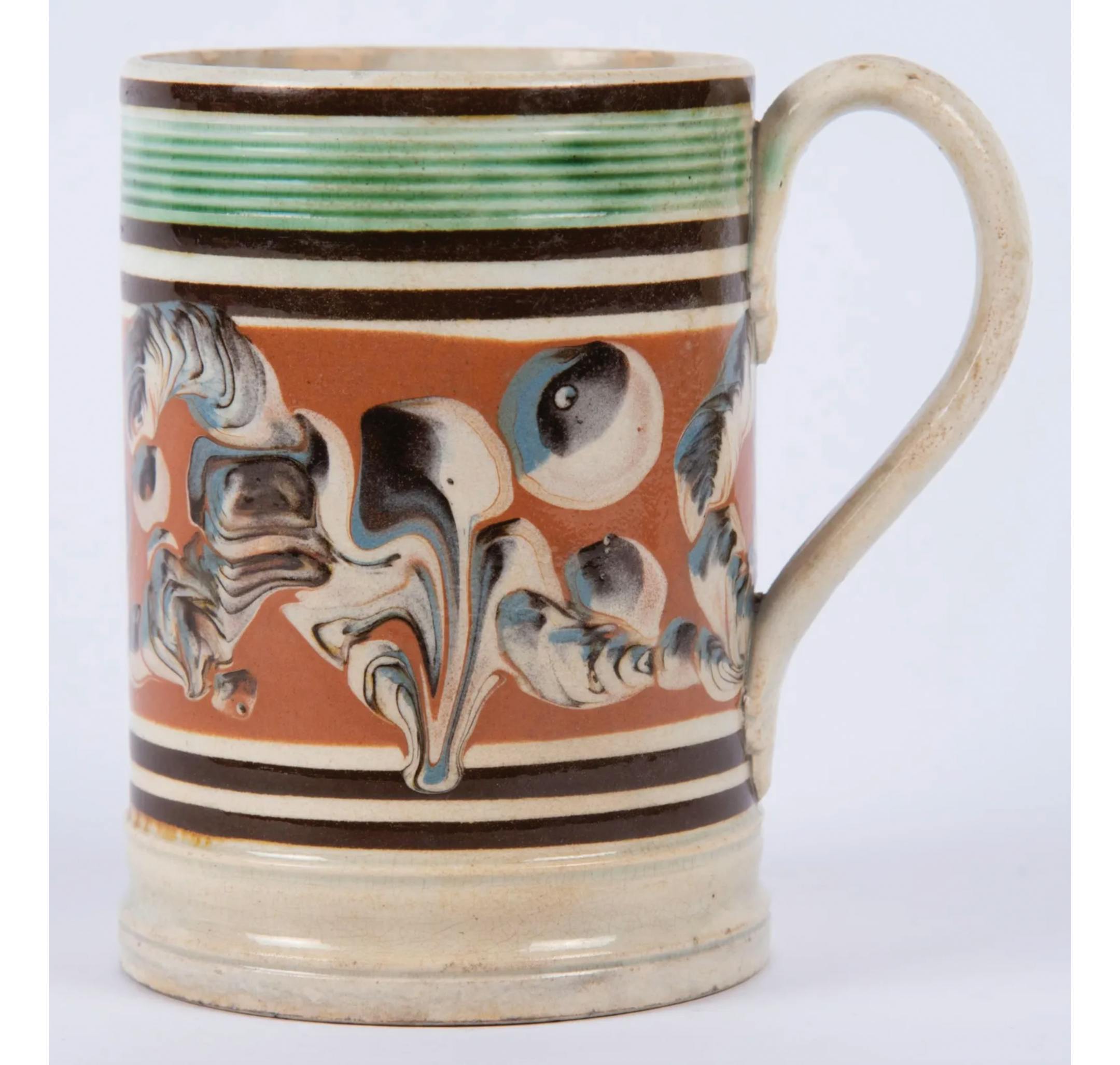
To a pottery collector, a "mocha mug" isn't meant for a coffee drink. "Mocha" is a type of decorated earthenware pottery made in England and sold in America in the early 1800s. Mocha pottery, or mocha ware, is usually utilitarian; pieces were originally used in the kitchen or during meals. It has colorful decorations painted in a slip glaze made from clay thinned with water to a liquid consistency. The decorations are usually painted over white glaze.
Traditional patterns have descriptive names, like "banded," "checked" and "marbled," or repeated "tulip," "fan," "seaweed," "dendrite" or "leaf" motifs. Others have less obvious names, like "cat's-eye," which consists of clusters of dots, and "earthworm," or thick, mottled lines in waves or loops.
This mug, which was made about 1800 and sold for $375 at Link Auction Galleries, has earthworm and cat's-eye patterns in its center section, with a green and brown banded top border and brown banded lower border.
The name "mocha" may come from some patterns' resemblance to mocha stone, another name for moss agate, an opaque multicolor semiprecious stone. Mocha pottery may also be named for the coffee-colored glaze that appears in many designs.
Read more about mocha ware here, including tips on buying mocha ware and ways to style it in your home.
Q: When my father was ill in 1939, he received a letter from Jack Dempsey wishing him "a speedy recovery." The letter was typed on his restaurant's stationery and signed in ink. What is it worth?
A: Jack Dempsey (1895-1983) was an American boxer who was the world heavyweight champion from 1919 to 1926. He opened his restaurant near Madison Square Garden in New York City in 1938. It closed in 1974. The value of an autograph is determined by the importance of the signer, rarity, condition and proof of authenticity. Signatures on letters are worth more than an autograph by itself. A handwritten letter is worth more than a typed letter with a handwritten signature. The content of the letter also affects the value. The letter must be seen by an expert to authenticate it. Contact an auction house or gallery that holds sales of autographs to see what it is worth.
Q: I'm trying to find information about a silver bowl marked "Reed & Barton, 1120" near a tiny engraved heart. It's 6 inches in diameter and about 3 1/2 inches high. How old is it and what is it worth?


