

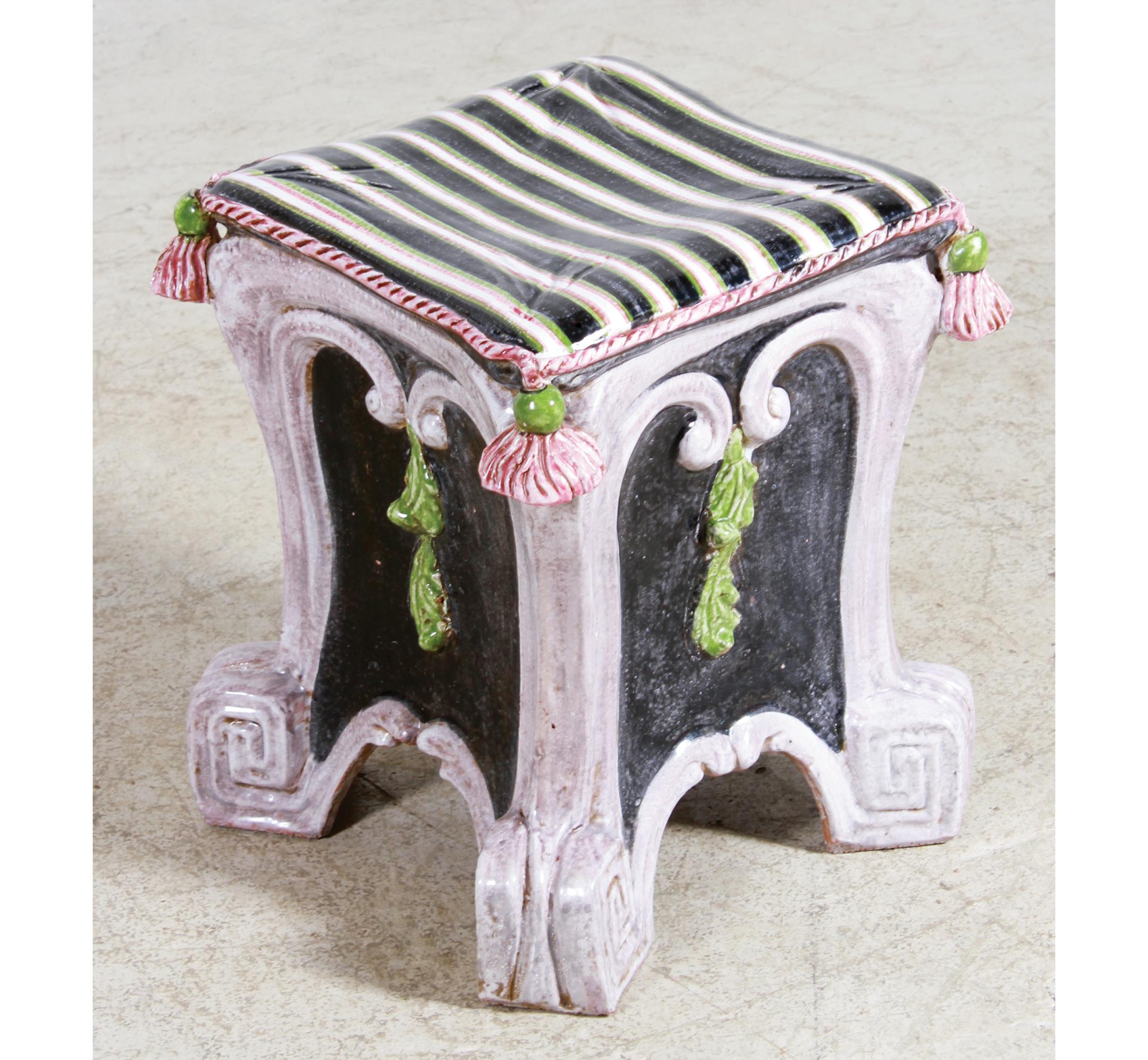
May means warmer weather, flowers blooming and more time spent outdoors, especially in the garden. Even if you're as avid a gardener as Terry Kovel, the garden is never just a place for work. It's a place to sit, relax and enjoy the view of your beautiful plants and the birds and butterflies they attract.
Garden seats have been used for centuries. Early garden seats in China, called zuodun, literally "a block to sit on," were shaped like barrels with a stretched skin top held in place with nails. Later garden seats were made of porcelain but had the same barrel shape and featured decorative rows of bumps to resemble the old nail heads.
In 19th-century Europe and America, majolica, an earthenware pottery with thick, colorful tin glaze, was a popular material for garden seats, planters and other garden furnishings. They often had three-dimensional nature-themed decorations, like flowers, leaves and insects. However, majolica is fragile, prone to chipping and cracking, so it should be brought inside during inclement weather or kept indoors. Victorians often kept majolica pieces in conservatories, or greenhouses, so they could be part of a nature setting without being exposed to the elements.
Majolica stools are still sought as decorative items. This one that sold for $160 at Bunch Auctions was made in the 20th century, but shares the vivid colors and three-dimensional decorations of its Victorian predecessors.
Q: We have a dining room set that belonged to my in-laws. I think it's from around the 1940s. One of the escutcheons on the buffet is missing. I had the piece refinished and was told to try to find a match or replace all the escutcheons! I haven't been able to find an antiques dealer or other source that has this type of thing. It's circular with scalloped edges, a simple design and a hole in the center for the drawer pull. I was told these were stamped on a machine. Do you have any suggestions?
A: Unfortunately, the chance of finding an escutcheon with the exact design is slim. Several companies make reproduction or replacement hardware. Some are listed in the Business Directory on Kovels.com. Try searching the internet to see if you can find something similar. Look for something that is large enough to cover the same space. Figure the cost and then decide if you want to replace all the escutcheons.
Q: I'd like some information about the short-lived Grossbaum & Sohne company of Dresden, Germany. Any pricing info would be greatly appreciated.
A: Porzellanmalerei R. Grossbaum & Sohne (Porcelain Painting Grossbaum & Sons) was a porcelain decorating company started by R. Grossbaum and his sons in 1890. It was in business until 1914. The company decorated white porcelain blanks made by other companies. Most were hand-painted with flowers and gilt trim. Not many pieces have been sold recently. Four demitasse cups and saucers sold for $54. A 10-inch plate was offered for sale for $170 and a 9-inch leaf-shaped plate for $150. Other asking prices are even higher, but that does not mean they will sell for that much.

