
Annual tundra swan show starts soon along the Mississippi

Tens of thousands of the Arctic birds can be seen migrating across Minnesota and Wisconsin.

October 20, 2017 at 12:30PM
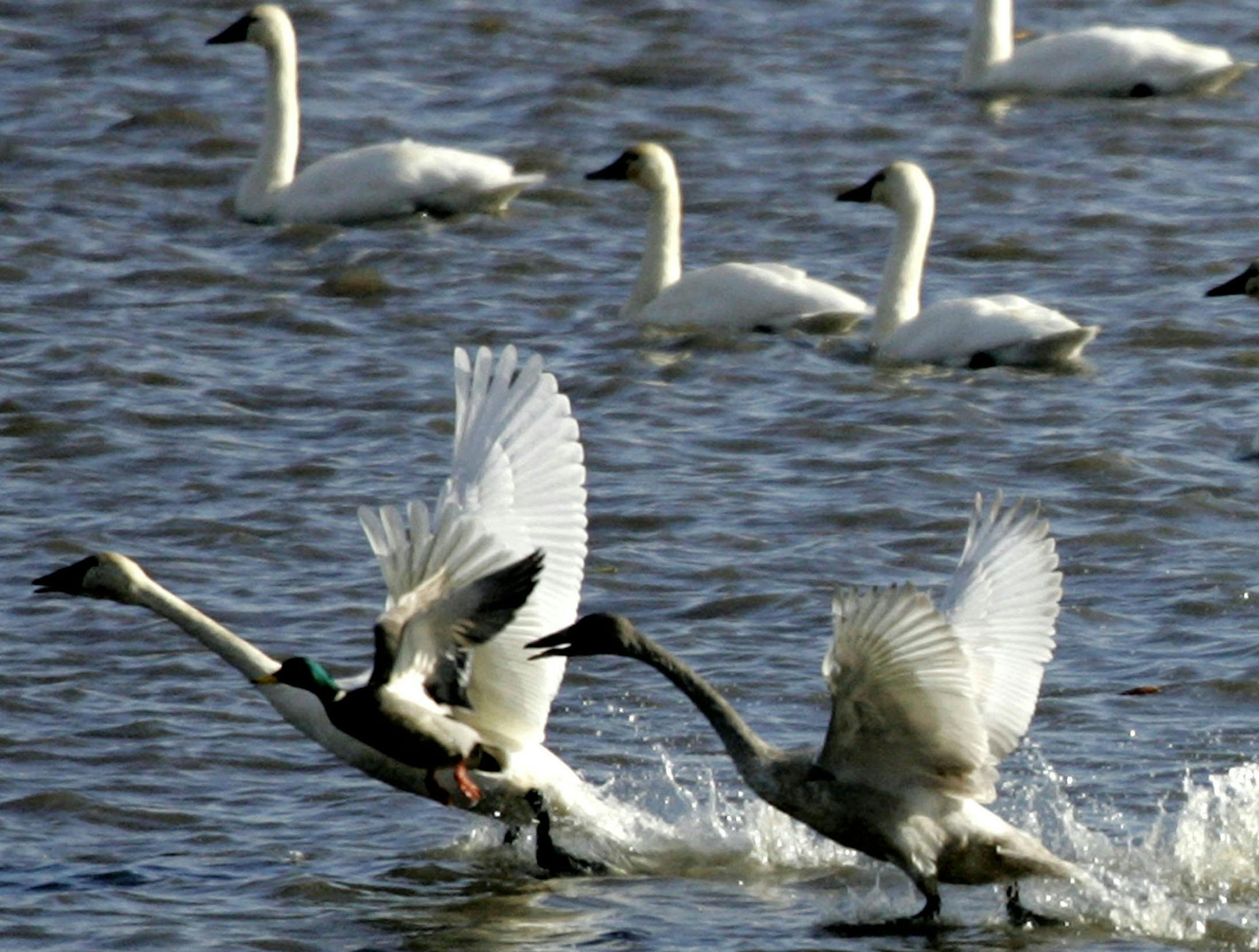
DAVID JOLES ï djoles@startribune.com Brownsville, MN - Nov. 20, 2008- A drake mallard is dwarfed by a pair of tundra swans lifting off of pool 8 on the Mississippi River, south of Brownsville, off of Highway 26. The annual tundra swan migration along the MIssissippi River through Minnesota is nearing its end as many of the pools along the route have become frozen. An aerial survey conducted by the U.S. Fish and Wildlife Service on Nov. 17, estimated tundra swan numbers to be about 31,890 be
A pair of tundra swans dwarf a drake mallard taking off from Pool 8 on the Mississippi River, south of Brownsville, Minn. (The Minnesota Star Tribune)

The reds, oranges and yellows of fall are fading soon along the Mississippi River, giving way to the white of late fall and early winter.

Not snow — not yet, at least — but swans.

In late October and November, tens of thousands of tundra swans migrate through the Upper Mississippi River National Wildlife and Fish Refuge along the Minnesota-Wisconsin border, stopping in areas around La Crosse, Wis., to feed and rest before continuing to their wintering grounds on the East Coast.

"This is usually the time they do make their appearance, and they will stick around in this area with their numbers building until we get freeze-up," said Brenda Kelly, a Mississippi River wildlife biologist with the Wisconsin Department of Natural Resources. "[Numbers] can go as high as 50,000."

Two overlooks

The birds congregate en masse in an area along the Mississippi known as Pool 8. Kelly said two overlooks south of La Crosse provide prime viewing spots: the Brownsville Overlook on the Minnesota side of the river, and the Shady Maple Overlook off Hwy. 35 south of La Crosse.

Kelly said people travel from all over to see the birds as they congregate in one of the largest concentrations in the Midwest.

And the flocks of the beautiful, long-necked white birds are as amazing to see as they are to listen to.

"If you've never sat at the Brownsville Overlook and heard the melody of 20,000 tundra swans down in front of you, it's pretty spectacular," Kelly said. "It can be on a day like today where it's so quiet out, and you stop at one of those overlooks, it can be deafening."
Peak migration is usually around mid-November, Kelly said, when swans are heading from their summer breeding grounds in Alaska and Canada near the Arctic Circle to their winter grounds on the East Coast around Chesapeake Bay.

During their migration, the birds also used to congregate in large numbers a bit farther north on Rieck's Lake Park near Alma, Wis. But the habitat conditions there aren't as good anymore, Kelly said, noting there isn't as much of their food source (arrowhead tubers, mainly) there anymore. While it's still possible to see some swans there, she usually directs visitors to the two overlooks farther south.

Diving ducks and eagles, too

There, birdwatchers can also see another mass bird congregation, of canvasbacks. Kelly said the ducks can number in the hundreds of thousands. The large ducks boast a white body and rust-colored head, and are prized among hunters who call them "the king of ducks," she said.

According to the U.S. Fish and Wildlife Service, 50 percent of North America's canvasback population and 20 percent of its eastern tundra swan population use the wildlife refuge during fall migration.

"You can travel the Great River Road, and say driving from that overlook in Wisconsin and head south to, let's say, Ferryville [Wis.], that puts you adjacent to the open area of Pool 8 and the open area of Pool 9. ... It's a big open-water area and that's where the canvasbacks and other diving birds congregate in what we call rafts," Kelly said. "It's hard to imagine thousands and thousands and thousands of diving ducks, and that's just what you get to see."

And as waters begin to freeze, bald eagles — which are residents along the river year-round — will begin to congregate in open-water areas near locks and dams, adding to the wildlife show that also includes migrating mallards, common mergansers, golden­eyes and coots.

Kelly said she gives bird talks at the Shady Maple Overlook because of the variety of species birdwatchers can see there.

"I can take them to this spot and see every species of puddle duck that comes through Wisconsin," she said.

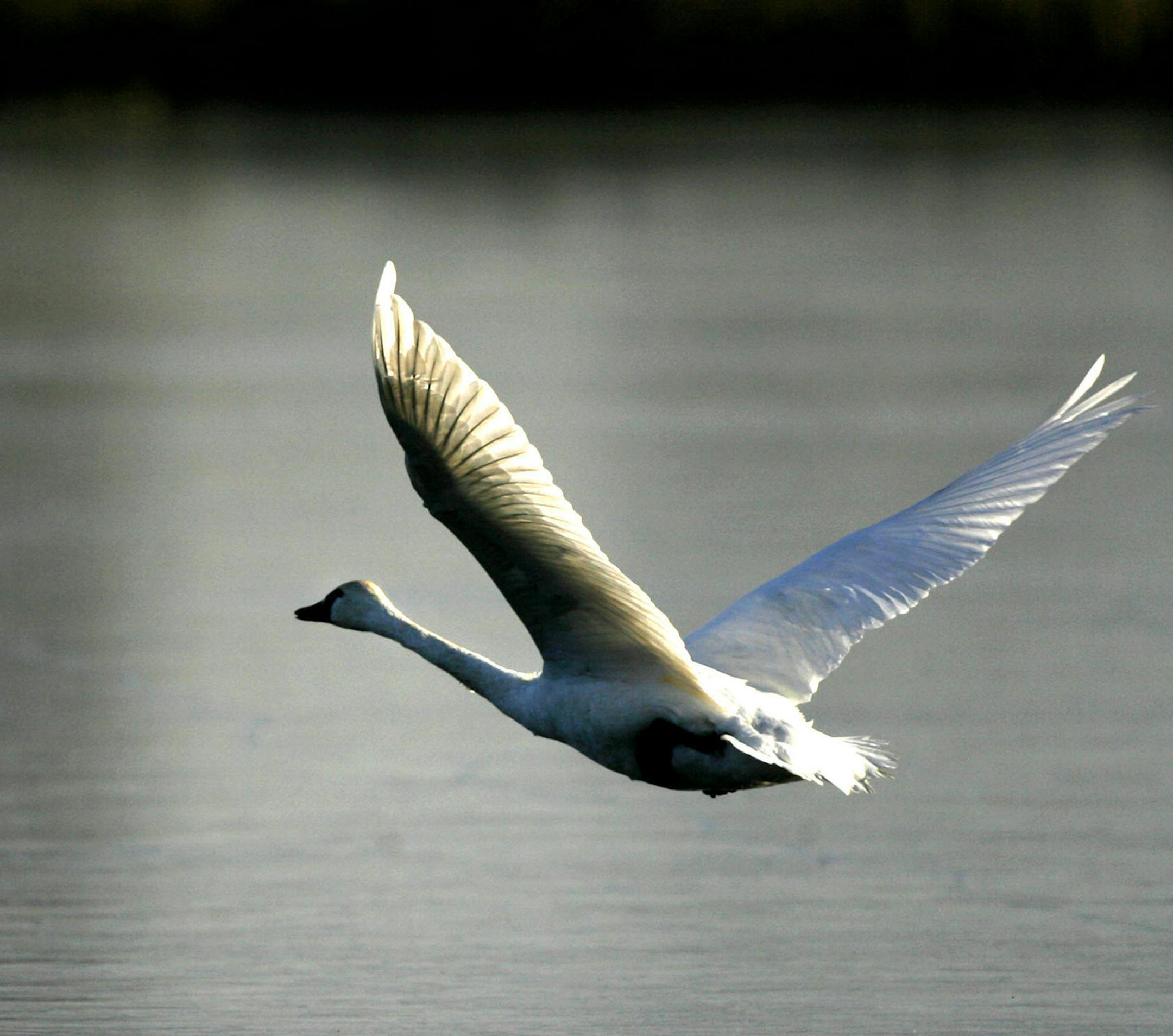
DAVID JOLES ï djoles@startribune.com Brownsville, MN - Nov. 20, 2008- A lone tundra swan which had gotten seperated from larger flocks, lifts of of frozen Rieck's Lake in Alma Wisconsin. The annual tundra swan migration along the MIssissippi River through Minnesota and Wisconsin is nearing its end as many of the pools along the route have become frozen. An aerial survey conducted by the U.S. Fish and Wildlife Service on Nov. 17, estimated tundra swan numbers to be about 31,890 between pools
A lone tundra swan, which had gotten separated from its flock, lifts off of frozen Rieck’s Lake in Alma, Wis. (The Minnesota Star Tribune)
about the writer

about the writer

Chelsey Lewis, Milwaukee Journal Sentinel

More from No Section

See More
FILE -- A rent deposit slot at an apartment complex in Tucker, Ga., on July 21, 2020. As an eviction crisis has seemed increasingly likely this summer, everyone in the housing market has made the same plea to Washington: Send money — lots of it — that would keep renters in their homes and landlords afloat. (Melissa Golden/The New York Times) ORG XMIT: XNYT58
Melissa Golden/The New York Times

It’s too soon to tell how much the immigration crackdown is to blame.