2:13
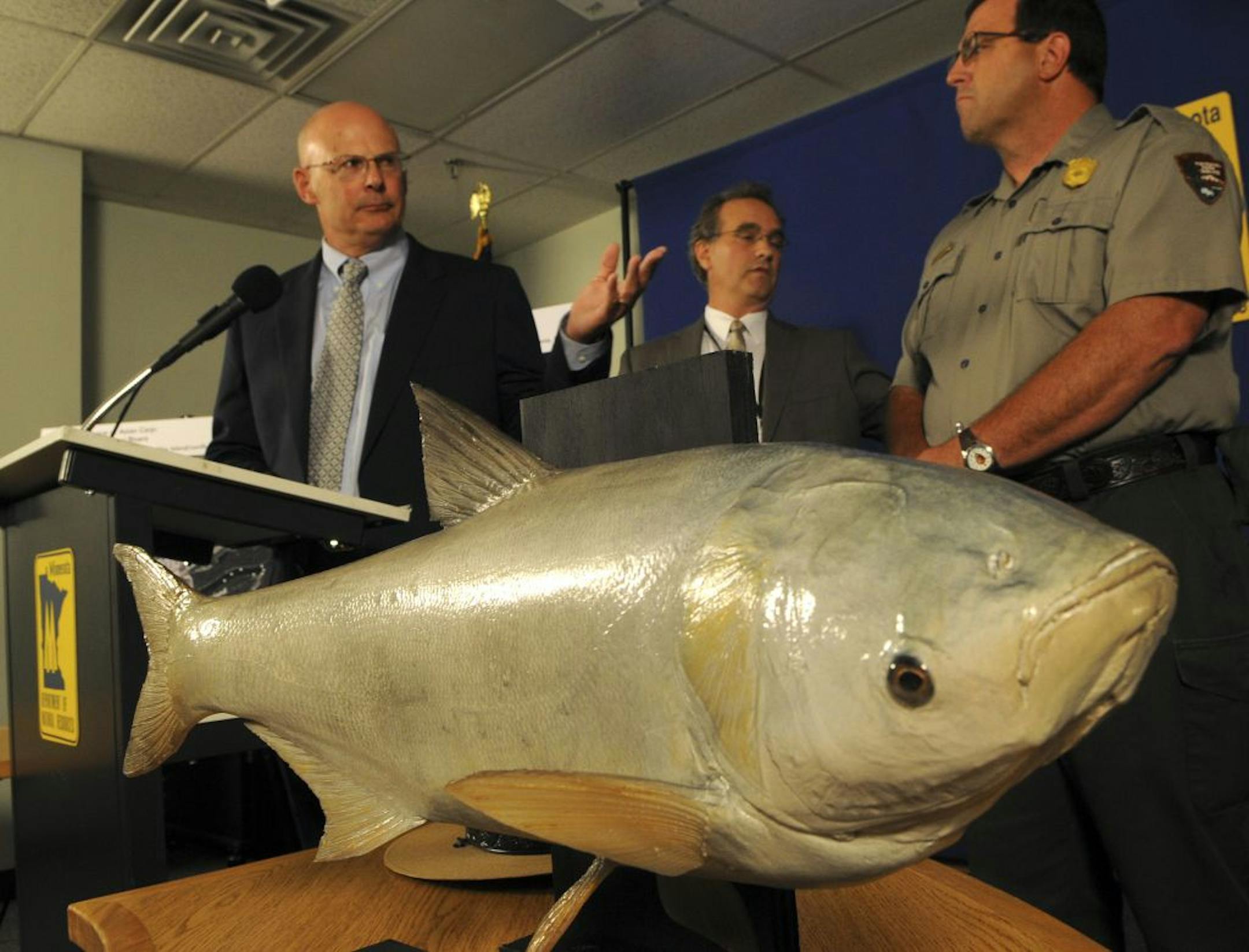
2:13Exhibited on the sixth floor of the Department of Natural Resources headquarters Thursday afternoon was a mounted silver carp, a fish perhaps 2 or 3 years old, and one that, as a species, presents a clear and present danger to Minnesota waters, not least the St. Croix River, where special tests conducted in June for the first time suggest -- the DNR's parsing -- the presence of these leaping villains.
Chances are that suggestion will become a statement of fact in coming weeks as the DNR deploys commercial fishermen as well as its own staff in an attempt to catch a silver carp, thereby confirming what has long been feared: that these jumping missiles have made their way upstream to Minnesota. And Wisconsin. If true, tributaries such as the Apple River, which enters the St. Croix from the east, also are threatened, as are other adjoining waters.
Similar Mississippi River tests -- called eDNA -- conducted in June from the Ford Dam downstream to the Minnesota River found no suggestions of the presence of Asian carp, the DNR and National Park Service said. But the chance is better than even that the high, turbid water that prevailed during that testing masked the presence of Asian carp in that stretch of the big river.
A creature that wasn't discussed at the DNR on Thursday, but was present at the news conference nonetheless, was the elephant in the room. Namely, that invasive species such as round gobies, spiny water fleas, zebra mussels, Eurasian water milfoil or the much feared (and not here yet) snakehead, as well as Asian carp, are overwhelming the DNR.
Make that have overwhelmed the DNR. And if legislators don't act soon to boost Minnesota's defenses against these critters, the state will be overwhelmed by them too.
True, in its past session, the Legislature hiked DNR funding by a few million bucks a year, over two years, to fight invasive species. And wouldn't it be nice if that would be sufficient to purchase boat decontamination units for assignment statewide, pay for watercraft inspectors at more public and private launch sites and supplement the pay of conservation officers whose new and updated list of never-ending duties now includes invasive species enforcement, Asian carp to zebra mussels?
But it's not nearly enough. What's needed instead, or in addition, is Big Thinking. Or at least thinking and action proportionate to the size of the problem.
Perhaps a sufficiently staffed Invasive Species Division should be added to the DNR.