

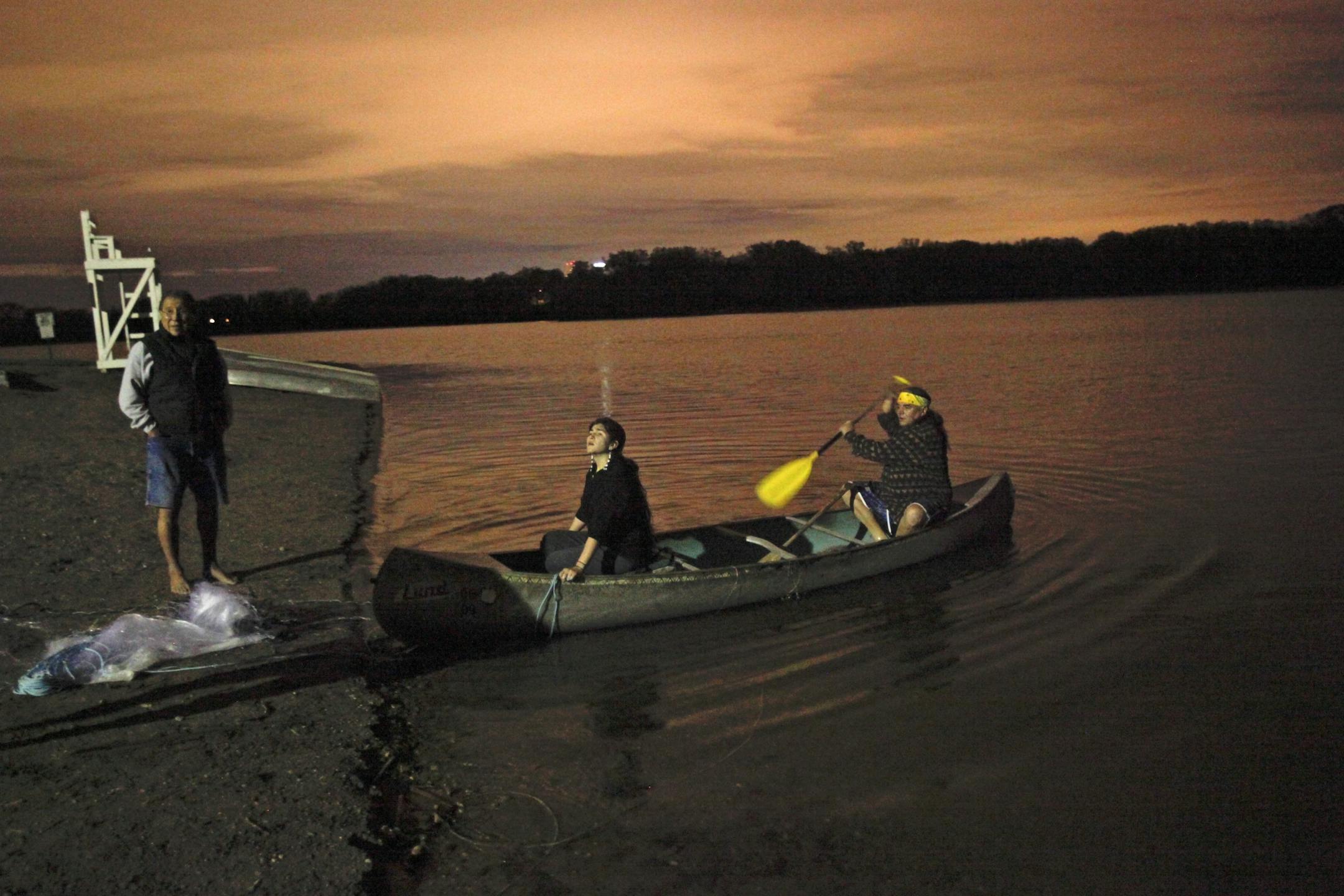
Advance notification to the media that a group of Dakota would net Cedar Lake in Minneapolis on the day before the state's fishing season yielded a predictable throng of reporters lakeside, also Department of Natural Resources conservation officers and of course the Dakota, who had themselves sent the advance notification. This is how the news game works sometimes: cut, dried, staged.
The Dakota are Sioux, and this group, in staging its fishing protest in violation of state law, claims an 1805 treaty with the federal government gives it the right to hunt and fish largely free of state regulation on 155,000 acres, the centerpiece of which, the Dakota say, is the Twin Cities area.
"We're just asking the U.S. to honor its treaties with the Dakota people of Minnesota," Chris Mato Nunpa, 70, a Dakota and retired professor from St. Paul and Granite Falls, told Doug Smith of the Star Tribune. "We think we have the right to hunt, fish and trap as we formally did. These aren't special rights. These treaties are the supreme law of the land."
Mato Numpa added: "I would say Minneapolis and St. Paul aren't paid for. We'd like to get land reparations into court, too."
A year ago, also on the day before the state's fishing season, Chippewa (also known as Anishinabe) from the Leech Lake and White Earth bands staged a similar protest at Lake Bemidji, saying they are owed not only hunting and fishing rights across a large swath of northern Minnesota (essentially everything north of I-94) but timber and mineral rights, also.
The Chippewa cited an 1855 treaty in making claims similar to those made in the 1990s by the Mille Lacs band of Chippewa, except that the Mille Lacs band cited an 1837 treaty. The latter case was decided 5-4 by the U.S. Supreme Court in 1999 in favor of the band, which had been joined in the suit by seven other Chippewa bands (one from Minnesota, six from Wisconsin).
Which is how we arrived today at the convoluted "co-management" of the Mille Lacs fishery between the bands and the state, and why also an ever-increasing walleye quota from Mille Lacs is dedicated to the Chippewa.
This year, for example, the Chippewa's quota was 142,500 pounds, up 42 percent from the bands' share only four years ago. (Inclement weather this spring cut the Chippewa's actual harvest to about half their quota.)


