
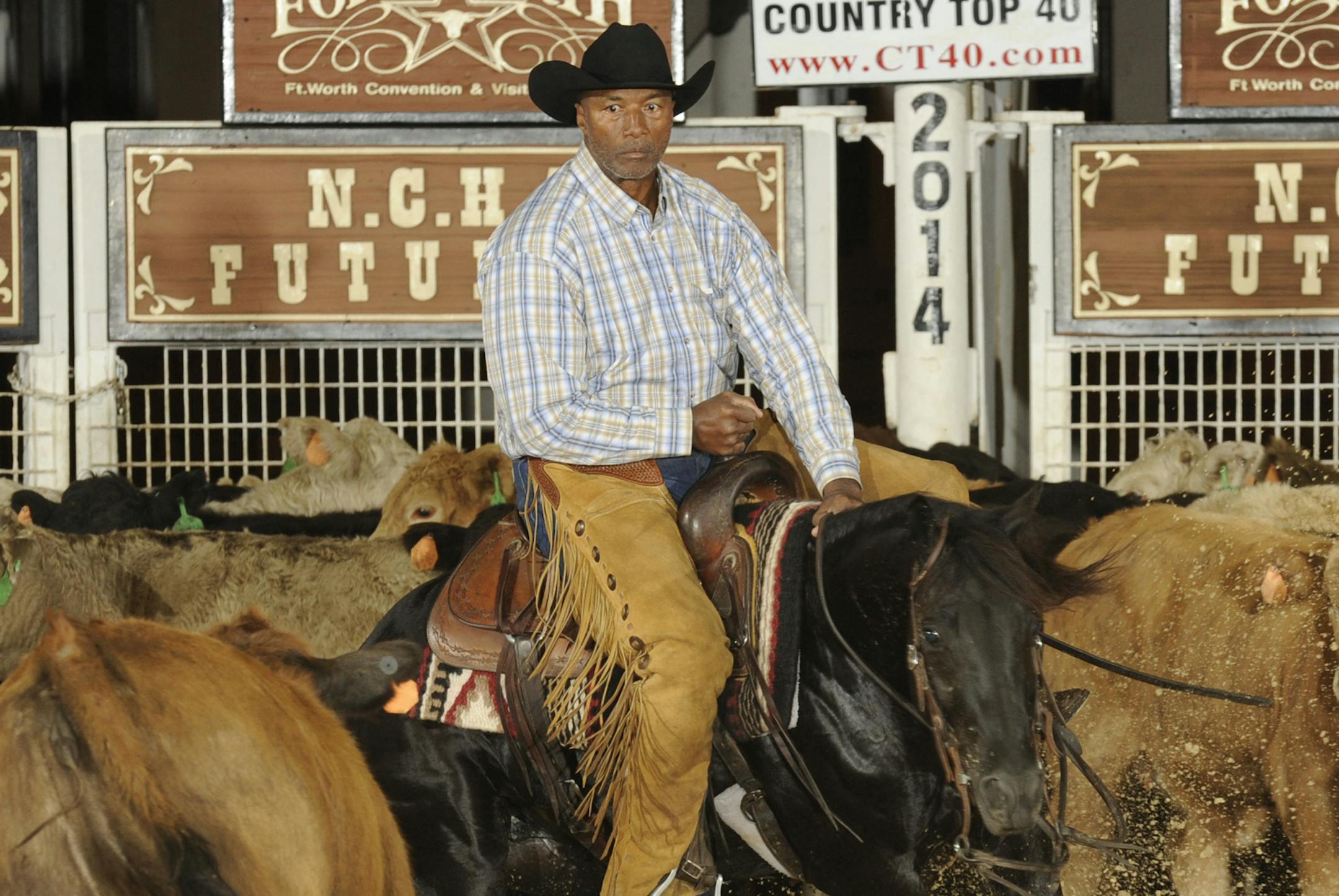
Anderson: NFL Hall of Famer Blount competes on a horse these days

An expert horseman who in his mannerisms, dress and experience is every bit a cowboy, the former Steelers cornerback first worked with horses as a kid, growing up poor in Georgia's Toombs County.

December 12, 2014 at 5:24AM
Retired NFL and Pittsburgh Steelers great Mel Blount in the opening rounds of the National Cutting Horse Association World Championship Futurity, which concludes this weekend in Fort Worth. Blount grew up poor in rural Georgia, working horses and mules on a farm. His lifelong love of horses continues today, and each year in December he is among hundreds of riders from throughout the U.S. and Canada who show 3-year-old quarter horses in the NCHA futurity, with a payout of about $4 million.
Former Pittsburgh Steelers cornerback Mel Blount still competes, but now it’s on a horse. He and his gelding, Hesa Squeak Star, lost in the early rounds of the National Cutting Horse Association World Championship Futurity for 3-year-olds. (The Minnesota Star Tribune)

FORT WORTH, TEXAS - Mel Blount long ago established himself as one of the best players ever to pull on a football jersey. A five-time NFL All-Pro who in 1975 was voted the league's most valuable defensive player, Blount was a feared Pittsburgh Steelers cornerback who could punish receivers coming off the line, yet had speed enough to stay with the swiftest downfield. He intercepted at least one pass in each of his 14 pro seasons, owns four Super Bowl rings and can remember well the Steelers' 16-6 victory over the Vikings in 1975, in Super Bowl IX.

But Blount, now 66, doesn't come to Fort Worth in December to play football. Or even to talk football — though former teammates and fellow NFL Hall of Famers Terry Bradshaw and "Mean'' Joe Greene were in town the other night to watch Blount compete in the National Cutting Horse Association World Championship Futurity for 3-year-olds.

"They're old friends and always will be friends,'' Blount said. "We have a lot of fun.''

An expert horseman who in his mannerisms, dress and experience is every bit a cowboy, Blount first worked with horses as a kid, growing up poor in Georgia's Toombs County. "We used horses and mules to work the farm, and pull the wagons,'' he said. "It was our way of life.''

A prep standout in baseball, basketball and track, as well as football, Blount accepted a football scholarship to Southern University in Baton Rouge, La., a historically black college where he was a Pro Scouts All-America safety and cornerback.

It was at Southern where Blount's life as a horseman changed forever.

"It was my senior year,'' he said, "I was walking across campus and I saw a man wearing nice starched pants, a starched shirt and a cowboy hat. I said to myself, 'I have to meet that man.' ''

As Blount surmised, the man, Matt Mathews, was a horseman, and in short order he introduced Blount to the world of performance horses; animals that could bury their hocks while stopping with a cow in a cutting pen, or spin like a top while performing a reining pattern.

"When I finished college I was drafted by the Steelers and paid a $13,000 signing bonus — or roughly what kids drafted today make in a half-hour,'' Blount said, laughing.

The year was 1970, and for the first time, Blount had money in his pocket — and soon did what any lover of latigos and saddles, boots and spurs would do.

"I bought three horses,'' he said. "They weren't great horses. But they were good horses. I moved them to our farm in Georgia.''

Even these many years later, Blount remains a football legend in Pittsburgh, along with Bradshaw, Greene, Franco Harris, Jack Ham, Lynn Swan, Jack Lambert, John Stallworth, the late Mike Webster and others who starred during the Steelers' dynasty era, when they won four Super Bowls in six years, between 1974 and 1979.

But Blount is a man apart as well. Deeply religious, he often wondered when he returned to Georgia in the offseason how he could do more for the kids who, as he did, were growing up poor, and who were sometimes in trouble.

"No one from that little town had ever gone off and made it like I did in sports, and I thought, 'I should be able to do more for these kids than just pose for pictures, or throw a ball to them.' ''

In 1983, Blount formed his first home for at-risk youth on the farm where he grew up. Not long thereafter, he flew from Pittsburgh to Miami to reach out to a young man who had run out of chances, and was facing a judge and jail time.

Blount asked the judge to send the boy to his youth home, instead.

"When the judge agreed, I just put my arms around the young man and embraced him,'' Blount said. "A photographer from the Miami Herald was there and took a picture of us that went around the country, and we turned that picture of us hugging into the logo for our youth home.''

Five years later, Blount opened a similar home for kids (www.mbyh.org) in the countryside near Claysville, Pa. The early years were rough. The Ku Klux Klan protested, and two days before Blount was inducted into the Pro Football Hall of Fame in 1989, shots were fired into the home. Additionally, after the home opened, questions were raised about the use of corporal punishment.

Through it all, Blount stood fast.

"We're not going anywhere,'' he said.

So it was last week when hundreds upon hundreds of trucks and horse trailers descended on Will Rogers Coliseum here in Fort Worth, and the jangle of spurs played like background music in the long aisle ways that divide the endless stalls where cowboys keep their prized charges, Blount was a man contented, and challenged.

This is complex stuff, cutting, in some ways more so than playing cornerback for the Steelers. Drop your rein hand, Blount knew, allowing your horse to coil in anticipation of a cow's first move, and it is not much different than vaulting for an interception, each an exercise in suspended exhilaration, thrills like no other.

In 2004, Blount placed third in the futurity among hundreds of non-pros, a rare feat.

This year, he and his gelding, Hesa Squeak Star, didn't make it out of the second go.

Still, this was Fort Worth, the month was December, and Blount had come a long way from Toombs County in Georgia and the horses and mules of his childhood.

Or maybe he hadn't.

Now, as then, he relishes few things more than slipping a boot into a stirrup, and pulling himself into a saddle, ready, as always, to ride.

Dennis Anderson • danderson@startribune.com

about the writer

about the writer

Dennis Anderson

Columnist

Outdoors columnist Dennis Anderson joined the Star Tribune in 1993 after serving in the same position at the St. Paul Pioneer Press for 13 years. His column topics vary widely, and include canoeing, fishing, hunting, adventure travel and conservation of the environment.

See Moreicon