
Anderson: Minnesota Trout Unlimited, Great Waters Expo remind us fishing has a message beyond sport

Trout Unlimited and fly fishing expo are platforms for a unifying message.

March 15, 2019 at 3:06PM
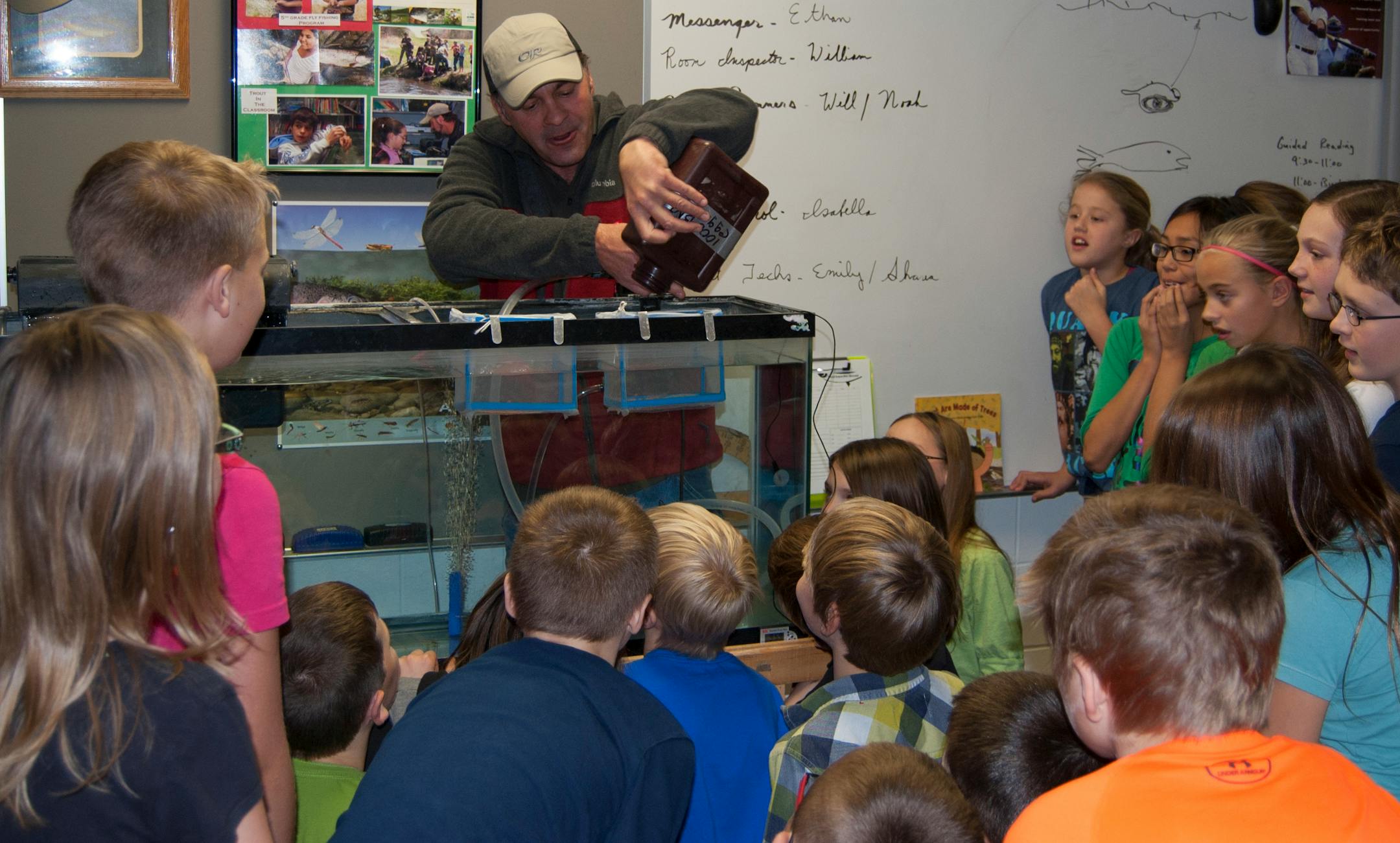
Bemidji elementary school students watched trout eggs put into a special school aquarium as part of a special environmental education project through Minnesota Trout Unlimited.
Bemidji elementary school students watched trout eggs put into a special school aquarium as part of a special environmental education project through Minnesota Trout Unlimited. (Robert Timmons/The Minnesota Star Tribune)

The New York Times on Sunday published a beautifully photographed tale about fly fishing for trout in Patagonia.

Spun in the timeless "me and Joe go fishing'' reportage genre, albeit more polished than some yarns in this category, writer Jon Gluck's have-fly-rod-will-travel adventure recalled Izaak Walton's keen reminder centuries ago that, "God never did make a more calm, quiet innocent recreation than angling.''

Or maybe not.

To read some of the 50-plus reader comments appended to the online version of the narrative, one would have thought Gluck and his wader-clad pals had arrived in Chile brandishing Kalashnikovs, not carefully cased 9-foot, 5-weight graphite wands.

"Can we not leave a few places on this planet where wild animals ... can grow to their historic sizes without being lusted after by some human?'' lamented Trish Marie from Michigan. Karen B. of California chipped in, "Now more rich humans will go disturb nature instead of just appreciating it.''

All of which is another reminder that, of this nation's various ills, the belief, seemingly ever growing, particularly on the East and West coasts, that people and nature are somehow separate, is among the scariest.

George Monbiot in his book, "Feral,'' described this phenomenon as "dewilding.''

"I am not quite sure how this happened,'' Monbiot wrote, "(but) I had found myself living a life in which loading a dishwasher presented an interesting challenge.''

Only through "rewilding'' ourselves and the world, Monbiot believes, can people avoid the "ill-defined longing'' that he interprets as "ecological boredom,'' a condition whose inevitable dead end is societal stupefaction.

None of which, fortunately, will be on display this weekend during the Great Waters Fly Fishing Expo (greatwatersflyexpo.com) at Hamline University, sponsored by Minnesota Trout Unlimited.

It's there that a few thousand anglers, and anglers-to-be, will gather in a celebration not of ecological boredom but of ecological excitement.

The expo's many attractions and seminars will include instruction in fly casting and fly tying. But none will exemplify the gathering's positive conservation vibe more than Amber Taylor's report on Minnesota Trout Unlimited's environmental education program, which stresses to kids the interconnections of land, water, fish — and people.

"The program is designed for students in grades four through 12,'' said Taylor, the fishing group's education program supervisor and overseer of the group's Trout in the Classroom program. "We set the schools up with aquariums and other equipment, including 'chillers' to keep the water between 48 and 53 degrees, which trout need. Then the class receives about 300 rainbow trout eggs, which the students hatch and raise to fingerlings.''

Funded in part by a grant from the Legislative-Citizen Commission on Minnesota Resources, using lottery proceeds, the plan's approximate cost is $2,000 per school. Included is a spring field trip for students to cold-water streams, so they can release their trout.

Many students also visit the streams in autumn. Donning waders and turning over rocks, the kids — many knee-deep in trout water for the first time — hunt for various insects that can be telltale of a waterway's health.

"Kids who otherwise wouldn't be engaged in science get excited to have the little fish in their room,'' Taylor said. "Exposing kids to the importance of clean water is one goal. But at the end of the day, trout are just a platform to show how important it is to take care of the environment, and to show how everything is connected.''

Intrigued herself by trout and trout fishing, Taylor intends to take advantage this weekend of the expo's continued emphasis on attracting more women to fly angling.

Seminars that specifically target women are planned for Friday and Saturday. Additionally, Friday night at Hamline, Fly Fishing Women of Minnesota (flyfishingwomenmn.com) will co-host a social along with other women's fly angling groups.

"We think women are, or can be, just as interested as men in fly fishing,'' said Carl Haensel, an educator, writer, photographer and fishing guide who lives in Duluth. With his conservation-biologist and photographer partner, Jade Thomason, Haensel manages the Great Waters Fly Fishing Expo for Minnesota Trout Unlimited.

"From a broader perspective, the more people we get on the water to enjoy our natural resources, including women, men and kids, the more effective advocates we'll have when those resources are threatened,'' Haensel said. "That's what Minnesota TU's efforts are intended to do, to get more people involved in conservation.''

Which in its way is an attempt at "rewilding.''

Of course, some people — Trish Marie from Michigan and Karen B. from California come to mind — will remain forever immune to nature's full seduction.

Walton noted as much in his "The Compleat Angler,'' published in 1653.

"Rivers and the inhabitants of the watery elements are made for wise men to contemplate," Walton wrote, "and for fools to pass by without consideration."

Dennis Anderson • 612-673-4424

about the writer

about the writer

Dennis Anderson

Columnist

Outdoors columnist Dennis Anderson joined the Star Tribune in 1993 after serving in the same position at the St. Paul Pioneer Press for 13 years. His column topics vary widely, and include canoeing, fishing, hunting, adventure travel and conservation of the environment.

See Moreicon

More from No Section

See More
FILE -- A rent deposit slot at an apartment complex in Tucker, Ga., on July 21, 2020. As an eviction crisis has seemed increasingly likely this summer, everyone in the housing market has made the same plea to Washington: Send money — lots of it — that would keep renters in their homes and landlords afloat. (Melissa Golden/The New York Times) ORG XMIT: XNYT58
Melissa Golden/The New York Times

It’s too soon to tell how much the immigration crackdown is to blame.