

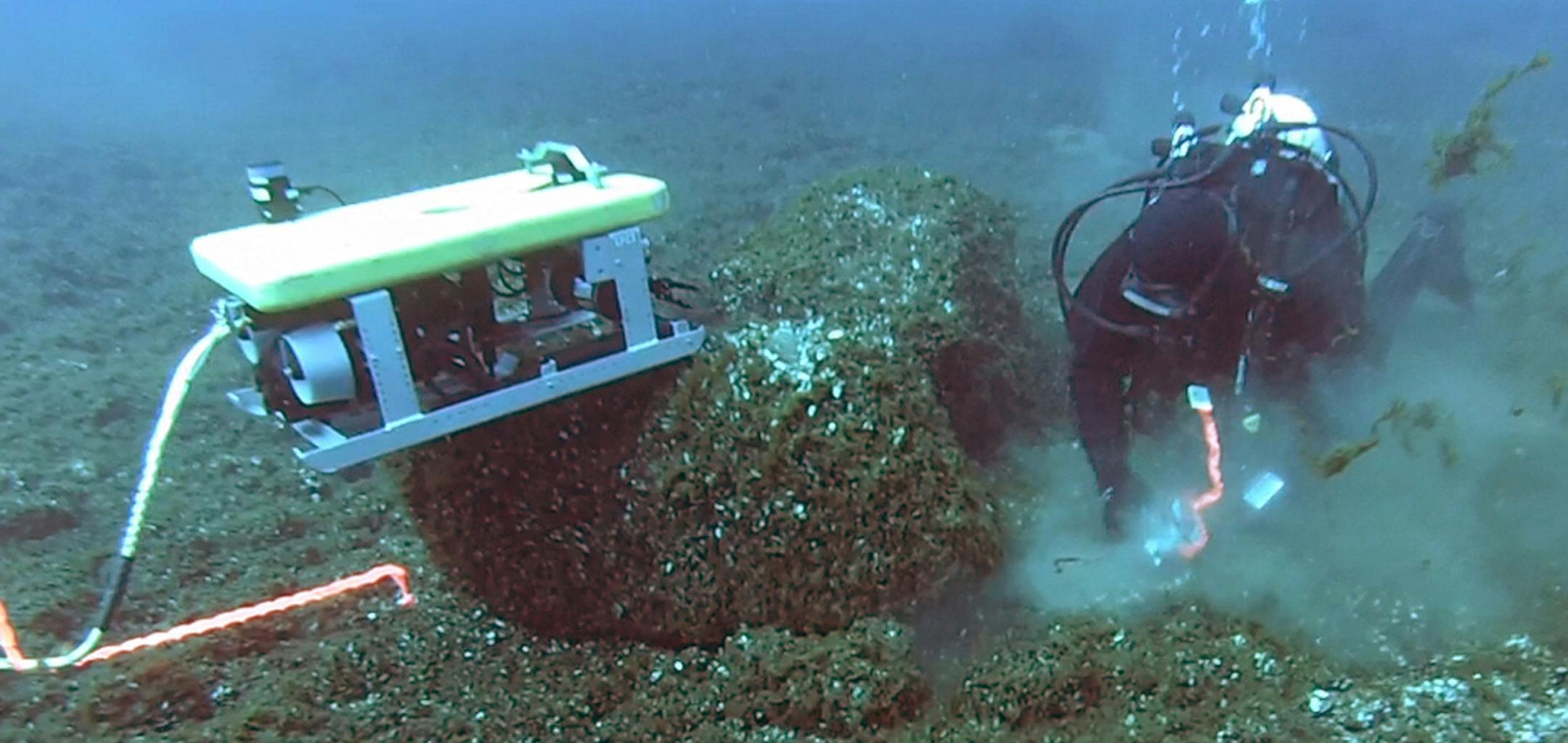
A 9,000-year-old stone structure used to capture caribou has been discovered 120 feet beneath the surface of Lake Huron. Researchers say it is the most complex structure of its kind in the Great Lakes region, illustrating the sophistication of ancient peoples whose survival depended on understanding the habits of their prey.
"The only evidence we're going to find of this kind is underwater," said John O'Shea, an anthropological archaeologist at the University of Michigan who led the project. "If it had existed anywhere on land, it would have been disturbed by farming."
Constructed on limestone bedrock, the site consists of two parallel lines of stones leading toward a cul-de-sac formed by the natural cobble pavement. Three circular hunting blinds are built into the stone lines. Additional stone alignments may have served as blinds and obstructions for corralling caribou, researchers said.
"One reason this area was so valuable is that it provided … predictability," said O'Shea, who was lead writer of the paper in the Proceedings of the National Academy of Sciences.
Hunters of the Late Paleoindian-Early Archaic periods "had a lot of confidence the animals would have to pass there," he said. "If you guessed wrong about where the animals are, you may very well be dead."
Archaeologists found the site using remote underwater vehicles, sonar and other technology. They say the main feature, "Drop 45 Drive Lane," is the most complex hunting structure that has been found beneath the Great Lakes. The structures, and the chipped stone debris for repairing stone tools, are evidence of human construction and use, O'Shea said. They also shed light on the social and economic organization of the ancient hunters.
It suggests that the hunters used "distinctly different seasonal approaches," he said. "In autumn, small groups carried out the caribou hunts, and in spring, larger groups of hunters cooperated. … The larger size and multiple parts of the complex drive lanes would have necessitated a larger cooperating group of individuals involved in the hunt. The smaller V-shaped hunting blinds could be operated by very small family groups relying on the natural shape of the landform to channel caribou toward them."
news services


