

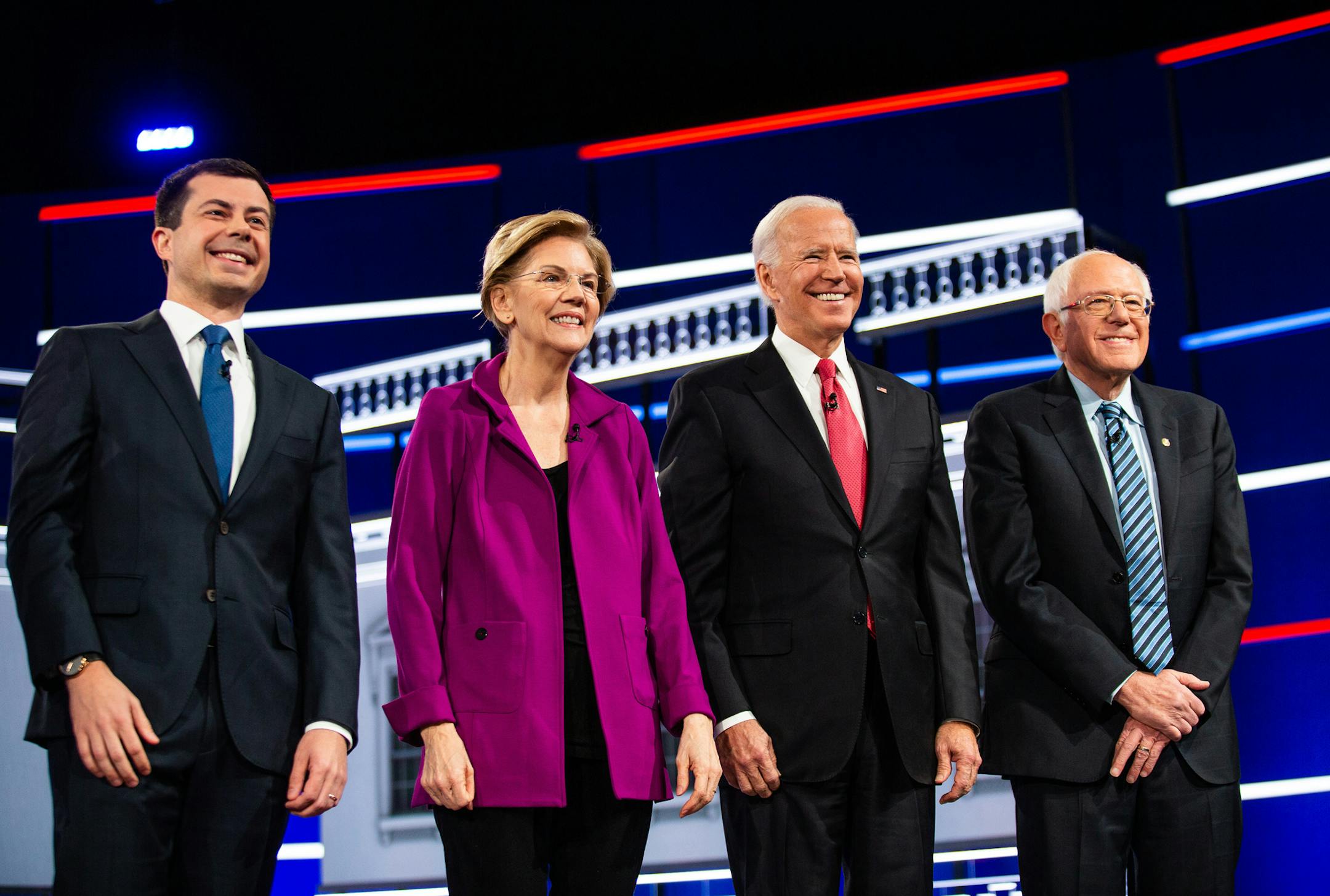
The Democratic presidential candidates have been on the campaign trail for nearly a year. Confusion rather than clarity continues to be the story of their contest for the 2020 nomination.
Early in the year, the party's liberal wing seemed to be ascendant, defined by the candidacies of Sens. Bernie Sanders, I-Vt., and Elizabeth Warren, D-Mass., and the embrace of a single-payer, Medicare for All health care program. Sanders and Warren were calling for other dramatic changes to the system — economic and political — and their voices stood out. Some other candidates offered echoes of their ideas.
That proved to be a misleading indicator of where the Democratic electorate was on some of the issues, particularly health care, in part because fewer moderate voices were being heard. Former Vice President Joe Biden didn't join the race until April. South Bend, Ind., Mayor Pete Buttigieg wasn't being taken very seriously. Sen. Amy Klobuchar, D-Minn., wasn't breaking through.
The candidate debates provided the setting for the arguments to play out before a larger audience. Warren and Sanders came under attack from moderate Democrats at the first debate in June in Miami, with former Maryland congressman John Delaney the most vocal. But Warren and Sanders more than held their own. It appeared as if the progressive wing was on solid ground.
Subsequent debates, however, have produced a different impression. The progressives have been much more on the defensive and the moderates more assertive. Biden tangled with Sen. Kamala Harris, D-Calif., in the Detroit debate over the issue of health care. Harris subsequently modified her position, moving toward the center. On the issue of Medicare for All, the ground has shifted.
During the Atlanta debate in late November, even Sanders seemed to be tempering his overall message. Asked about comments by former President Barack Obama, who had earlier told some wealthy Democratic donors that the country wasn't looking for a revolution, Sanders replied, "He's right. We don't have to tear down the system, but we do have to do what the American people want."
Judged by current polling in the four early states, the more moderate candidates are prospering. To the surprise of many, Buttigieg is at the top of the field in both Iowa and New Hampshire, according to the RealClearPolitics average of polls. No one would have predicted that last spring.
Biden trails Buttigieg, Sanders and Warren in those two states, which is hardly a comfortable place to be for someone who was the acknowledged leader in the race when he announced his candidacy and who continues to lead in national polling. But he is ahead in Nevada and he has a big lead in South Carolina, where strong support from black voters gives him what he hopes will be a firewall in the event that he gets swamped in Iowa and New Hampshire.
The possibility that the four early states could be won by three or even four different candidates is one big reason Mike Bloomberg, the billionaire former mayor of New York, sees an opening for a campaign that skips those four and starts in the states voting on Super Tuesday in early March.

