

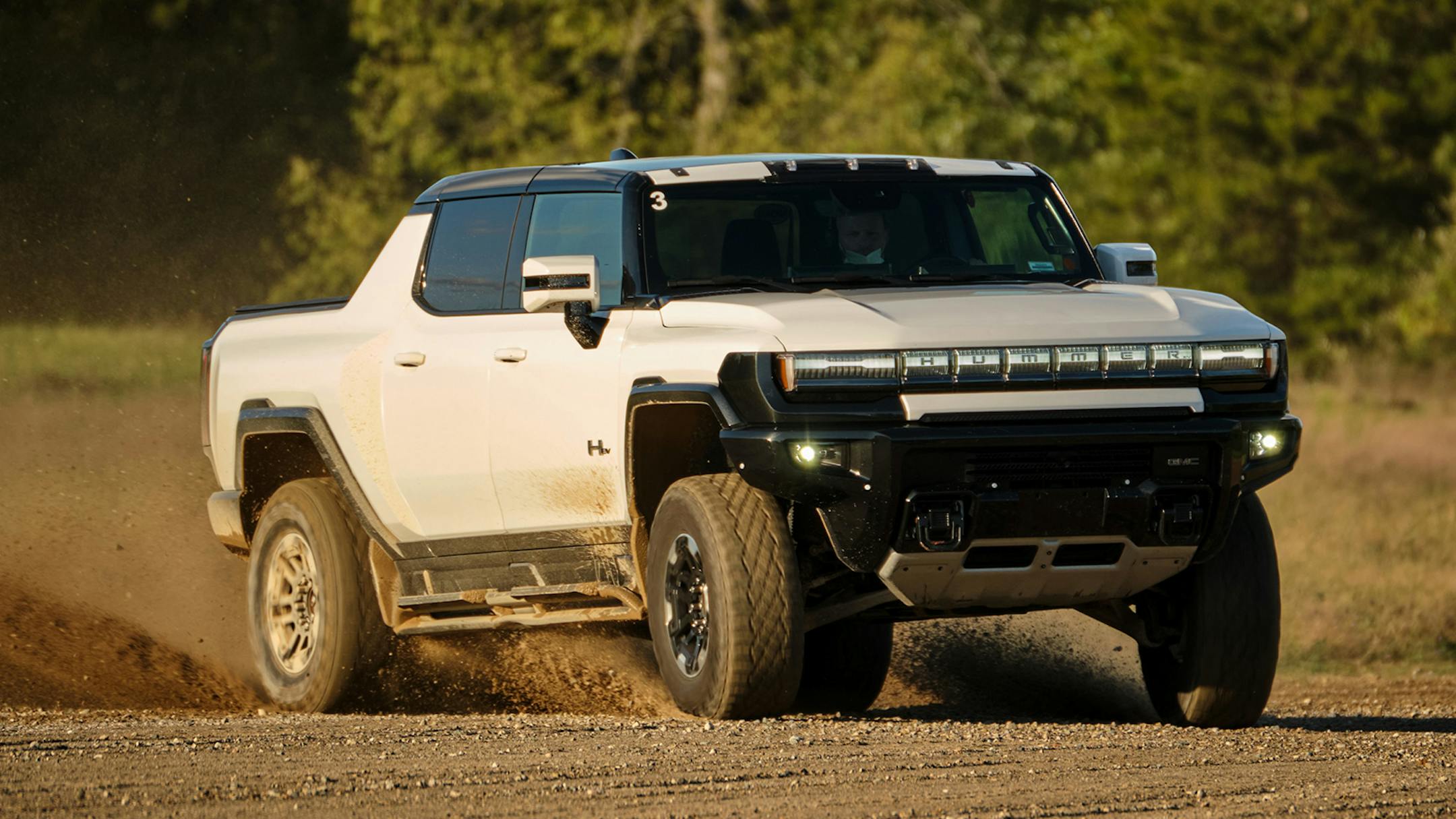
The GMC Hummer EV truck is big, bad and surprisingly balletic.
Auto reporters got a rare opportunity behind the wheel of the mega-ute at General Motors' 4,000-acre proving grounds in Milford, Mich., where it showed off its bag of tricks.
Reborn as an electric vehicle 30 years after it invaded U.S. roads as a military-Humvee-turned-SUV, the upcoming GMC Hummer aims to be the General's halo for a new generation of electron-powered autos.
Weighing more than 9,000 pounds, it is armed with three electric motors, 1,000 horsepower and state-of-the-art electronics. The $112,595 First Edition model, expected to hit dealerships by year's end, should also come with a cape. (Standard $80,000 models are expected to be available in the first quarter of 2022.)
I mashed the accelerator, and the Hummer EV's jaw jutted upward. Then it devoured a gravel and dirt road, evenly distributing torque between its four 35-inch off-road tires. Then it showed off some tricks. I rotated this elephant in tennis shoes in a 37-foot circle — equivalent to a much smaller Chevy Equinox — then pitched it through a tight slalom like a sedan.
Credit all-wheel-steering that can angle rear wheels up to 10 degrees. Turn off Traction Control, and the Hummer will do dirt doughnuts. The maneuverability is assisted by the Hummer's independent rear suspension — a novelty among full-size trucks that prefer solid rear axles to maximize towing but sacrifice handling. The Hummer's priorities lie elsewhere.
If the original military Humvee was armored for battle, Hummer EV is built for the Outback.
Its extreme suspension travel allows it to hike itself 16 inches off the ground (from a normal 10.5), as well as providing a 50-inch approach angle to manage tough terrain. In Terrain mode, I utilized 18 camera views — two of them under the truck's belly — to pick through a rock pile. From the 13.4-inch console screen, I monitored camera views above, below and beside the Hummer.

