

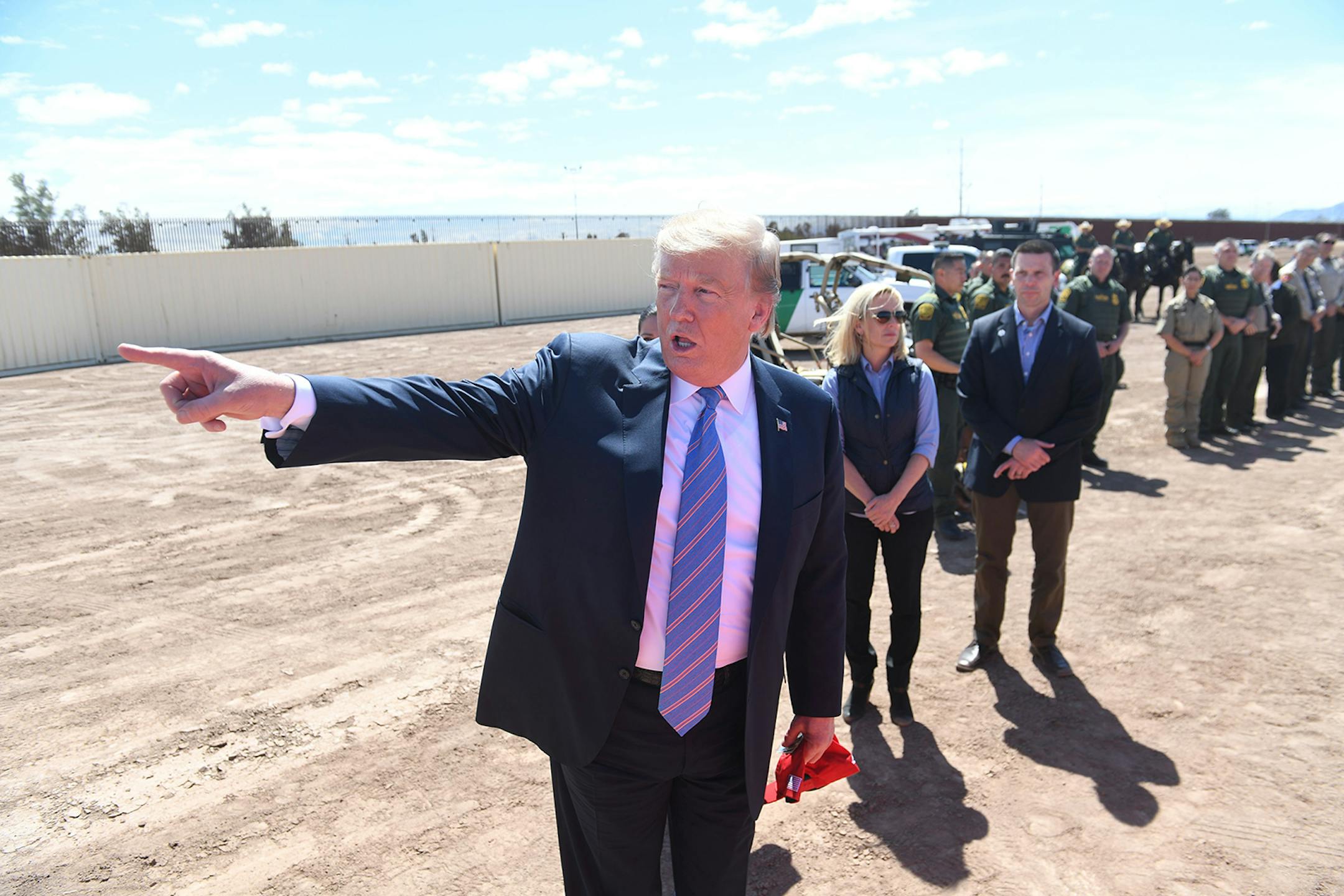
While the world waits and waits to see whether Donald Trump will seek the presidency again, it is worth looking back at one of the enduring puzzles of his time in office: why he failed to achieve some of his key goals on immigration even when the opportunity to win seemed to be handed to him.
Immigration was central to his rise. During the 2016 primaries, Republican voters who said it was their top issue were among his biggest supporters. A wall on the U.S. border with Mexico was his most famous policy objective. Yet he got only 47 miles of the border walled off during his term.
Even though he was elected alongside Republican majorities in the House and Senate, he did not make funding for the wall a legislative priority. And he kicked away his best chance at a bipartisan deal to pay for it.
In February 2018, while Republicans still had a slim Senate majority, seven Democratic senators offered to provide $25 billion in funding for a wall. In return Republicans were to grant legal status to millions of undocumented immigrants who came to the U.S. as minors. As Trump had also been saying he wanted them to have legal status, this idea had the makings of a double win for him. He could deliver for his base and soften his image at the same time. He had said the month before that he would sign any deal Congress sent him.
But then the president switched course. He said he would veto any bill that didn't meet four conditions. In addition to wall funding and a targeted legalization, he wanted Congress to end chain migration and the diversity lottery, two categories of legal immigration. (Chain migration refers to the process by which extended families of immigrants resettle here, and the lottery distributes visas in an effort to diversify the immigrant population.)
Trump had endorsed a bill to enact those reductions a few months earlier, but never insisted on them as conditions for a deal. Cuts to legal immigration that he hadn't even campaigned on turned out to be deal-breakers. A day after his statement, the Senate voted down those cuts 60-39, with 14 Republicans opposed. The political conditions for a deal then disappeared, never to return. (In February 2018, Democrats were just coming off a failed attempt to use a partial government shutdown to force Republicans to move ahead with legalization. They would not be so defensive again later in Trump's presidency. A few months later, Trump implemented a family-separation policy that hardened Democratic resistance to making a deal with him on immigration. And in November, Republicans lost control of the House.)
A year later, Trump back-flipped again. In his State of the Union address in 2019, he said he wanted higher levels of immigration: "I want people to come into our country in the largest numbers ever, but they have to come in legally." He didn't follow through with any concrete proposal, but he reiterated this desire on multiple occasions. The upshot: Trump had thrown away the chance to deliver on his promise to build the border wall, and he had done it in the name of immigration cuts to which he had no real commitment.
This seemingly self-defeating behavior was all a matter of public record in real time. But I hadn't seen Trump's explanation for it until I got to the last few pages of "Border Wars," a book about his immigration policies that New York Times reporters Julie Hirschfeld Davis and Michael Shear published in late 2019.


