During our most recent war in Iraq, I was dispatched to Camp Ripley as the leader of a seven-person Minnesota Department of Natural Resources Division of Forestry team. Our assignment was to train a company of Army National Guard soldiers in the basics of wildland firefighting. We spent three saturated days working with the troops, some of them combat veterans. We employed live fire — flames, not ammunition — to enhance the sessions. In the midst of those exercises, the company's captain pulled me aside to express his appreciation. "You know," he said, "we don't really consider you guys civilians."
The statement was both flattering and disturbing. On one hand, it was obviously beneficial to the training environment that we enjoyed a rapport. Earlier in the day, a young private had addressed me: "Sir! We're having fun, sir!" On the other hand, my fire colleagues and I were indeed civilians, and made no claim to the contrary.
The subtext of the captain's remark was that people he deemed civilians would've had less, if any, credibility. For me the episode raised — not for the first time — a concern about the militarization of American society, and most particularly, the emergency services.
Firefighters, emergency medical personnel and law enforcement officers are public servants, and significant numbers of them are volunteers. They are not ensconced in camps or on bases, but are fully enmeshed in the civilian community, subject to civil laws and norms, not military law and discipline. There is a line of demarcation, but that line seems blurred. Recruitment ads for the National Guard stress flood response and firefighting.
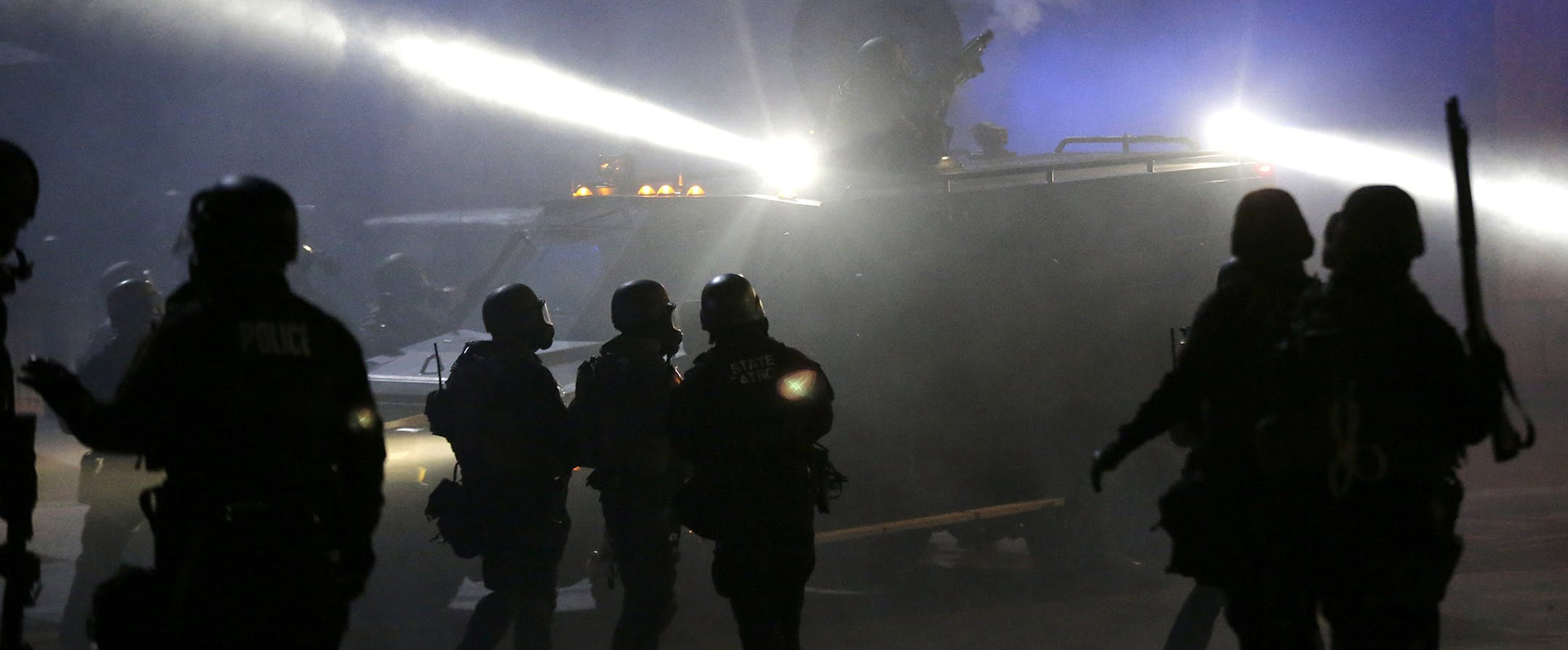
Lately we've become aware of the exponential growth and routine use of SWAT (Special Weapons And Tactics) teams. Local police have access to armored vehicles, heavy machine guns, grenade launchers and other trappings of the armed forces. Though there is occasional need for equipment beyond a standard-issue sidearm or stun gun, any citizen should be concerned about heavily armed police behaving like commandos. It's a truism that whatever tools you possess will tend to be employed. If you own an armored combat vehicle, you need to train with it. If you train with it, it's only natural to want to use it, and to find — or even invent — a means to do so.
There's no weaponry in the fire service, but increasingly I see military values being inculcated into training, and thus into operations. In the wildland arena, for example, there are a series of leadership courses produced by the NWCG (National Wildfire Coordinating Group) that borrow heavily from the military. Recommended reading and reference lists include many combat titles. Preferred instructors for some of these courses are retired special operatives such as Army Rangers and Navy SEALs.
Obviously there are similarities between the armed services and the emergency services. Both have chains of command and, often, rank. Both professions are dangerous, and both deal with death, injury and destruction. Many emergency workers wear uniforms, including, sometimes, a dress uniform. Police officers, firefighters and medics who die in the line of duty are routinely celebrated in language and ceremony reminiscent of combat casualties. A popular book for fire officers (and for corporate CEOs) is "The Art of War" by Sun Tzu, the ancient Chinese warrior/guru. None of this is wrong or alarming per se, but in the context of 14 years of war, my comfort level is eroding.
It may be that our zeitgeist backdrop of constant conflict is partly the result of the all-volunteer military. It's likely true, as senior officers maintain, that current soldiers are the best we've ever fielded, but there are costs. One is that the concept of "citizen soldiers" has been replaced with "professional specialists." Our troops are now self-selected career people with a skill set society can routinely access — not unlike engineers, programmers and, yes, police. "Be all you can be" meshes the civilian and military spheres in an antiseptic, no-body-bags kind of way, and the quasi-capitalist message is clear: The military is just another growth opportunity for individuals and the economy. Since the elimination of the draft, we have no unwilling (by definition) combatants, no servicemen complaining about "Catch-22," no families mourning a dead soldier who was forced into war on pain of prison.