

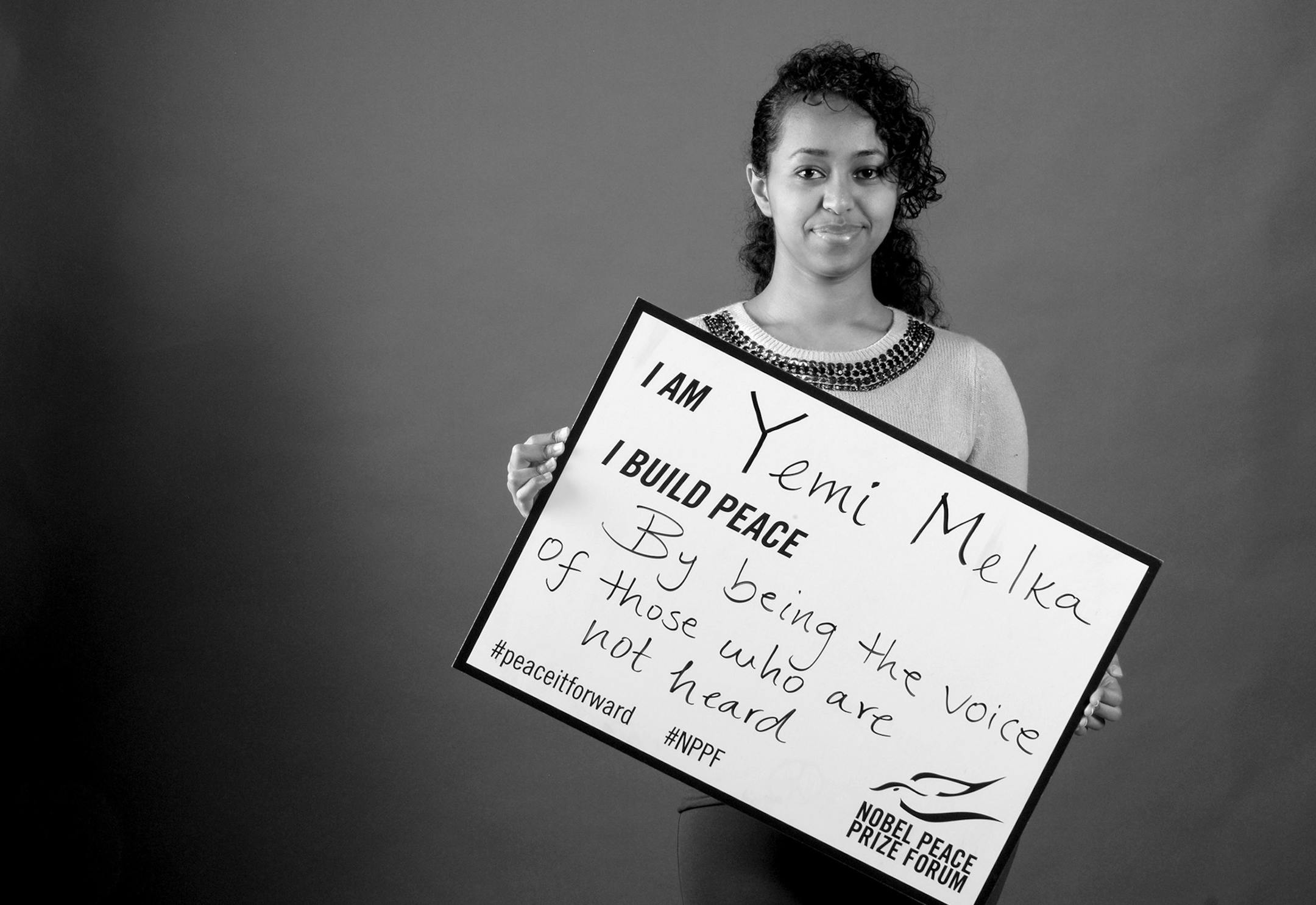
Speaking at a White House summit last week, President Obama gave his recommendation for countering violent extremism in the digital age. "We have to confront squarely and honestly the twisted ideologies that these terrorist groups use to incite people to violence …," Obama said. "We need to find new ways to amplify the voices of peace and tolerance and inclusion, and we need to do it online."
Yemi Melka, an Augsburg College student originally from Ethiopia, did just that on Tuesday. She took part in the Nobel Peace Prize Forum's #peaceitforward campaign, which asks participants to "tell the world how you build peace." Melka was photographed holding a whiteboard on which she wrote, "I build peace by being the voice of those who are not heard." The image was tweeted under the campaign's hashtag, and it may be part of an international video and broader social media campaign. "It's really important for people to speak up and say why and how they are promoting peace in their lives," Melka said.
Indeed it is — especially given the multimedia messages from the hydra-headed monster of extremism.
In only a few examples from just this week, Somalia-based Al-Shabab posted an online video calling for attacks on Western targets, including the Mall of America. The identity of the infamous ISIL (Islamic State in Iraq and the Levant) militant known as "Jihadi John," seen in barbaric beheading videos, was revealed to be Mohammed Emwazi, a Kuwaiti-born British citizen. And other ISIL nihilists appeared in a separate online video sledgehammering irreplaceable ancient artifacts in Mosul, Iraq, in an act U.N. spokesman Stephane Dujarric called "reprehensible and criminal."
These three examples show how some Islamic extremists, while hostile to modernity, have made an exception for cutting-edge communication tools to concurrently repel and attract, or to terrorize and recruit. Many international experts believe extremists are far more adept at adopting social media and other platforms than the multinational coalition allied to fight ISIL.
Groups like ISIL "are taking what we consider parts of our democracy, and our freedom of speech, and things that have been used for a lot of good, and turning it on its head," said Gina Torry, executive director of the Nobel Peace Prize Forum.
Torry, who will oversee her first forum March 6-8 at the Radisson Blu Hotel in Minneapolis, arrives with extensive experience in international organizations, including the United Nations. Observing the morphing methods and tactics of several current conflicts, Torry said: "We have groups who don't have access to conventional weaponry — guns, tanks, helicopters — they're not part of an official state. They're going to resort more and more to methods of conflict that are not necessarily standard, like sexual violence, social media. They're going to use what is at their disposal to wage war in a way we haven't seen."
Torry is quick to contextualize the #peaceitforward movement within efforts made by governments, international organizations and individuals. "Part of what we are trying to do with the #peaceitforward campaign is exactly the opposite of that kind of movement [ISIL's], and if you think of that growing and flowing over the world, these kinds [#peaceitforward] of movements, using the same kind of social media, can act as a buffer. It's not going to solve the problem, but it's certainly a tool that's being used."


