

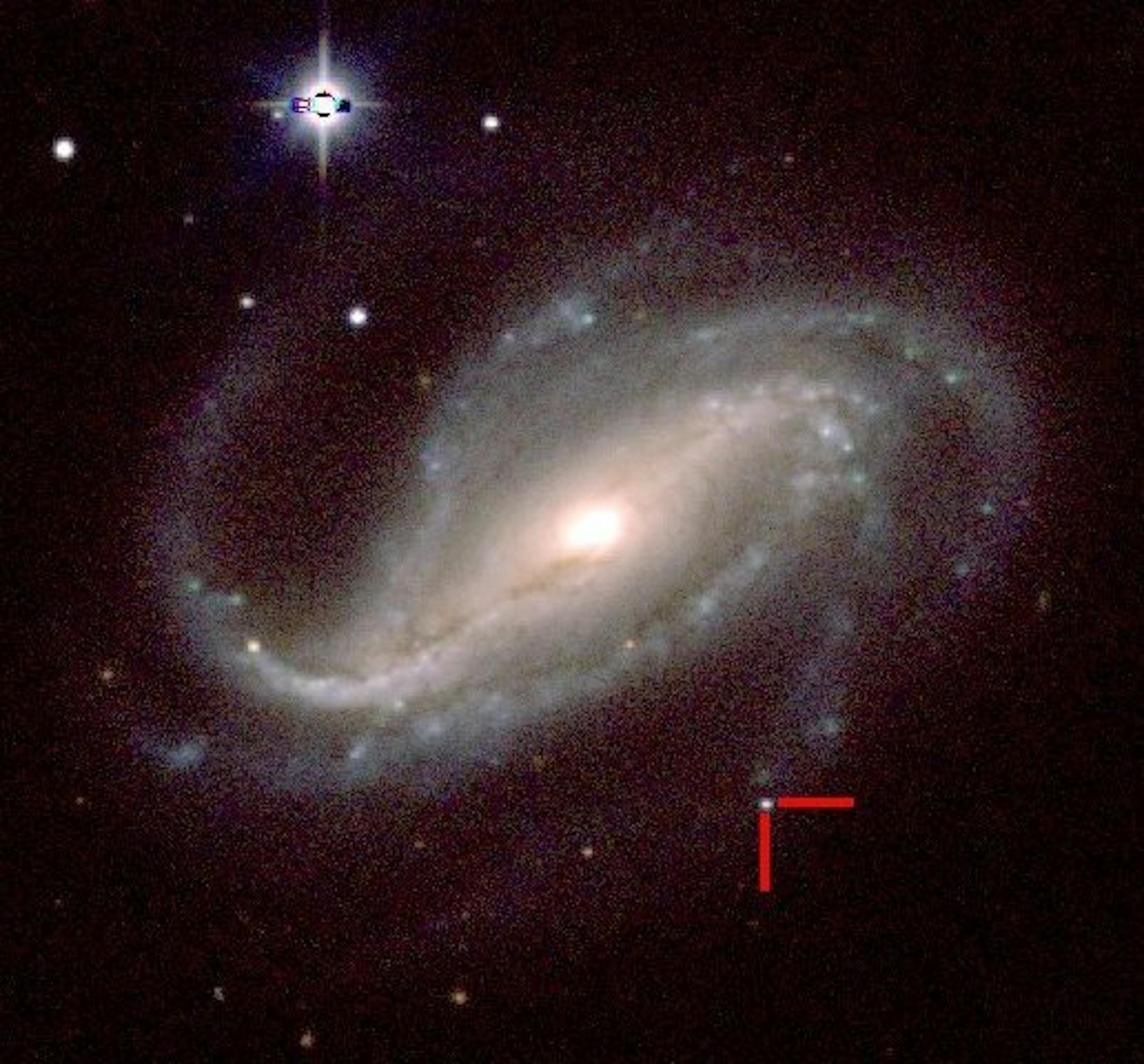
Peering at a distant galaxy, an amateur astronomer in Argentina managed to capture a star in the act of going supernova. The chances, scientists said, were 1-in-a-million at best.
This discovery, described in the journal Nature, offers the first images of the sudden brightening caused by a shock in the star's core — a process that had been theorized but never observed. "This is the first confirmation of the existence of this phase," said lead author Melina Bersten, an astrophysicist at the Instituto de Astrofisica de La Plata in Argentina.
The supernova, SN 2016gkg, could shed fresh light on the end stages of a star's life.
It was spotted in September 2016 by study co-author Victor Buso, an amateur, self-taught astronomer. He had been testing a new camera on his telescope by aiming it at spiral galaxy NGC 613, which lies about 80 million light-years away. When he looked at his work, he noticed, at the end of one of the galaxy's spiral arms, a bright point in the later images that hadn't been there in the earlier ones.
It takes experience to be able to notice such a tiny but significant change, said astronomer Gaston Folatelli, one of the study's authors.
"Victor was really very lucky — cannot deny that — but also he had enough expertise to be able to see the object and to realize that this was possible," Folatelli said.
Buso put the word out. Within hours, telescopes around the world were trained on the object. Astronomers continued to study it for two months to better understand the nature of the explosion — and the dying star that fueled it.
Even as scientists hunt for supernovae, the next discovery may also require a healthy dose of luck — and all the help they can get. "I would hope the amateur astronomers are encouraged to do more of this," Folatelli said.


