

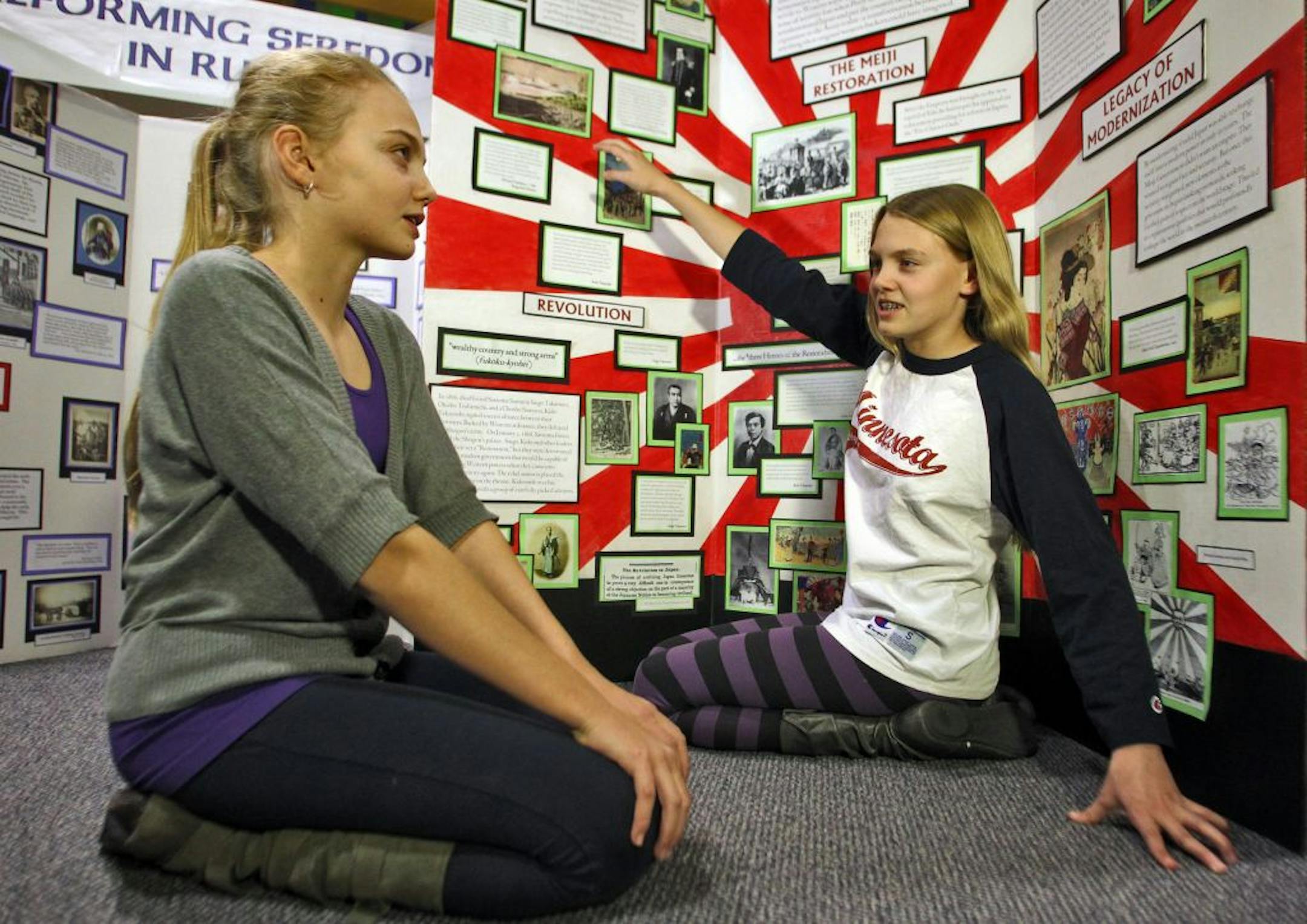
Twelve-year-old twins Grace and Sovigne Gardner often finish each other's sentences when talking about some of their favorite activities. The eighth-graders at Cyber Village Academy in St. Paul also study martial arts (both have brown/black belts), take classes at Circus Juventas and love reading and math. They also are serious history buffs.
Last year, as first-time participants in National History Day, co-sponsored by the Minnesota Historical Society and the University of Minnesota, each girl was recognized for her individual exhibit display board. "Reforming Serfdom in Russia" -- Sovigne's project -- took third place in the state competition's Junior Division and was first alternate to the national competition. Grace's project, "The Meiji Restoration: A Political Revolution," not only won second place in Minnesota but went on to win first place in the Junior Division of the National History Day competition last June at the University of Maryland in College Park.
It's likely that most kids their age wouldn't know the first thing about either topic, but neither did the Gardner girls until they started diving into their research. Up to 30,000 middle and high school students across Minnesota work on the projects, which begin in December and result in regional events in March. The top 14 regional winners in each of nine categories advance to the state competition in late spring.
"Competition is by no means the most important aspect of History Day. The ultimate goal is for students to learn how to do primary and secondary source research," said Laura Zeccardi, library program specialist for History Day with the Minnesota Historical Society. "We've done surveys asking students after History Day if they feel more comfortable doing research in a library and more than 70 percent say yes."
Head to the library
While most History Day work takes place in the classroom (more than 200 public and private schools statewide participate and teachers receive project curriculum from History Day planners), "History Day Hullabaloos" -- workshops at libraries across Minnesota -- are frequently the starting point for students.
The Minneapolis Central Library hosts three Hullabaloo sessions -- which can easily draw more than 150 students each -- where students come in and meet one-on-one with University of Minnesota student mentors to talk about their projects, focus on their subjects, learn about research techniques and get excited about the work that lies ahead.
"I always say I can spot a History Day student the second they get off the elevator," said JoEllen Haugo, History Day Hullabaloo coordinator for the Minneapolis Central Library. "Their arms are filled with notebooks."

