
After killing two teens, Smith tells himself: 'I was doing my civic duty'

New recordings were played for the jury in a Morrison County courtroom on the third day of Byron Smith's first-degree murder trial.

April 23, 2014 at 8:54PM
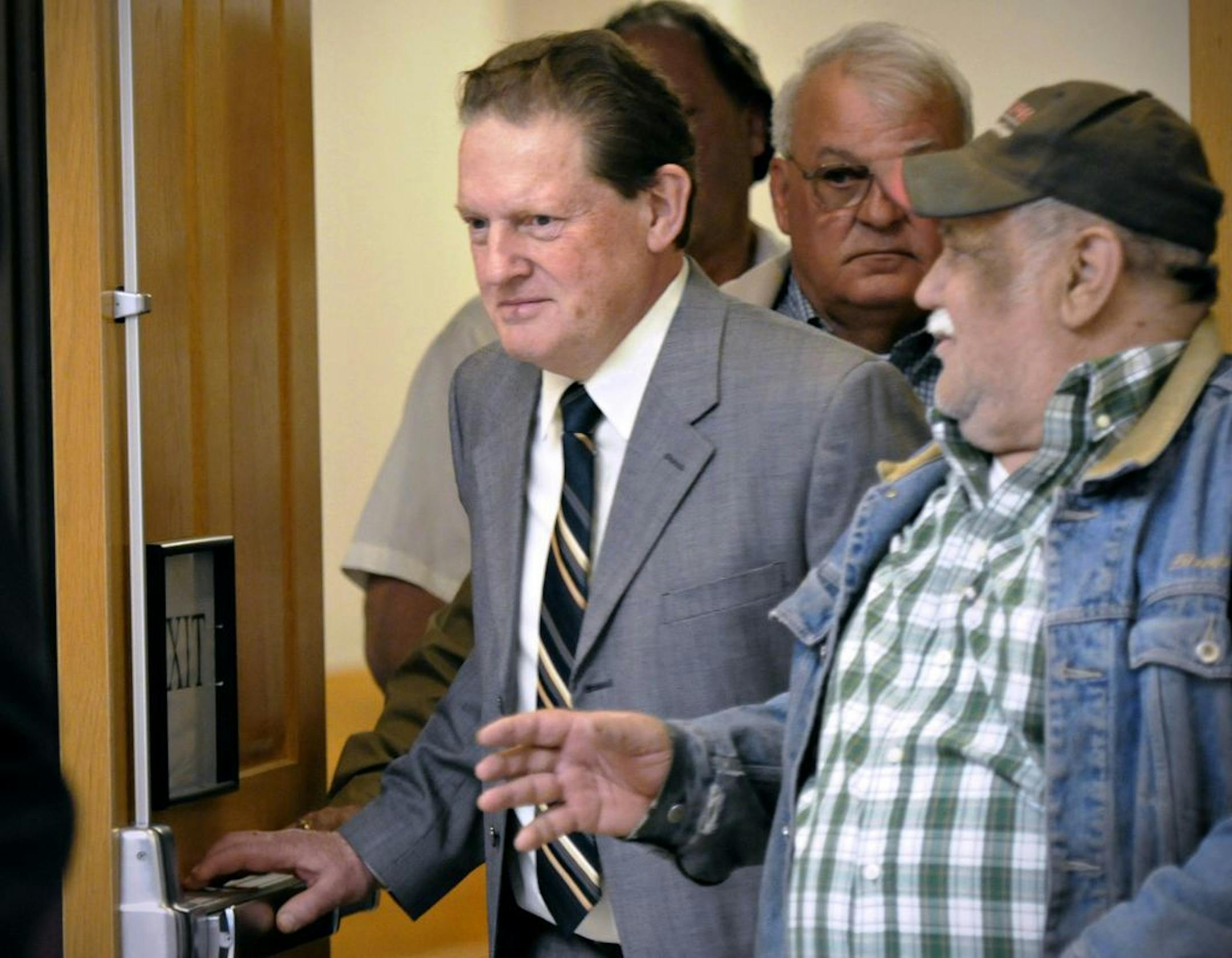
Byron Smith, center, comes out of a Morrison County courtroom in Little Falls, Minn., during a break in his trial.
Byron Smith, center, comes out of a Morrison County courtroom in Little Falls, Minn., Monday, April 21, 2014, during a break in his trial. Smith shot and killed two teenagers who broke into his house on Thanksgiving Day 2012. Jurors began the process of deciding whether the killings were justified or whether the homeowner committed murder. Smith, 65, faces two counts of premeditated first-degree murder for the killings of Haile Kifer, 18, and Nick Brady, 17.(AP Photo/St. Cloud Times, Jason Wachter) NO SALES. (St. Cloud Times via AP/The Minnesota Star Tribune)

LITTLE FALLS - After he killed two teenagers who had broken into his house, Byron Smith told himself, "I was doing my civic duty."

He continued, "I feel a little bit safer. Not totally safe, I'm still shaking a bit."

The recordings were played for the jury in a Morrison County courtroom here, on the third day of his first-degree murder trial in the deaths of 18-year-old Haile Kifer and 17-year-old Nick Brady after they broke into his house on Thanksgiving Day in 2012.

Smith is claiming he was defending himself and his home when he shot the intruders. Prosecutors argue the former State Department security engineer, who protected U.S. embassies from terrorism, crossed a legal line into murder when he continued to shoot after each unarmed intruder was wounded and no longer posed a threat.

Jurors earlier had heard the chilling audio recording of the killings themselves. Wednesday afternoon the recordings continued with the aftermath of the killings as Smith continues to talk to himself, often in a whispery voice.

"I refuse to live in fear," Smith is heard saying. Then later, "I felt like I was cleaning up a mess."

Among his other comments:

"I'm safe now."

"Cute. I'm sure she thought she was a real pro."

"I don't see them as human. I see them as vermin."

"Fun, cool, exciting and highly profitable until somebody kills you."

"I'm sorry. So much regret. I try to be a good person. I try to do what I should."
And even later: "I'm a sucker. They think I'm there to take advantage of. Is that the reward for being a good person?"

The recordings were part of a compressed audio that an agent from the Bureau of Criminal Apprehension put on a CD, 29 minutes long, and played for the jury. It skips from one time he talks to himself to the next.

Before the break-ins, he said, "I realize I don't have an appointment but I would like to see one of the lawyers here."

As the audio of the shootings was replayed, Kifer's mom put her face in her hands.

The jury also saw surveillance video of Smith moving his truck at 11:25 a.m., then walking back to his house at 11:45.

Brady, wearing camouflage and a hoodie, approaches the house at 12:33 p.m., according to Smith's surveillance video. He is seen looking into windows and trying doors.

The testimony followed a morning that included Judge Douglas Anderson denying a request for a mistrial, from Smith's lawyers. The lawyers contend they they didn't know about ballistics notes.

In his denial, Anderson gave the defense time to review the volume of scientist notes about testing to see how far away the gun was when fired at Kifer.

A forensic scientist from the BCA testified this morning that two bullet holes in Kifer's hoodie came from a gun 0 to 6 inches away and another came from 0 to 12 inches away based on residue patterns.

Smith had previously told authorities that after he shot Kifer and dragged her into his basement workshop he noticed she was still gasping for air and didn't believe she should suffer. He gave her "a good clean finishing shot," he told authorities. "She gave out the death twitch."

BCA special agent William Bennett testified Tuesday that he photographed the scene and found, among other things, a 22-caliber rifle in the shower, a survellience system in the basement workshop that was reading off of four cameras and a cell phone jammer on the kitchen counter. When he plugged the jammer in, he testified, it worked.

Testimony continues this afternoon.

Pam Louwagie • 612-673-7102

about the writer

about the writer

Pam Louwagie

Reporter

Pam Louwagie is a regional reporter for the Minnesota Star Tribune. She previously covered courts and legal affairs and was on the newspaper's investigative team. She now writes frequently about a variety of topics in northeast Minnesota and around the state and region.

See Moreicon