BRAINERD - Renowned conservationist Aldo Leopold once wrote, "One way to hunt partridge [ruffed grouse] is to make a plan, based on logic and probabilities, of the terrain to be hunted. This will take you over the ground where the birds ought to be. Another way is to wander, quite aimlessly, from one red lantern to another. This will take you where the birds actually are. The lanterns are blackberry leaves, red in October sun."
I counter that a better plan, at least if you are hunting ruffed grouse in northern Minnesota, is to wander from one "maroon" lantern to another. This will take you where more birds are than when chasing red lanterns.
The maroon lanterns are not blackberry leaves, as in Leopold's writing. Instead they are the leaves of grey dogwoods. You can't miss the head-high shrubs once September frosts have transformed the summer green leaves into a rich red-wine color. Look too, for the small white berries that hang in clumps on red stems. Ruffed grouse find the fruit irresistible. Thus the prudent grouse hunter should "wander quite aimlessly" from one maroon lantern to another.
I did just that one late afternoon last week.
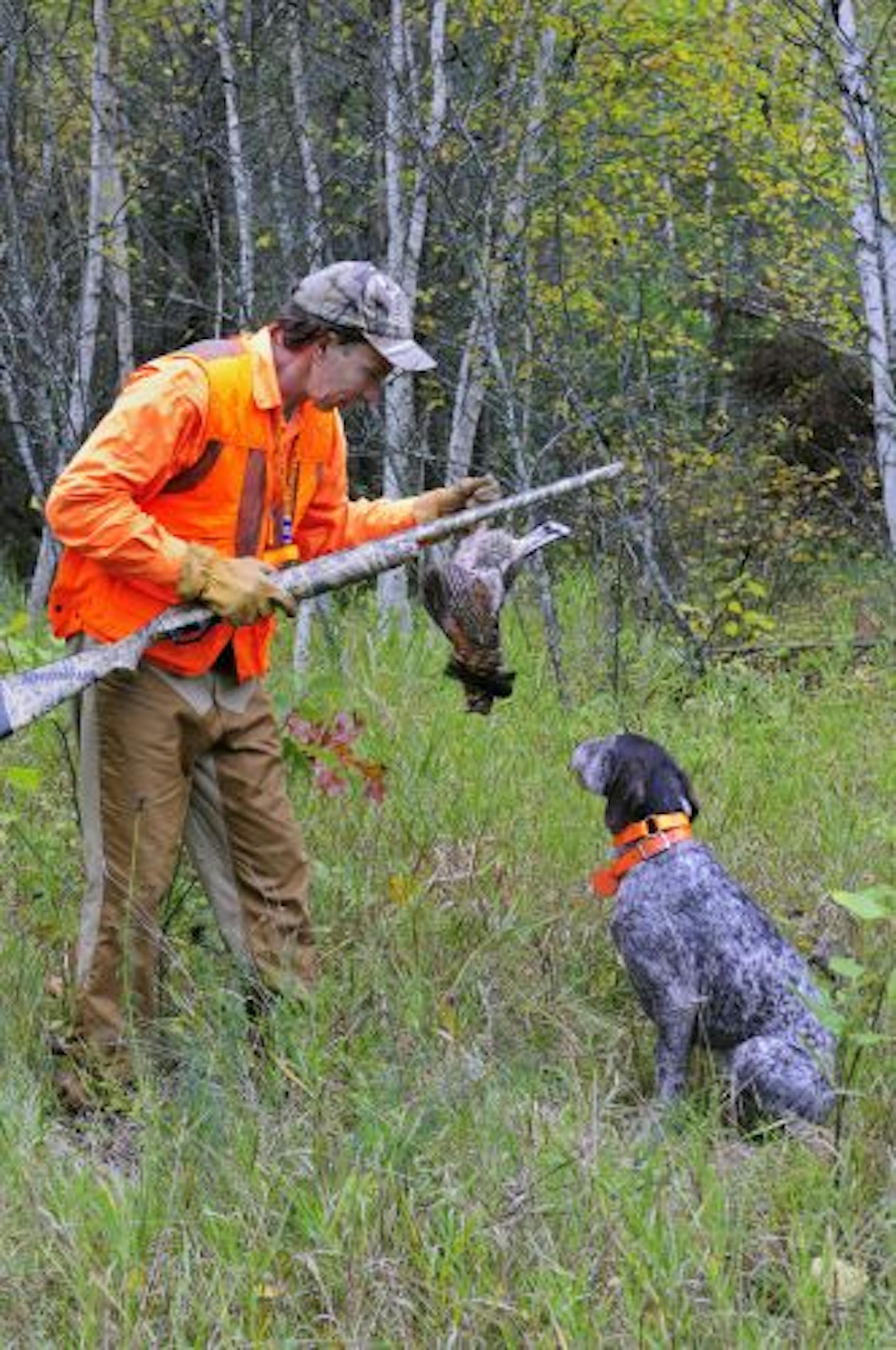
It was nearly 4 p.m. when I entered the woods, a chunk of public land not too far from town. Accompanying me caninewise was my Deutsch Drahthaar, Axel. The dog is 9 years old, and he knows about the maroon lanterns, although I'm sure he labels the shrubs from an olfactory perspective rather than visually. Regardless, Axel has pointed and retrieved enough grouse from maroon lanterns -- many times on this very property -- that he usually approaches them with his senses on high alert.
A stiff breeze blew from the west and the sky was battleship gray. Despite the gloomy weather, the forest was aglow. Leaf color was at or near its peak, and it was spectacular. Few leaves had fallen and I knew a high percentage of flushed grouse would escape unseen. Axel, too, was obscured by the leaf cover, invisible even when nearby, so I followed his progress via an electronic beeper attached to his collar.
Twenty minutes into the hunt we had yet to find a grouse. This fall, the maroon lanterns are laden with fruit, good for the grouse but not so good for the grouse hunter since the forest birds can easily find supper and are therefore more spread out.
Just ahead, though, I knew there was a particular ruffed grouse hot spot. The location contained all the elements a grouse desires. A 15-year-old aspen clear-cut butted up to a stand of mature aspens, and where the two forest types transitioned grew a grousey-looking mix of hazel, alder, willow, chokecherry and, most important, grey dogwood.