

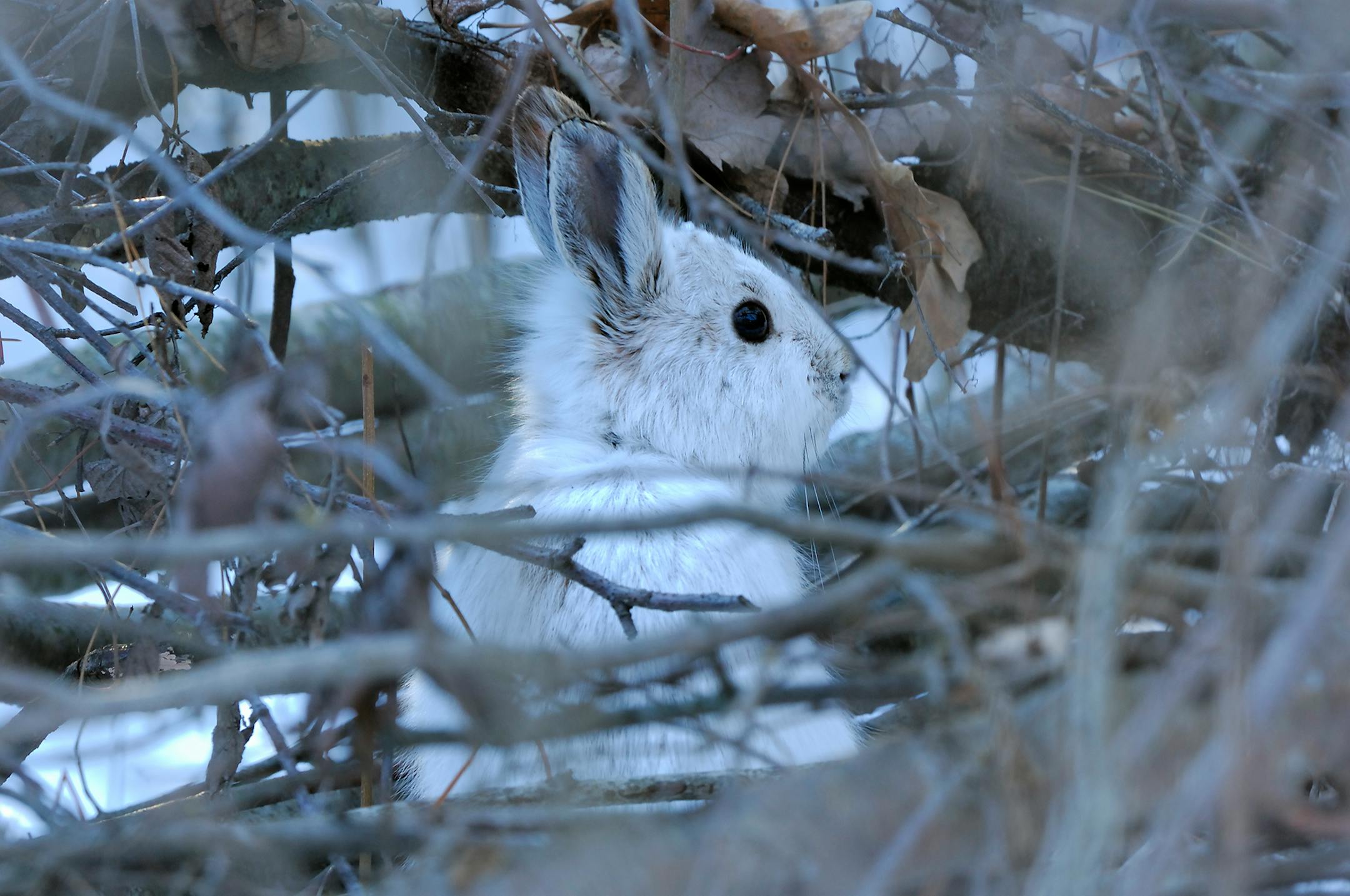
BRAINERD — Last Tuesday, during the current difficult interval in our nation's economy, four hunters did their part to ensure a profitable 2009, at least for the manufacturers of carbon hunting arrows.
Four archers, Lindy Frasl of Fort Ripley, Brian Smude of Brainerd, Bela Smude of Baxter and I, gathered midafternoon at a chunk of county land not too far from town.
We hit the woods brandishing bows and arrows. Our objective was to spend the remaining two hours of daylight chasing snowshoe hares, forest cousins to the more familiar cottontail rabbits that tend to reside near human habitation. It was a splendid afternoon. The sky was blue, the air crisp but not cold, the wind relatively calm.
A week earlier I had scouted this woodland and found a patch of balsam fir nestled in a rolling oak forest. The tallest balsams were perhaps 50 years old. I guessed they had been planted roughly 50 years ago and now stood tall in long rows about 30 feet apart, near-perfect triangles of green reaching for the sun. The offspring of those adult trees grew in thick clumps between the rows. All of this provided snowshoe hares an ideal hideout in an otherwise mature oak forest inhospitable because of the open understory.
Which is to say snowshoe hares, like ruffed grouse, are critters of young forests.
As we stepped between balsams big and small, the snow reached nearly to our knees. But it was a soft snow, fluffy to the point we could drag our feet a bit, thus eliminating the laborious marching-band-motion needed to tread through snow that is deep and compacted.
I've bowhunted for snowshoe hares since, well, since I was young enough that my friends and I needed to convince a parent to drop us off outside of town near a likely hare haunt. And, if earlier on those days we had shoveled the driveway or otherwise convinced the parent of our worth, they might come back to pick us up.
During the years since those youthful hunts, my comrades and I have developed a system of hunting hares that often allows an archer a close shot necessary in heavy cover. Our preferred method of hunting snowshoes employs three or four hunters to make short drives. Usually two hunters attempt to push the hares while the others take stands. We execute short, circular drives of 200 yards or less using fields, roads or other openings on at least one or two sides to act as barriers. Snowshoe hares are hesitant to cross any opening and are thus funneled past the waiting standers.


