

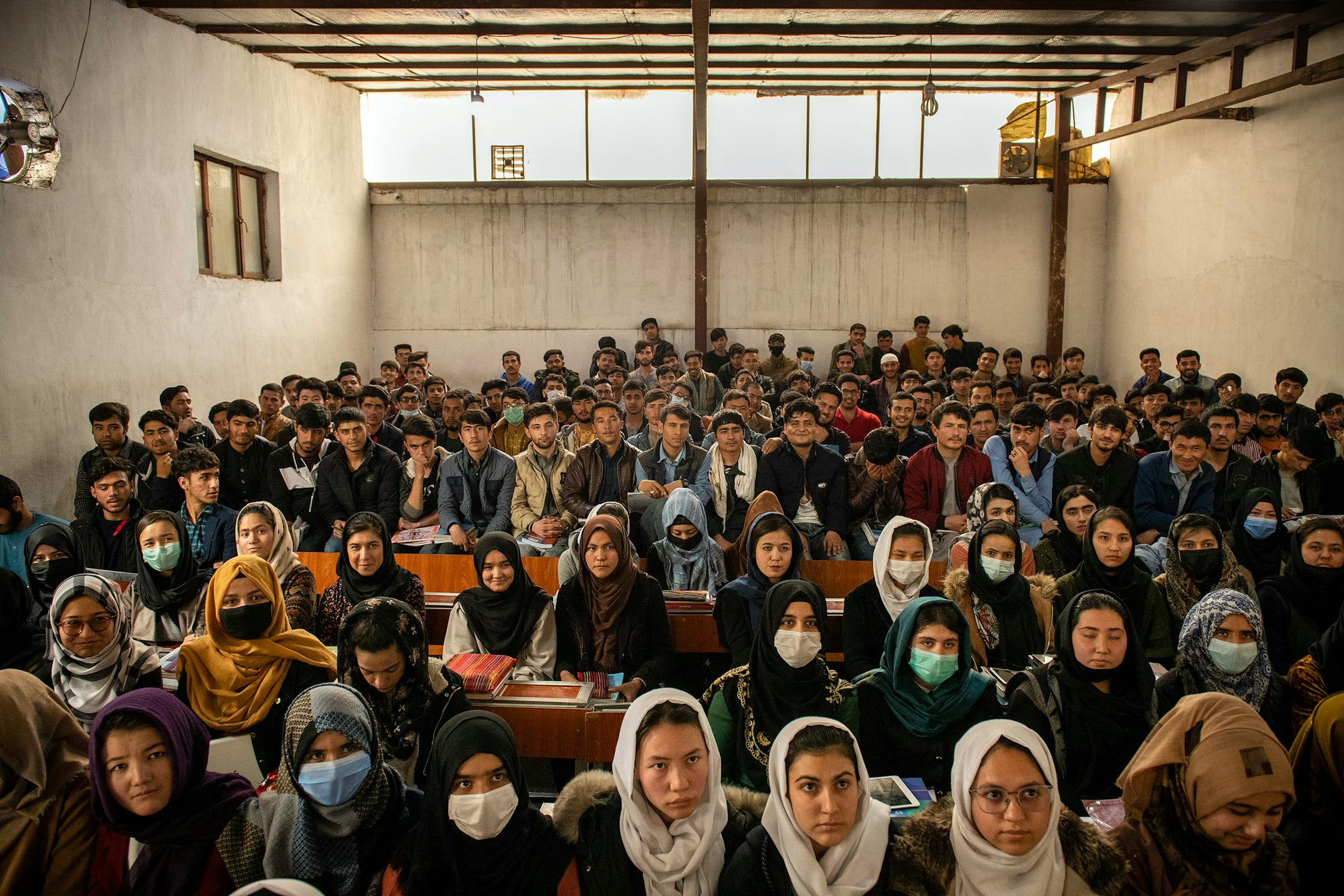
As men continue to bicker over the future and control of Afghanistan, I have already lost my home and my country. I worked in Kabul as a television journalist for 12 years, and finally left in November after threats to my life.
I know how the Taliban plan to shape the future of my country, and their vision of my country has no space for me.
For what turned out to be one of my last assignments, I traveled from Kabul to Doha, Qatar, in October to report on the negotiations between the Afghan government and the Taliban. Like many Afghans, I was somewhat hopeful that the talks might help end the long, pitiless war in our country.
In Doha, I had the opportunity to interview members of the Taliban negotiating team at the conference hall where the talks were being held. The experience reinforced my sense that postwar Afghanistan, dominated by the Taliban, was bound to be a bleak place for Afghan women.
The incident that crystallized that dreadful feeling was my interview with Sohail Shaheen, the spokesman for the Taliban. I approached Shaheen for an interview in a room full of people. Like many young women in Kabul, I do not wear a head scarf. He couldn't hide his disdain at my presence and set about to ignore me. I didn't budge. I refused to be invisible and continued pointing my phone camera at him while asking my questions.
Afghan women live with a sense of being invisible. In our workplaces or in meetings like this one, our voices go unheard, our existence barely registered. Our presence in any public space is celebrated as gender equality in and outside Afghanistan, but all we experience in daily life is inequality and discrimination. It filled me with rage.
My encounter with Shahin filled me with terror. When he finally answered one of my questions, his eyes moved in every direction but mine: He examined the walls, the carpet on the floor, the chairs, the door. He couldn't look at me, even while I stood in front of him. It was as if he saw me as an embodiment of sin and evil. I felt unsafe, even in a room full of people, thousands of miles away from Afghanistan.
The Taliban's notions of religion, politics and governance are based on a combination of a very orthodox interpretation of Islam, Shariah law and tribal values. The "Emirate" they established in Afghanistan in the 1990s, which they are now seeking to establish again, barred women and girls from most jobs and forbade us to continue our education at schools and colleges, turning us into prisoners in our homes.


