

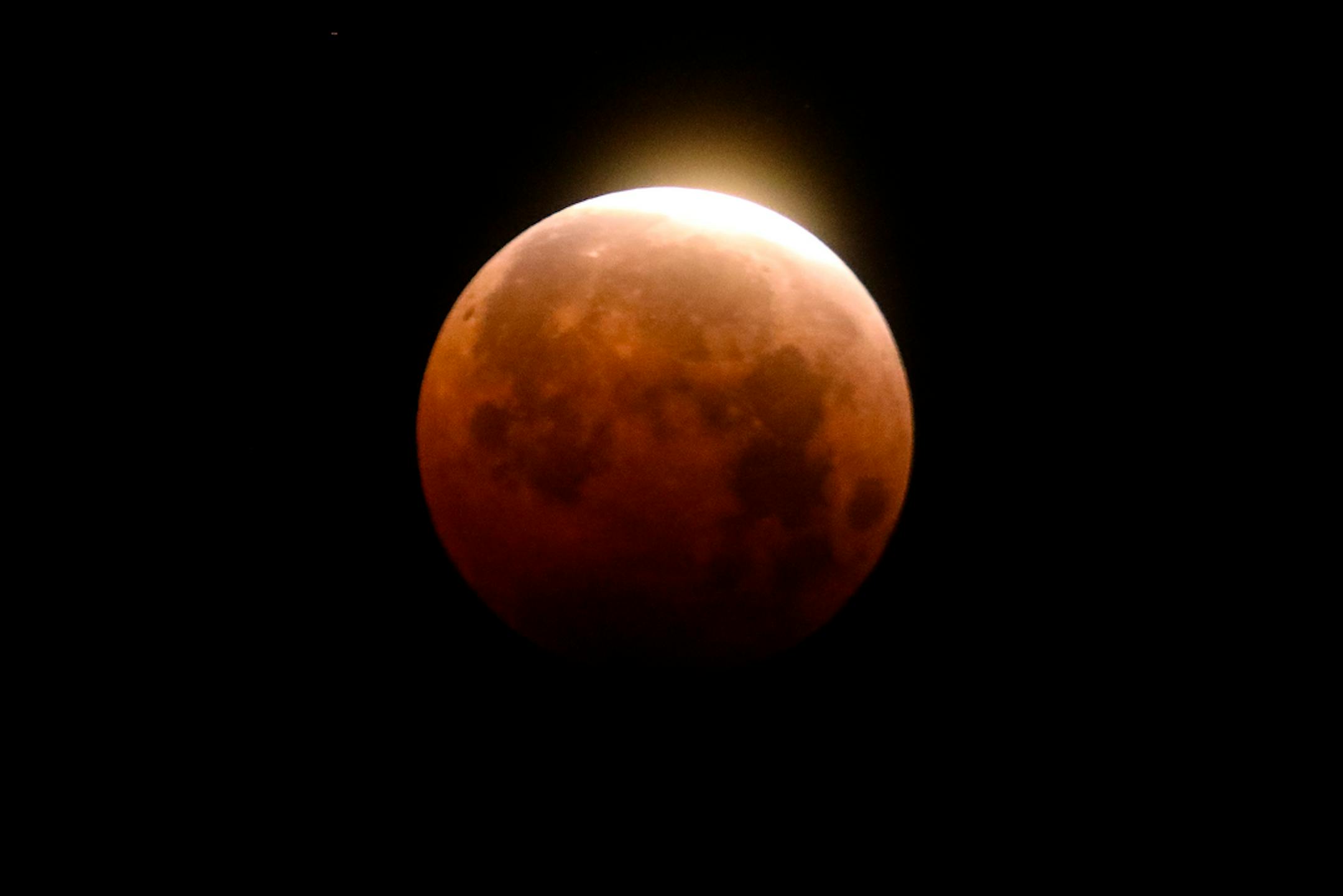
Finally a good reason to stay up on Sunday night: A total lunar eclipse.
Lunar watchers throughout the United States can experience some heavenly wonder as Earth's shadow covers the moon during prime viewing hours the night of May 15. Those on the East Coast can watch our natural satellite start to turn an eerie copper-red color at around 10:30 p.m. Central time during one of the longest lunar eclipses in recent memory.
"For pretty much all of North America, this is a tremendous viewing opportunity," said Madhulika Guhathakurta, an astrophysicist at NASA's Goddard Spaceflight Center in Greenbelt, Maryland.
Where and when can I watch the lunar eclipse?
The eclipse will be visible for a large portion of the world, including those in the Americas, much of Europe and Africa, and parts of the Pacific. Joseph Rao, an associate astronomer at the Hayden Planetarium in New York, estimates that some 2.7 billion people should be able to catch at least part of the eclipse.
Not long after sunset, the left-hand side of the moon should start appearing dusky. But the main event kicks off about 9:28 p.m. CT, when the moon enters Earth's central shadow, known as the umbra. At that time, it will begin to look like something has taken a bite out of the moon.
When the moon is about three-quarters of the way into the umbra, it should start lighting up with a reddish hue, "like your electric range just when the coils begin to glow," Rao said.
At 10:29 p.m., the moon will be in the deepest portion of the Earth's shadow and the total eclipse will begin in earnest. The eclipse will peak shortly after 11 p.m., at roughly 11:12 p.m., and remain that copper color until after midnight. The moon will leave the umbra at 12:56 a.m., regaining its pearlescent hue as the workweek begins.


