
A solution to the Trump saga? Try the Agnew angle.

In which he's told: You withdraw from public life; we'll drop the charges.

June 13, 2023 at 10:45PM
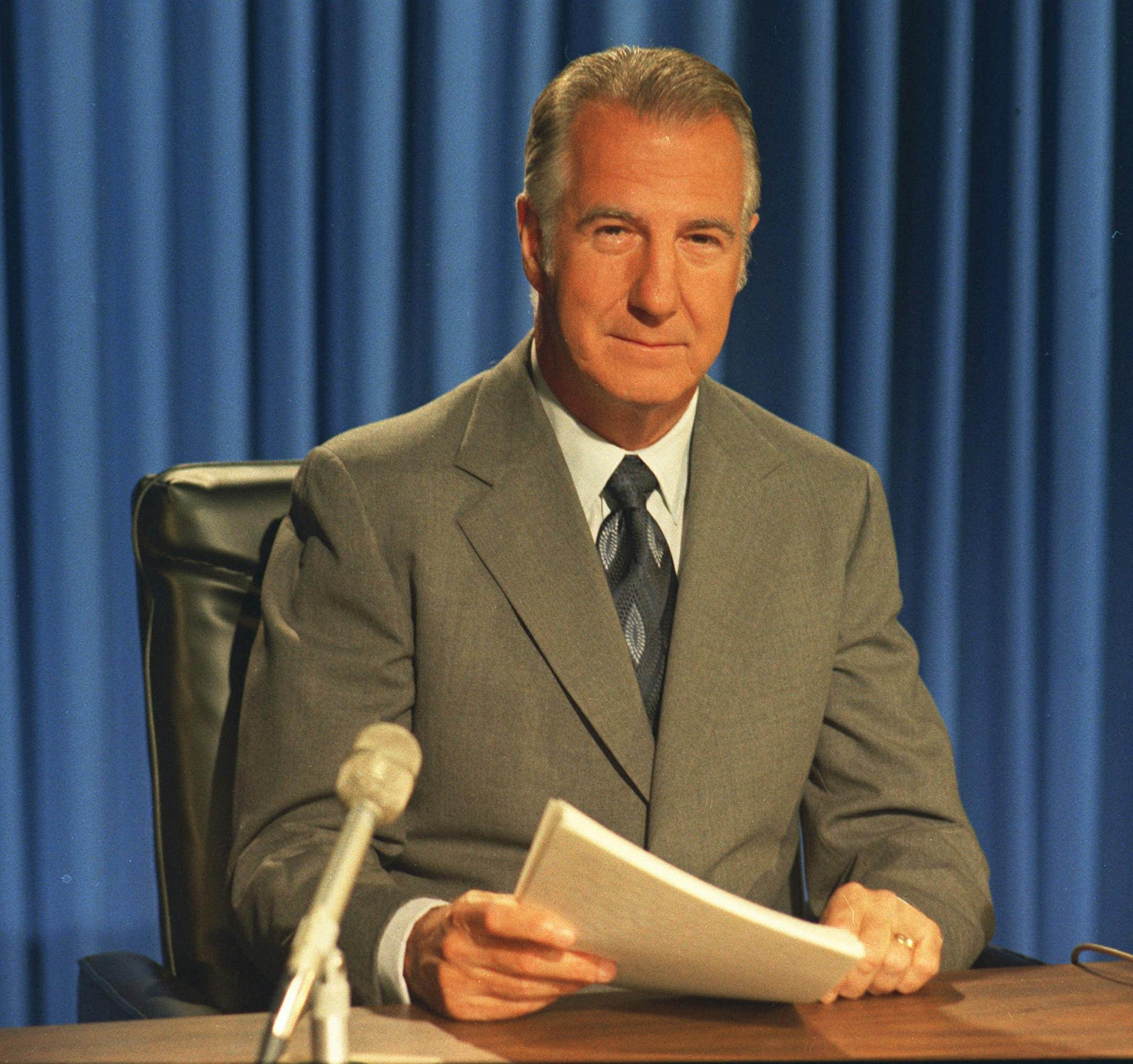
FILE—Spiro T. Agnew, shown after his address to the Nation from Washington D.C. following his resignation as Vice President in 1973. Agnew, an outspoken conservative who loved bashing the media before he resigned in disgrace as Nixon's vice president over a tax-evasion scandal in 1973, died Tuesday. He was 77. Agnew was the little-known governor of Maryland when Nixon picked him as his running mate in 1968. He made a name for himself as vice president for his die-hard conservatism and colorful phraseology, such as when he described the media as ``nattering nabobs of negativism.'' (AP Photo/File)
Spiro T. Agnew, shown after his address to the Nation from Washington D.C. following his resignation as vice president in 1973. (Associated Press FILES/The Minnesota Star Tribune)

Opinion editor's note: Star Tribune Opinion publishes a mix of national and local commentaries online and in print each day. To contribute, click here.

•••

As the unprecedented legal travails mount for former President Donald Trump, highlighted by the documents case, there is a precedent for him, the various government bodies prosecuting him and the public that could be a salvation for all concerned.

It occurred 50 years ago this fall when Vice President Spiro Agnew simultaneously acknowledged his criminality and stepped down from office, effectively banished from public life. The same could occur now for the ex-president.

Agnew, a former Maryland politician and governor, was brought down by a longstanding bribery scheme, prior and during his vice presidency, in which he took money from contractors whom he helped get lucrative government contracts. Wallowing in the throes of the Watergate scandal and with the potential ouster of President Richard Nixon looming, federal and state prosecutors, working quietly and out of public purview, devised an innovative arrangement. Using Agnew's clear-cut criminal culpability as a lever, they removed him from office; criminal charges would not be brought if he departed from office, which he did by copping a plea and disappearing from view.

A comparable device could be used to accomplish the same results now: Trump could acknowledge some culpability, all charges would be dropped and he would cease his campaign to regain the White House.

There are several similarities between that maneuvering five decades ago and the current situation. In each instance, urgency was, or now is, essential. Agnew posed a threat to the republic if he ascended to the presidency and was able to continue his perfidy from the Oval Office outside the immediate reach of the law. Trump likewise poses an existential threat, heightened by the reported grandiose plans he has to reorganize the federal government in his own image along with the pledge by him and some supporters to exact vengeance on his many enemies, real and imagined. If he makes it back to the White House, it will be too late to stop his chicanery.

But at the other end of the spectrum, strong incentives exist for Trump, like Agnew, to hedge his potential losses. His various criminal cases are, similar to Agnew's, laden with seemingly unassailable documentary evidence, creating substantial likelihoods of convictions.

But there are a number of obstacles to pursuing this path. One is that there are multiple prosecuting teams in various jurisdictions handling vastly divergent matters of differing complexities, both federal and state, that would need to cooperate and coordinate their actions to assure that the criminal slates are wiped clean; the county prosecutor in New York, where the Stormy Daniels "hush money" case is pending; the prosecutor in Atlanta, where his vote manipulation effort is expected to yield charges soon; and the federal system, where the Mar-a-Lago classified documents case is just getting started and a Jan. 6 insurrection prosecution may be looming.

Getting all of them to agree to dispose of their cases simultaneously might be like herding cats compared to the relative ease in Agnew's situation of getting state and federal authorities to work together on a relatively narrow case.

Trouble also lurks in getting the accused to agree to the disposition. Agnew never formally admitted guilt; he entered a plea of nolo contendere, a device in which a defendant, in order to save face, does not acknowledge guilt but recognizes that there is enough evidence to result in a conviction. That device is known in Minnesota jurisprudence as an Alford plea: no expression of guilt but a recognition that a jury could determine guilt based on the known evidence. To his dying day 23 years later, Agnew adhered to the position he had never been adjudicated guilty or admitted to guilt.

Would any quid-pro-quo deal with Trump hold up? Article II of the Constitution establishes the three exclusive requirements for the presidency: 35 years of age, native-born citizen and resident in the country for 14 years. The courts have ruled that those conditions are exclusive and cannot be supplemented; even a criminal conviction or imprisonment cannot bar a person from eligibility for president. So, an agreement to stand down from his campaign may not be enforceable, and some type of plea deal might not encompass that disposition.

It would be up to the prosecutorial coalition to count on Trump to keep his word to drop his campaign (and not run again in the future) even if it is not legally binding, which may be a bridge too far.

Despite these hurdles, an arrangement to forgo criminal proceedings in exchange for Trump ending his campaign may be worth the effort. It worked with Agnew; it should be tried anew.

Marshall H. Tanick is a constitutional law attorney in the Twin Cities.

about the writer

about the writer

Marshall H. Tanick

More from Commentaries

See More
card image
Richard Tsong-Taatarii/The Minnesota Star Tribune

The new policy for police questioning of young people is grounded in science and best practices.

card image
card image