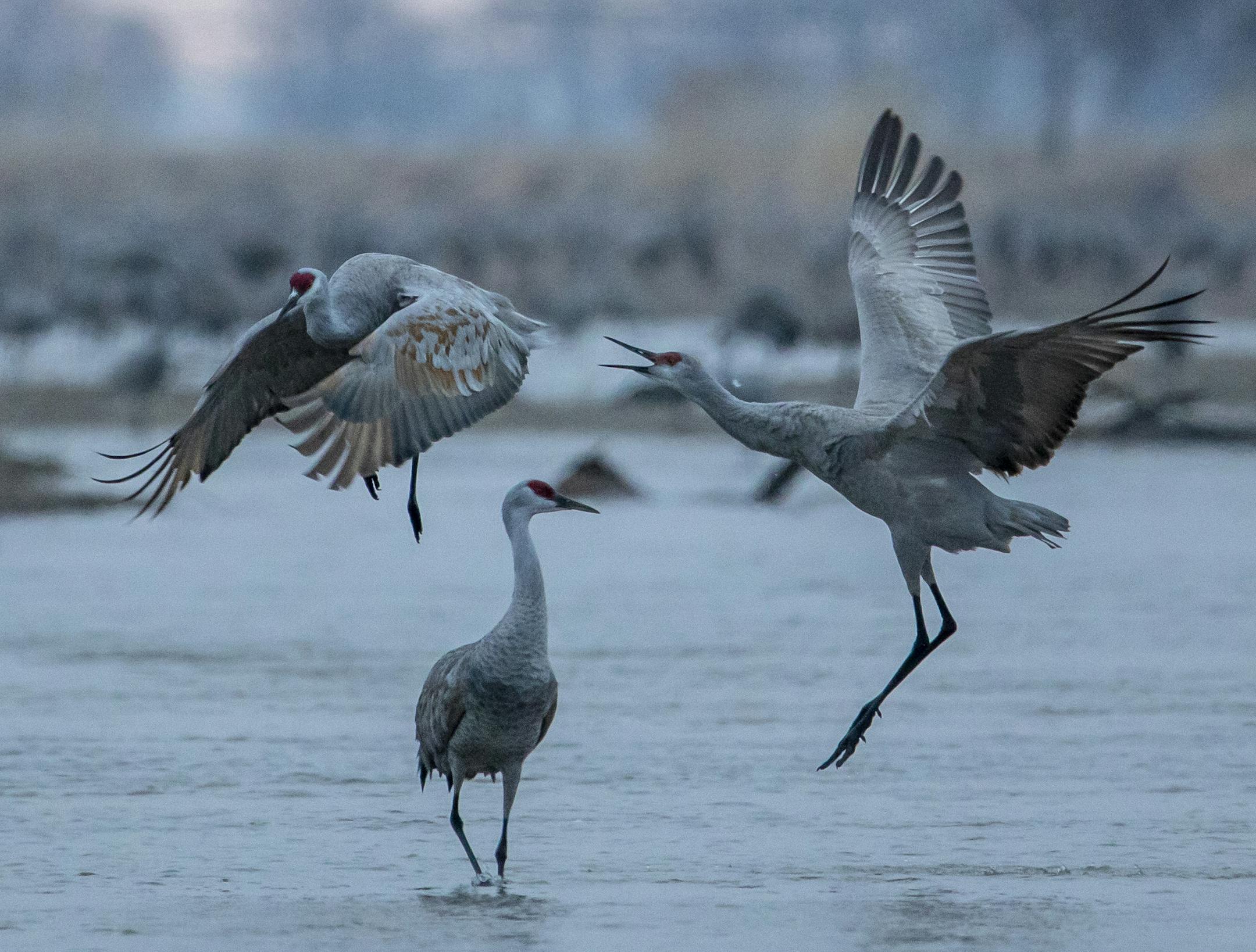
NEAR WOOD RIVER, Neb. – I should have brought ear plugs.
Wearing ear plugs just makes sense when you're going to sleep on the Platte River in Nebraska in the middle of more than half a million sandhill cranes, famous for their distinctive and near constant squawking. Truth is, I intended to have plugs with me. I simply forgot to pack them before I left Minneapolis for the eight-hour drive to the southwest.
While this early April trip was my fifth time seeing the cranes as they migrate through the central part of this state, it was my first spending all night among the birds.
Typically, visitors observe cranes from a handful of blinds along the river operated by two nonprofits, the Rowe Sanctuary in Gibbon and the Crane Trust in the city of Wood River. A person chooses a morning blind and gets to watch the sandhills leave the Platte to feed in fields, or picks an evening blind to witness them returning to roost in shallow parts of the river overnight, where they are safe from predators.
Either is a sublime experience, but in recent years I have found the blinds too crowded. At times more than 30 viewers are elbow to elbow in a blind, vying for window space. Other viewing options, such as public platforms near a handful of bridges, are to me a bit too far from where the cranes normally roost.
While the nonprofits do have blinds, they were all booked by the time I was ready to make my plans. So for this trip I found one — essentially a plywood shack about 7-by-7 — built and rented by local farmer Chad Gideon on a 300-acre property his family owns along the river. For $300 I had the place to myself, with an opportunity to see the birds coming in at night and going out in the morning.
There are always plenty of birds to see at this time of year. During the week of my visit, a record 659,000 cranes were estimated along the river, fattening up on waste corn as they stop off during their travel from the southern United States and Mexico to their summer homes in Canada, Alaska and Siberia. They begin appearing in mid-February and are gone by mid-April.
What I didn't know until shortly before my travels was that the blind I rented was located on an island. To reach it I had to wrestle on a pair of chest waders and traverse the flood-swollen river. I thought that might mean splashing through a few yards of river, but it was something more. To stay out of deeper water, I had to take a circuitous route to the island, crossing a half-dozen channels in the river and the sandbars that separated them.