
A primer on the FBI's Russia/Trump misdeeds

It turns out the FBI can be both incompetent and biased.

The New York Times
November 17, 2021 at 11:45PM
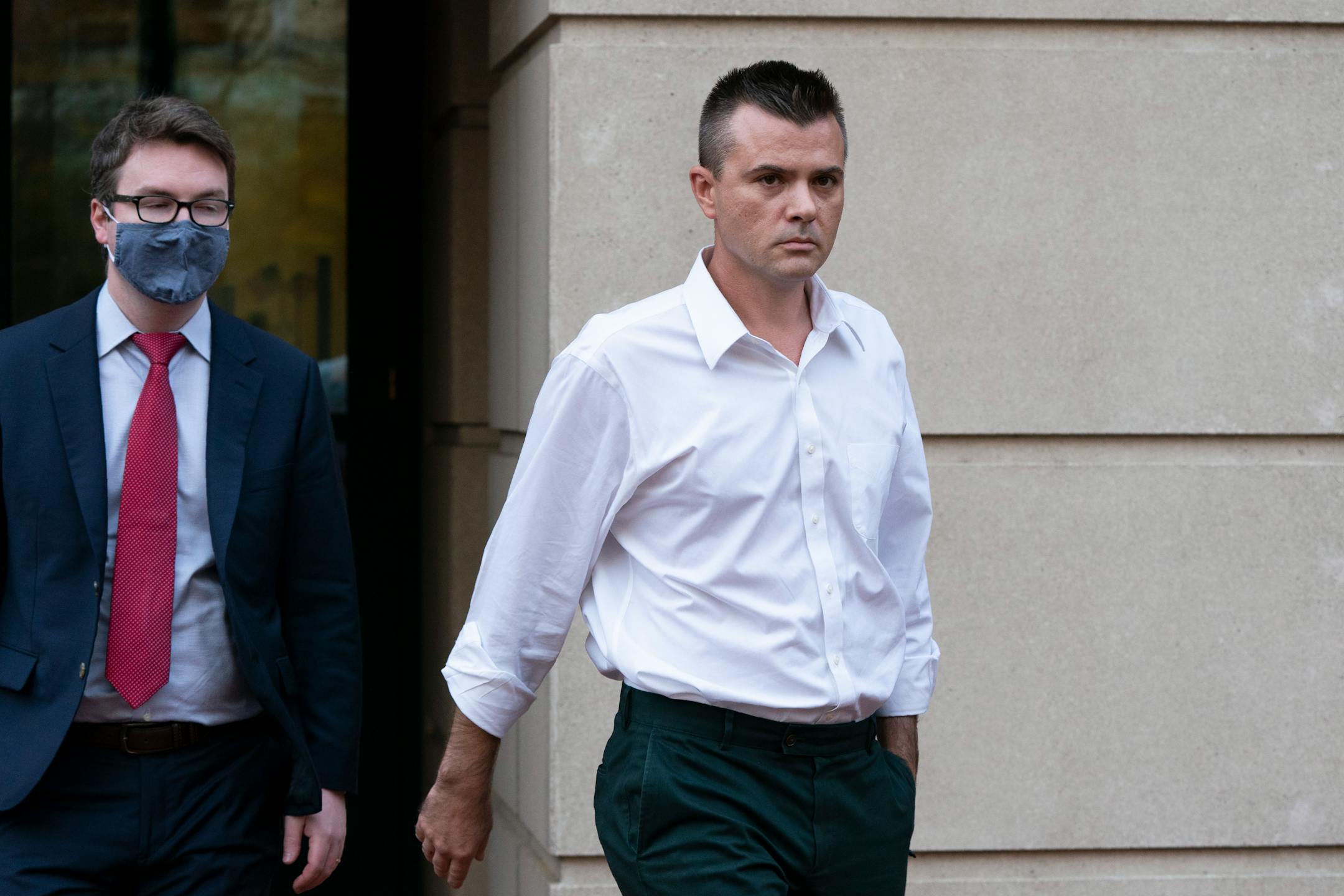
Igor Danchenko leaves Albert V. Bryan United States Courthouse in Alexandria, Va., Nov. 4. Danchenko, a Russian analyst who contributed to a dossier of Democratic-funded research into ties between Russia and Donald Trump, was arrested on charges of lying to the FBI about his sources of information. (Manuel Balce Ceneta, Associated Press/The Minnesota Star Tribune)

This month's bombshell indictment of Igor Danchenko, the Russian national who is charged with lying to the FBI and whose work turns out to have been the main source for Christopher Steele's notorious dossier, is being treated as a major embarrassment for much of the news media — and, if the charges stick, that's exactly what it is.

Put media criticism aside for a bit. What this indictment further exposes is that James Comey's FBI became a Bureau of Dirty Tricks, mitigated only by its own incompetence — like a mash-up of Inspector Javert and Inspector Clouseau. Donald Trump's best move as president (about which I was dead wrong at the time) may have been to fire Comey.

If you haven't followed the drip-drip-drip of revelations, late in 2019 Michael E. Horowitz, the Justice Department's inspector general, published a damning report detailing "many basic and fundamental errors" by the FBI in seeking Foreign Intelligence Surveillance Court warrants to surveil Carter Page, the American businessman fingered in the dossier as a potential link between the Trump campaign and the Kremlin.

Shortly afterward, Rosemary Collyer, the FISA court's presiding judge, issued her own stinging rebuke of the bureau: "The frequency with which representations made by FBI personnel turned out to be unsupported or contradicted by information in their possession, and with which they withheld information detrimental to their case, calls into question whether information contained in other FBI applications is reliable," she wrote.

Here a question emerged: Were the FBI's errors a matter of general incompetence or of bias? There appears to be a broad pattern of FBI agents overstating evidence that corroborates their suspicions. That led to travesties such as the bureau hounding the wrong man in the 2001 anthrax attacks.

But it turns out the bureau can be both incompetent and biased. When the FBI applied for warrants to continue wiretapping Page, it already knew Page was helping the CIA, not the Russians. We know this because in August 2020 a former FBI lawyer, Kevin Clinesmith, pleaded guilty to rewriting an e-mail to hide Page's CIA ties.

And why would Clinesmith do that? It certainly helped the bureau renew its wiretap warrants on Page, and, as he once put it in a text message to a colleague, "viva la resistance."

When the purpose of government service is to stop "the crazies" (one of Clinesmith's descriptions of the elected administration), then the ends soon find a way of justifying the means.

Which brings us to the grand jury indictment of Danchenko in the investigation being conducted by special counsel John Durham. Danchenko was Steele's main source for the most attention-grabbing claims in the dossier, including the existence of a likely mythical "pee tape."

Steele, in turn, wrote his report for Fusion GPS, an opposition-research outfit that had been hired by a Washington law firm close to the Hillary Clinton campaign and the Democratic National Committee.

Translation: The Steele dossier was Democratic Party-funded opposition research that had been sub-sub-sub-sub contracted to Danchenko, who now stands accused of repeatedly lying to the FBI about his own sources while also having been investigated a decade ago for possible ties to Russian intelligence. Danchenko has pleaded not guilty and adamantly denies Russian intelligence ties, and he deserves his day in court. He describes the raw intelligence he collected for Steele as little more than a collection of rumors and innuendo and alleges that Steele dressed them up for Fusion GPS.

Of such dross was spun years of high-level federal investigations, ponderous congressional hearings, pompous Adam Schiff soliloquies and nonstop public furor.

But none of that would likely have happened if the FBI had treated the dossier as the garbage that it was, while stressing the ways in which Russia had sought to influence the election on Trump's behalf or the ways in which the Trump campaign (particularly through its onetime manager, Paul Manafort) was vulnerable to Russian blackmail.

Instead, Comey used it as a political weapon by privately briefing President-elect Trump about it, despite ample warnings about the dossier's credibility. In doing so, Comey made the existence of the "salacious and unverified" dossier news in its own right. And, as the University of Chicago's Charles Lipson astutely notes, Comey's briefing "could be seen as a kind of blackmail threat, the kind that marked J. Edgar Hoover's tenure."

If you are a certain kind of reader — probably conservative — who has closely followed the Durham investigation, none of the above will come as news. But I'm writing this column for those who haven't followed it closely or who may have taken a keener interest in tales about Trump being Russia's puppet than in evidence that, for all of his many and grave sins, he was the victim of a gigantic slander abetted by the FBI.

Democrats who don't want the vast power wielded by the bureau ever used against one of their own — as, after all, it was used against Hillary Clinton — ought to see the Durham investigation as an opportunity to clean up, or clean out, the FBI once and for all.

about the writer

about the writer

Bret Stephens

More from Commentaries

See More
card image
Jehad Alshrafi/The Associated Press

Preserving the stories of others deepens our understanding of what it means to be human.

card image
The family of Harper Moyski, far right, poses with their Christmas tree at the Annunciation tree lot in December 2024.