

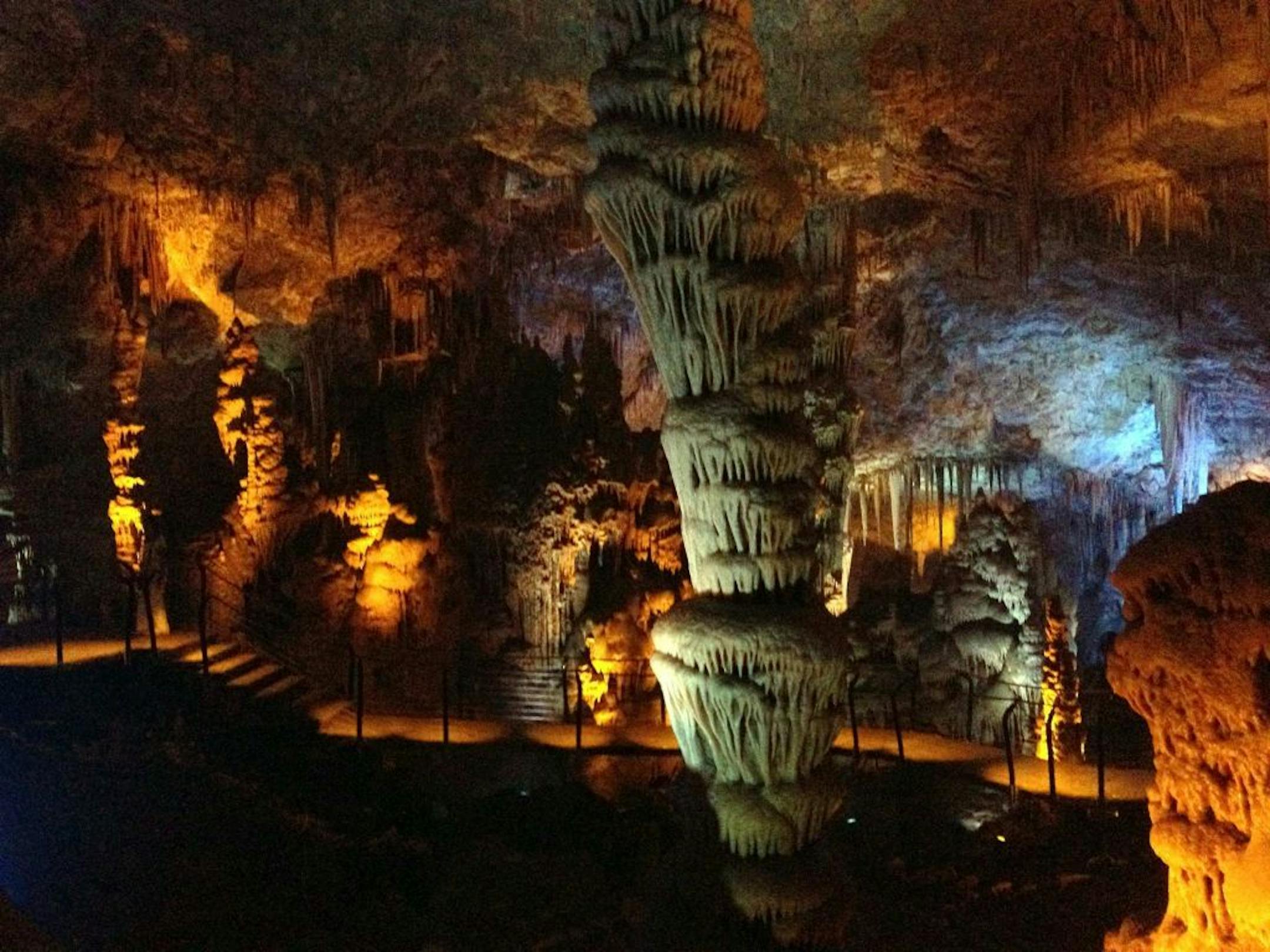
SOREQ CAVE, ISRAEL - This prehistoric cave on the slopes of Israel's Judean Mountains has always felt a little otherworldly.
Like other dripstone caverns, Soreq Cave is packed with stunning natural sculptures formed by hundreds of thousands of years of mineral-rich water drops slowly leaving behind a rock residue.
On the roof is a hanging forest of different-sized rods, resembling icicles, giant carrots, elephant trunks and twisting octopus tentacles. Rising up to meet them from the limestone floor are 30-foot sand castles, spiraling rock towers and hills that resemble coral reefs.
As if it weren't strange enough, a recent ecological makeover has added a lighting system as spectacular as it is eerie. Glowing amber spotlights fade into midnight blue mixed with circles of emerald, bathing the 50,000-square-foot cave and its formations in color. Programmed to change every few minutes, the lighting turns a sunrise orange before transforming into a deep purple.
"It's like the cave is breathing," said guide Boris Kripak, a Russian-born archaeologist who works at the cave, which was discovered in 1968 during rock-blasting for a nearby quarry.
The Hollywood-style lighting wasn't installed for artistic reasons. Instead, the colors were selected as part of a decades-long ecological battle designed to keep the cave's stalactites and stalagmites as pristine as possible.
By using only a limited part of the color spectrum of light and focusing on certain shades of orange, blue and green, scientists are betting the new system will eradicate one of the cave's biggest threats: algae.
From the moment the cave was opened to the public in the 1970s, the introduction of white light, initially provided by automobile headlamps, has triggered photosynthesis that led to the growth of algae. Public use has also raised the temperature slightly and altered the balance of carbon dioxide, said Tomer Saragusti, manager of the national Soreq Cave Nature Reserve.


