

Who wouldn't want to be an American ambassador?
Beyond the pomp and social cachet, you get a luxury residence, six-figure salary and private school tuition for your children — a comfortable diplomatic lifestyle bankrolled by taxpayers. For decades, presidents from both parties have quietly distributed a portion of these cushy posts (often in the touristy capitals of Europe and the Caribbean) to some of their most generous campaign donors. Although the practice is technically prohibited by law, Congress has long acquiesced.
"We're the only country in the world that does business in this way," says Dennis Jett, a retired ambassador, career foreign service officer and professor who wrote the book "American Ambassadors." "Nobody else has an open market on ambassadorships. If we really believed in capitalism, we would list these postings on eBay."
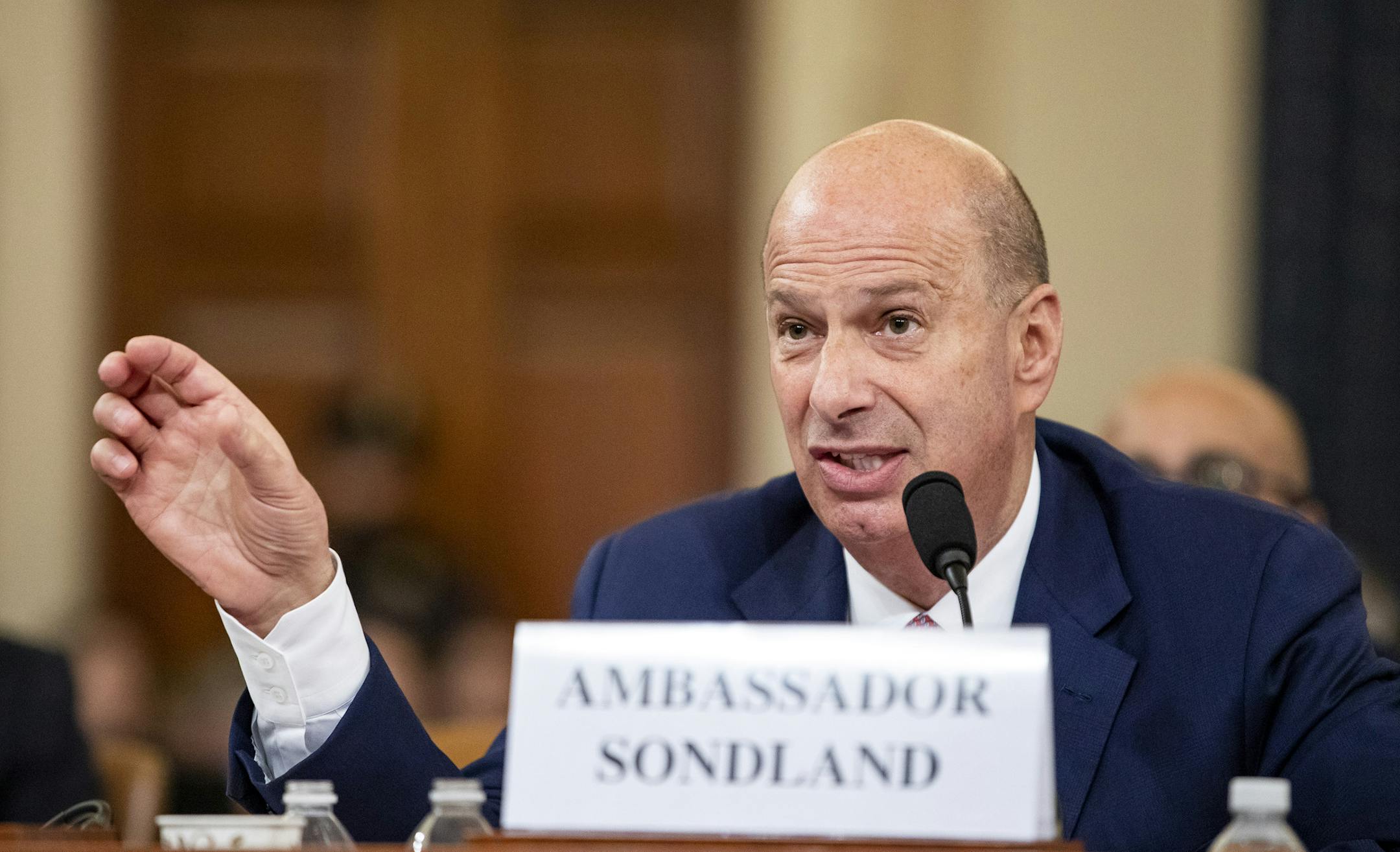
The problem, as indicated by Gordon Sondland and other donor-ambassadors during the Trump administration, is that the most loyal are often the least competent. But the practice of effectively selling ambassadorships did not start with President Donald Trump. The fact that nearly every modern president has done the same would seem to be the rare piece of evidence in support of Trump's claim that he is no more corrupt than the Washington "swamp." The incoming Biden administration now has a chance to prove him wrong.
The precise origins of ambassadorial graft are obscure, but one of the earliest examples can be found inside the original "smoke-filled room," a suite at the Blackstone Hotel in Chicago, where Republican power brokers haggled into the early hours of June 12, 1920, trying to choose an agreeable presidential candidate to unite their party's deadlocked convention. They finally settled on the stately-looking junior senator from Ohio, Warren G. Harding. One of Harding's powerful backers was George Harvey, publisher and industrialist, who had engineered Woodrow Wilson's ascent to the White House. After Harding won the election, he made Harvey ambassador to the Court of St. James in London.
Ambassador Harvey wasted no time in making a fool of himself. He showed up dressed like a minister from the previous century, in satin knee breeches and silver-buckled slippers. He gave a speech at a London club questioning whether women had souls. In another speech, delivered before the Pilgrims Society, he claimed that the U.S. had fought in World War I "reluctantly and laggardly" to save its own skin. Almost immediately, Harvey was condemned on both sides of the Atlantic. Harding distanced himself from his ambassador's views.
In 1924, Congress passed the Rogers Act, an attempt to create a corps of professional career diplomats. But the temptation to reward political allies with ambassadorships has only grown.
Sondland, a hotelier who gave a million dollars to Trump's inaugural committee, was made the U.S. ambassador to the European Union. Unlike Harvey, who had real clout, Sondland was mainly distinguished by his willingness to give away his own money.


