

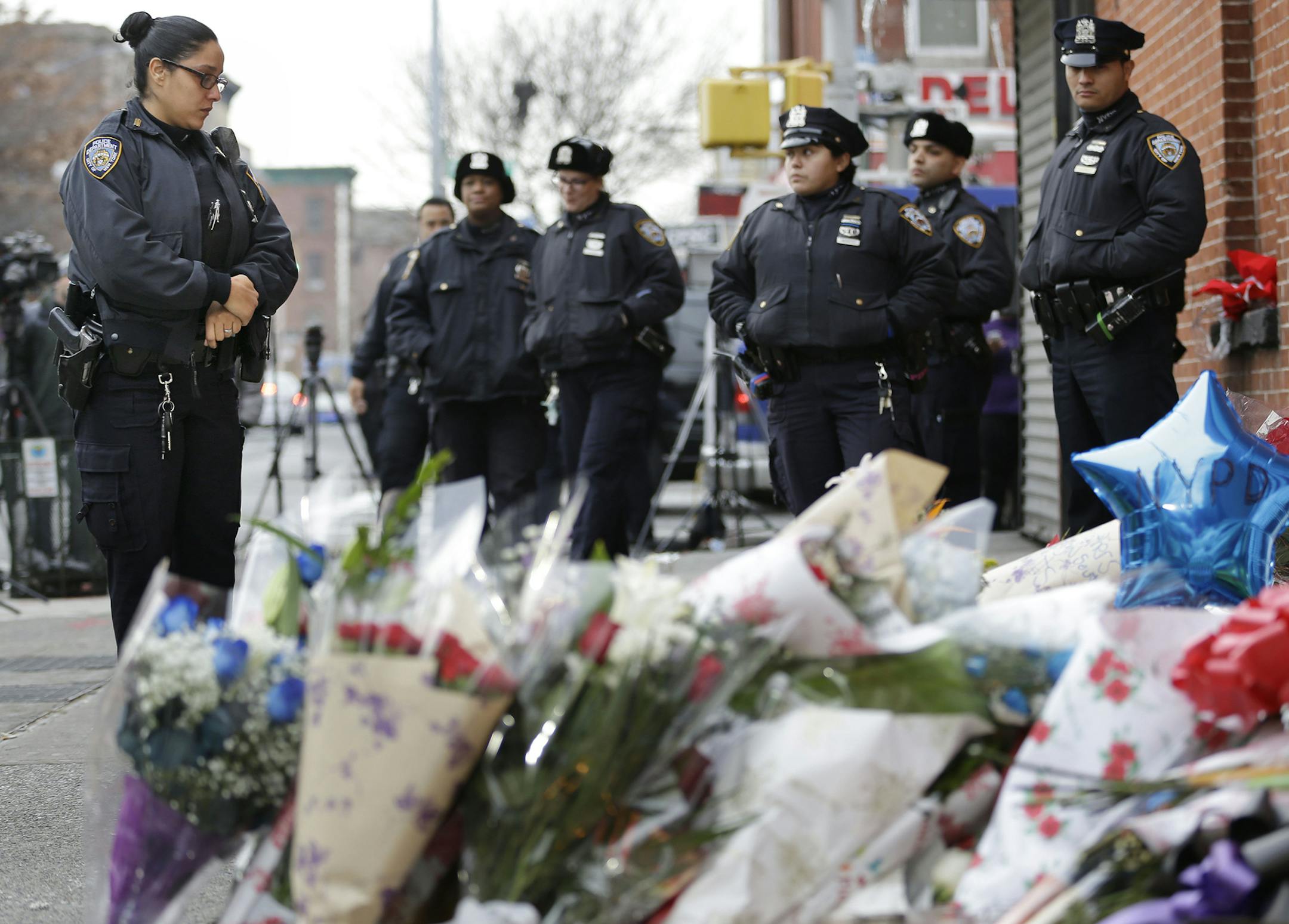
With the help of social media, it didn't take long for authorities to find evidence of the warped thinking of Ismaaiyl Brinsley, who assassinated two New York City Police Department officers in Brooklyn on Saturday.
Not only did Brinsley tell two bystanders to "watch what I'm gonna do" before opening fire on the officers, but he also apparently left an online trail of hate in which he said he planned to put "Wings On Pigs" and avenge the death of Eric Garner, who was killed in a confrontation with New York police. "They Take 1 of Ours, Let's Take 2 of Theirs," he reportedly posted on Instagram a few hours before killing officers Wenjian Liu and Rafael Ramos.
The deadly attack stunned a nation still struggling to come to terms with the 2014 police-involved deaths of Garner and Akai Gurley in New York, Michael Brown in Ferguson, Mo., and 12-year-old Tamir Rice in Cleveland.
One fundamental element of police-community relations that has received too little discussion amid the din of protests sparked by these cases is that law enforcement is an inherently dangerous profession. Brinsley's cowardly ambush provided a shocking reminder of that on Saturday.
Police "go to roll call every day thinking this type of thing is possible," Minneapolis police spokesman Scott Seroka told the Star Tribune on Sunday.
Indeed, the names Liu and Ramos will soon be engraved on the walls of the National Law Enforcement Officers Memorial in Washington, D.C. The memorial lists more than 20,000 sworn law enforcement officers who have been killed in the line of duty in the United States since 1791.
According to the FBI, 49,851 officers were assaulted while on duty in 2013, and 27 were killed in incidents involving felonies. Another 49 died in accidents while on duty.
Liu and Ramos were in their marked squad car in the Bedford-Stuyvesant section of Brooklyn when Brinsley approached them, providing easy targets for a man with mental health issues and a long history of violent behavior and run-ins with the police.


