

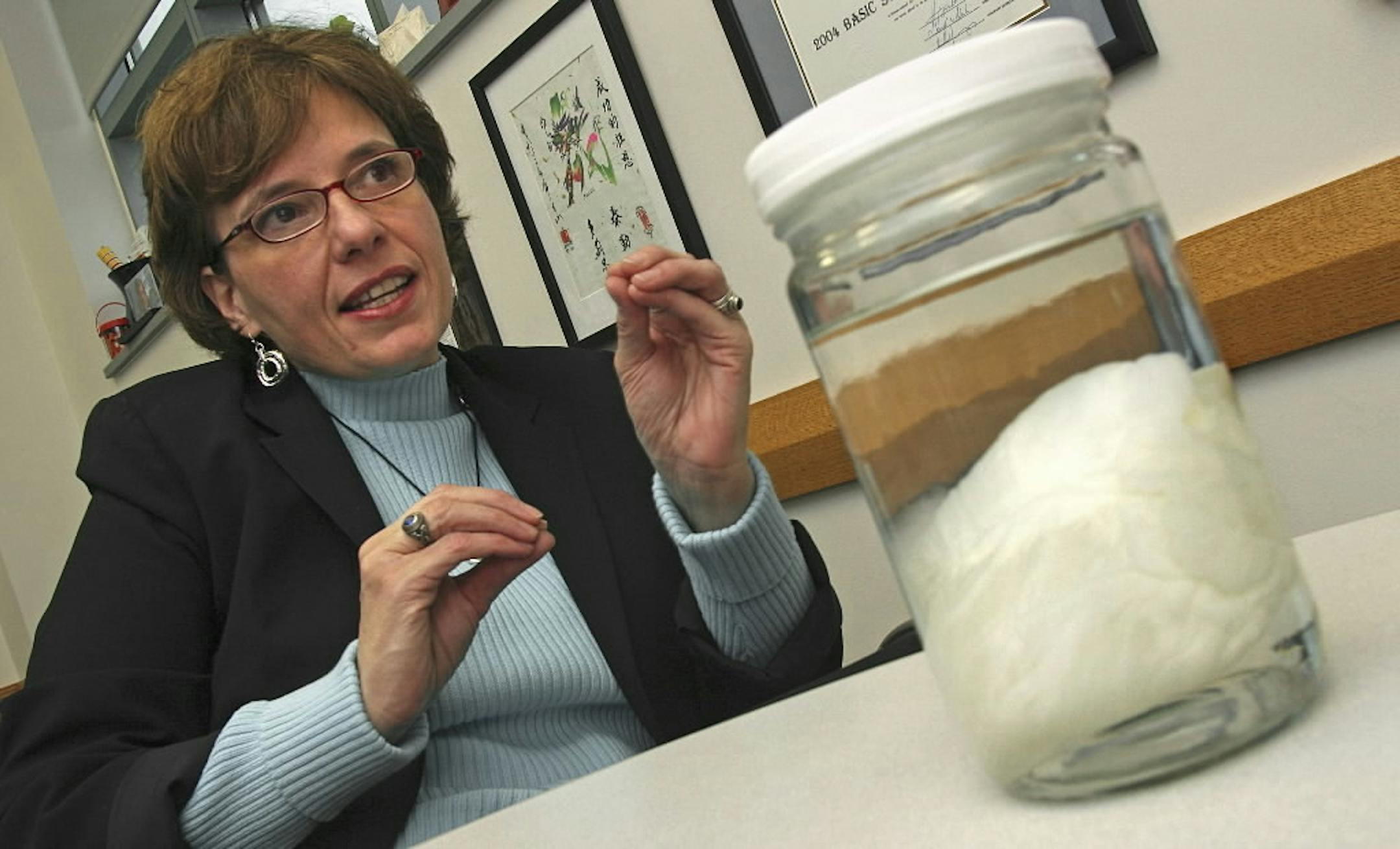
Researchers at the University of Minnesota have grown a beating heart in a jar.
They used detergents to strip a rat heart of its own cells, leaving behind a white, three-dimensional scaffolding of connective tissue. They then infused it with living cardiac cells from newborn rats, which multiplied and grew into a fully functional heart -- a first in the field of tissue engineering.
"We've figured out how to use nature's own matrix -- chambers, valves, blood vessels," said Dr. Doris Taylor, the lead researcher and director of the university's Center for Cardiovascular Repair. She said that the technique holds promise for growing human tissue to repair not only hearts, but many other parts of the body. It might be possible, she said, to grow whole organs for patients who need a transplant.
Other tissue engineering scientists around the country said there are enormous obstacles to using the technique for people.
But they described the work as exciting and a landmark.
"It's gutsy. I am very impressed with her going right for the meat of it ... and showing remarkable results," said Dr. Buddy Ratner, a University of Washington bioengineer.
The research was published online Sunday by Nature Medicine, a journal known for publishing cutting-edge science.
Growing human tissue outside the body has been a medical Holy Grail for decades. Progress accelerated in recent years with the use of stem cells, special cells in embryos and adults that can be manipulated to grow into many kinds of tissue. The National Institutes of Health has provided millions of dollars for tissue engineering, but so far researchers have had success with only a few types of human tissue -- primarily bladders, skin, and blood vessels.


