

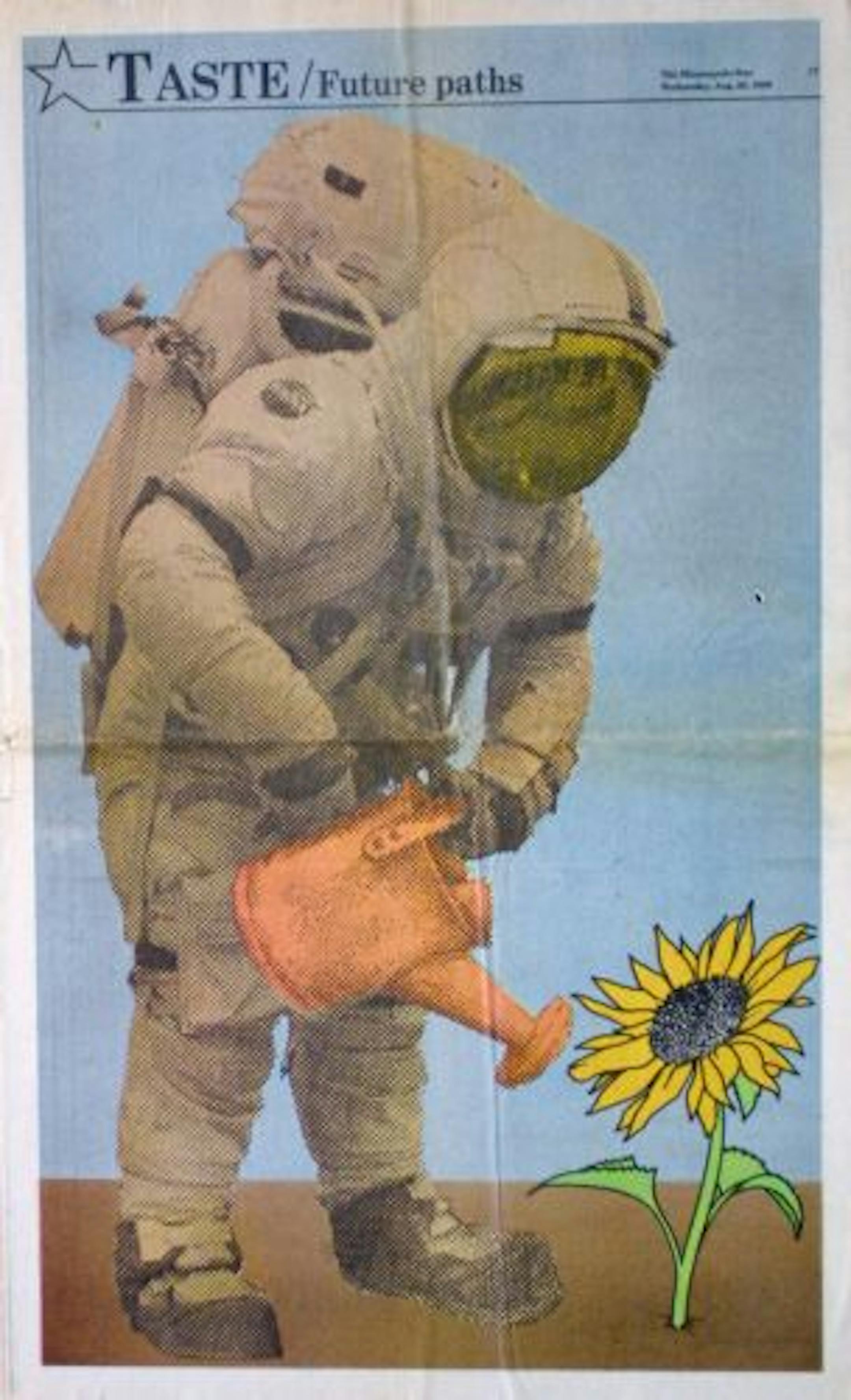
Taste staff members peered into the future on Aug. 20, 1980. Specifically, they were looking at 2002. Let's avail ourselves of hindsight to determine their accuracy.
Futurists were forecasting a drastic drop in meat consumption. "Meat is now considered a luxury and is rarely eaten more than two to three times per week," said Wesley Buchele, a professor of agricultural engineering at Iowa State University, speaking as if he were living in 2002, not 1980.
Instead, Buchele said, soybeans and yet-to-be developed high-protein legume crops would produce the bulk of the protein consumed by 21st-century Americans.
Buchele also believed that prohibitive energy costs would pretty much put the kibosh on trucking fruits and vegetables from coast to coast. Urban truck farm and greenhouse businesses would become a major growth industry. Extensive home gardening, with grass replaced by fruits and vegetables in nearly all front and back yards, would become a necessity.
Scarce energy resources would lead to the development of corncob-fueled gas generators for powering most of the nation's farm equipment. Automobile sales would plummet, and tractor sales would rise, as the population would grow more of its own food.
Home computers, then in their infancy, were seen as doing all -- well, at least some -- of the work. "The experts predict that resource management is the area where the personal computer will really star, helping us make the most efficient use of food, energy, water and time," wrote Taste staff writer Heather Randall. "Our crystal ball becomes clouded when we try to visualize a personal computer assisting us not only in the kitchen, but in areas of budgeting and income tax preparation, education, home protection and maintenance and leisure time activities."
Finally, Anthony Provenzano, a professor at Old Dominion University, envisioned a new high-protein, do-it-yourself food source: back-yard fish gardens. "During the past few years, there's been a tremendous amount of interest by the American public about increasing self-sufficiency," he said. "More and more people are gardening. The fish garden would be a natural extension. People could grow their own fish -- pollution-free."
RICK NELSON


