

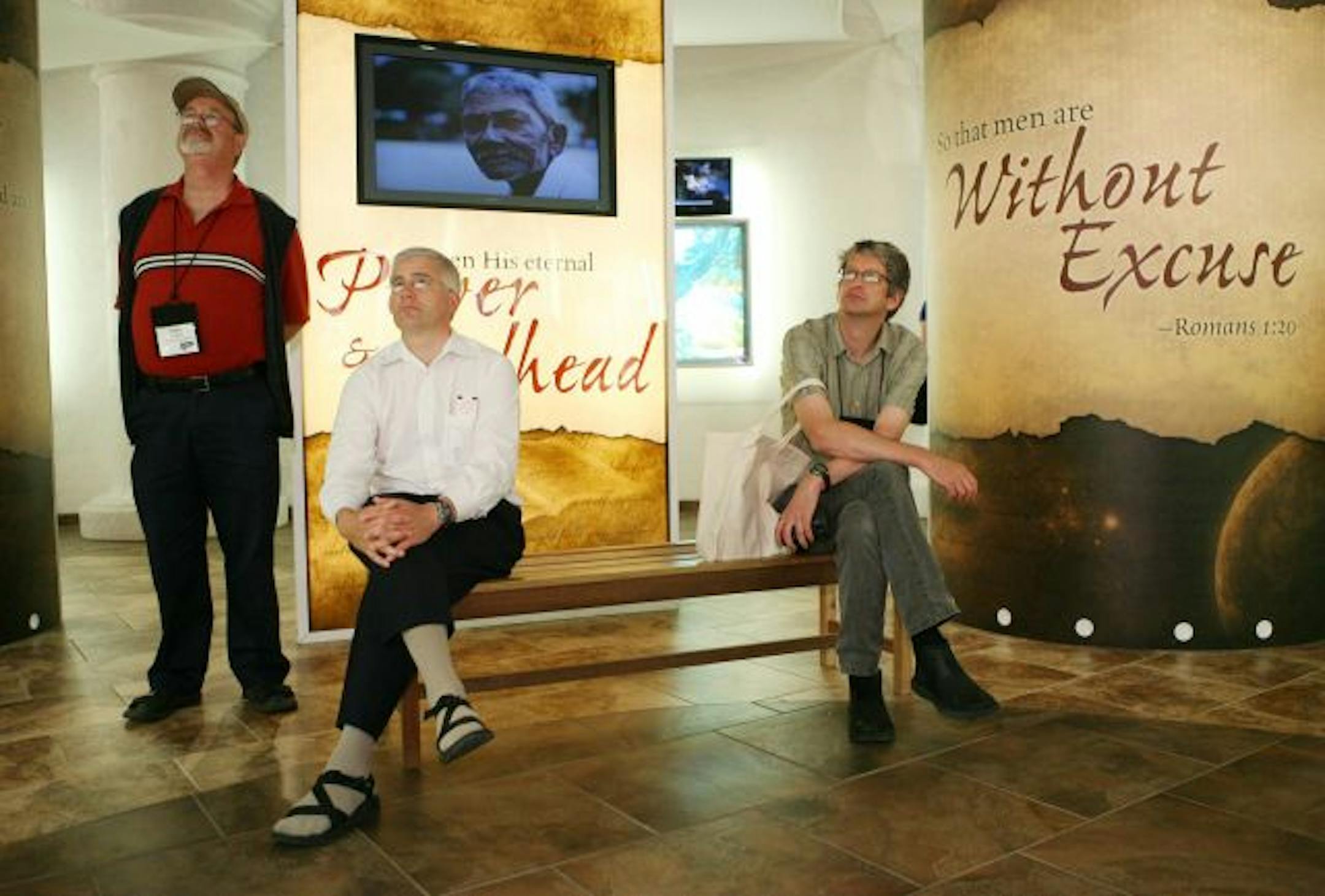
A scientist who scoffs at those who believe that men and dinosaurs cohabited the Earth rode a saddled triceratops last weekend. Paul Zachary Myers, an associate professor of biology at the University of Minnesota, Morris, was on an unlikely field trip to the Creation Museum in Petersburg, Ky.
Myers, who goes by "PZ," brought to the museum 304 scientists, students and secularists who were in town attending a meeting of the Secular Student Association. To this group, Myers is a celebrity, not for his scientific research (zebrafish brain development) but for his often loud and inflammatory defense of science and skeptical inquiry. In 2006 his Pharyngula blog was chosen the most popular science blog by the research journal Nature. It draws more than a million visitors a month.
Why does a biologist known as a fierce critic of creationism travel more than 800 miles and pay $10 to visit a creationist museum in rural Kentucky?
"To gather evidence," Myers said. "You can't just sit in a quiet corner of Minnesota and complain about something."
The Creation Museum presents an alternative to the views of mainstream science. Here the Bible is "the true history book of the universe," a history of a 6,000-year-old Earth based on a literal interpretation of the Book of Genesis. Adam and Eve share the Garden of Eden with dinosaurs, and posters on a variety of topics contrast the explanations provided by "man's reason" and "God's word."
The $27 million Creation Museum was built by the nonprofit organization Answers in Genesis, whose president and CEO, Ken Ham, is on a mission to get creationism into science classrooms nationwide. Last month, for example, Ham attended a meeting of the National Education Association and passed out creationist DVDs and books. He was quoted in a press release as hoping that teachers "see how the Bible is confirmed by observational science."
This association of science and creationism has drawn complaints from the scientific community. When the Creation Museum opened in May 2007, more than a thousand scientists from Kentucky, Ohio and Indiana signed a petition protesting the "scientifically inaccurate exhibits." A New York Times article in June featured a group of paleontologists who toured the facility and said the exhibits misrepresented and ridiculed them and their work.
'Faulty science'

