
A different school of fish

The University Bass Fishing Club has found some success in college tournaments despite limited resources.

August 16, 2009 at 5:01AM
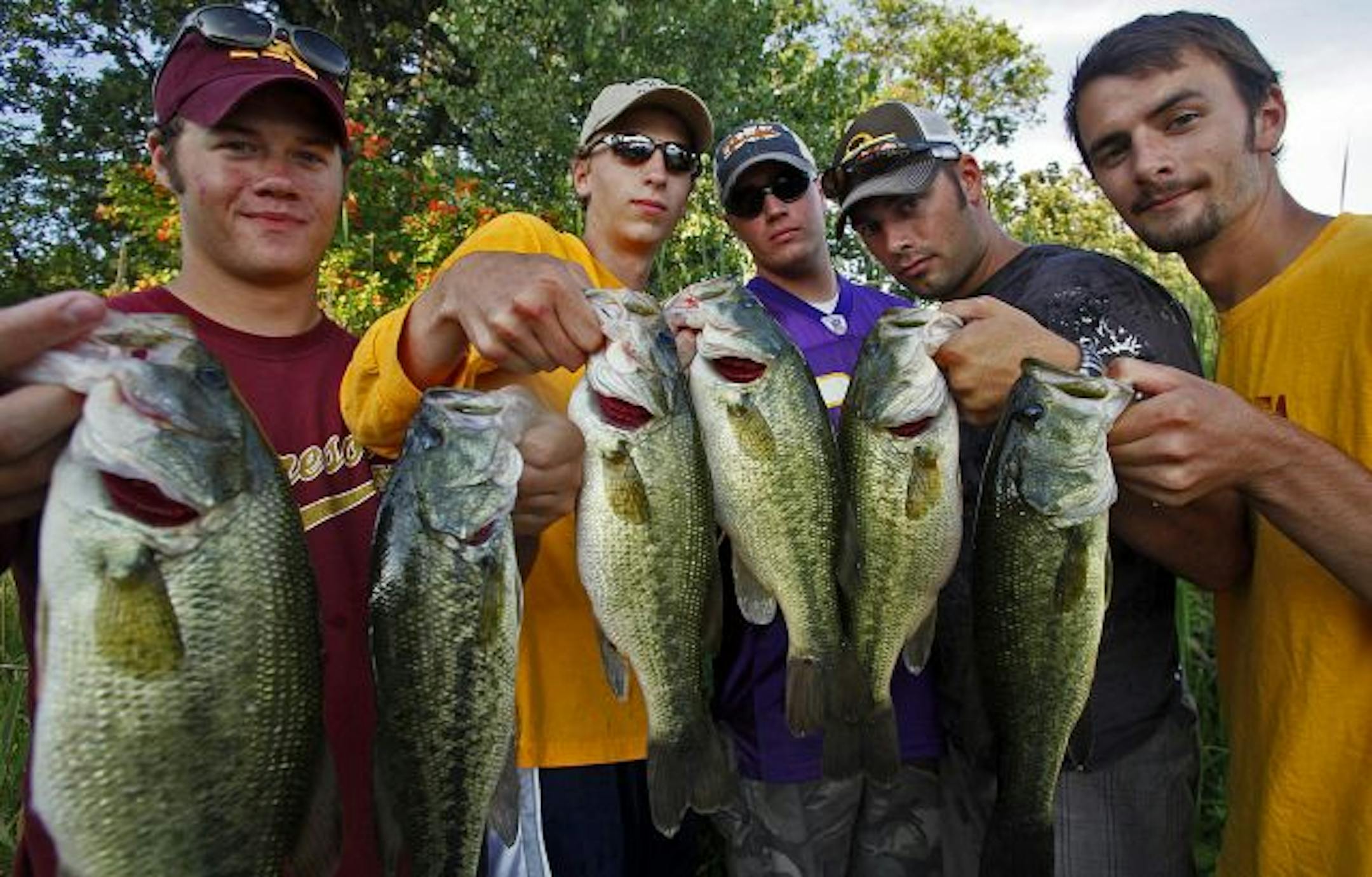
Holding up Sunday's catch of bass at Bald Eagle Lake were, from left, Eric Sanft, Alex Batts, Corey Vance, Jeff Hoberg and Jeff Batts. The University Bass Fishing Club, a club at the University of Minnesota, doesn't have many members, although no one is excluded from competing.
Holding up Sunday’s catch of bass at Bald Eagle Lake were, from left, Eric Sanft, Alex Batts, Corey Vance, Jeff Hoberg and Jeff Batts. The University Bass Fishing Club, a club at the University of Minnesota, doesn’t have many members, although no one is excluded from competing. (Star Tribune/The Minnesota Star Tribune)

With no fish locator and a broken trolling motor, University Bass Fishing Club president Jeff Batts, his brother Alex Batts and I cruised across Bald Eagle Lake last Sunday. ¶ In their beat-up 16-foot Smokercraft, we headed for the north end of the lake to meet up with six other University of Minnesota students who were set up in three boats for an informal practice on the busy northeast-metro lake. ¶ "If the motor survives today, it will be a miracle,"Jeff said half-jokingly, as their 90-horse Mercury fired up sounding as if it could explode any second. At first glance, it would be hard to confuse the Batts brothers, or the rest of the University Bass Club, for the professional tournament anglers who pilot lightning-fast metalflaked craft, don sponsored uniforms and make hundreds of thousands of dollars in winnings every year.

But as Jeff puts it, "Fancy uniforms don't catch fish."

In its first year of existence, the University Bass Fishing Club has fielded a group of about 10 college students who love to fish and know how to catch bass. Despite their lack of resources, they have had success in the highly competitive college bass fishing arena.

If you haven't watched ESPN2 in a while, college bass fishing has become a growing sensation around the country, and the FLW, a tournament circuit sponsored by Wal-Mart among others, regularly plays host to televised competitions.

In April, Minnesota's club took third in the Big Ten tournament, held in Indiana. The University Bass Club sent down five people but ended up having only two hours to pre-fish the lake because the students couldn't afford to leave any earlier and miss class.

The University of Illinois, the tournament winner, sent 10 anglers, had five boats and set aside two full days to prefish the lake, Jeff said.

The Bass Club members also finished in the middle of the pack in the two FLW (for Forrest L. Wood, founder of Ranger boats) tournaments they have competed in this summer. The prize for winning the national college FLW tournament is thousands of dollars and a new bass boat painted in school colors.

"It's an adrenaline rush," said Alex, a junior majoring in finance. "You kind of feel like it's a professional tournament."
Jeff, an elementary education major, allows all club members to fish in any tournament, regardless of experience. The club has no tryouts, and no one gets benched.

Most join the Bass Club because they just like fishing, but incoming president and university sophomore Eric Sanft has pro aspirations.

"Ideally, it would be great to be a professional bass angler," he said.

Sanft is probably the best angler on the club and has been fishing bass tournaments for three years. He has been poring over maps and studying fishing reports for his next FLW tournament in Iowa next weekend.

"I really want to beat Iowa this time," Sanft said. The University of Iowa took second in the Big Ten tournament, just barely ahead of the Minnesota team.

But it's a hard life for a bass-fishing team based in the land of 10,000 walleye lakes. Many of the big college tournaments go on in the south, which makes traveling expensive and time-consuming. Also, the bass fishing season is shorter in Minnesota than in southern states, putting Batts and his crew at a competitive disadvantage.

The club members had the odds stacked against them again Sunday. Powerful thunderstorms had ripped through the area the day before and were followed by a high pressure system that slowed fish activity.

And along with the typical Sunday afternoon chaos of a metro lake, there was a local bass tournament that morning, which ensured every dock, log and lily pad we targeted had already been picked over.

Jeff, Alex and I tossed spinner baits, Senko worms, topwater baits, weedless jigs and even live nightcrawlers but had painfully little success.

As the sun started heading for the horizon, I could see frustration rising in the Batts brothers. Alex sat quietly in the bow, casting like it was his job, and Jeff kept telling me, "I don't want you to think we're a bunch of hacks."

Finally, after I lobbed a spoon with a long plastic tail at a patch of lily pads, my line started running to the right.

I set the hook and hauled in a feisty 16-inch bass through a jungle of weeds. The frustration faded to relief.

After a few more hours we headed back to the launch, boating only two bass: the one I caught and a 12-incher Alex had reeled in earlier.

"We know when we've been beat," Jeff said as he pointed us home.

But the other boats, ones with working trolling motors, had much better results. Between four boats, club members landed 25 bass, the biggest being a stout 3 1/2-pounder.

"As we get bigger, we'll start to be more competitive," Sanft said.

Alex Robinson • 612-673-7405

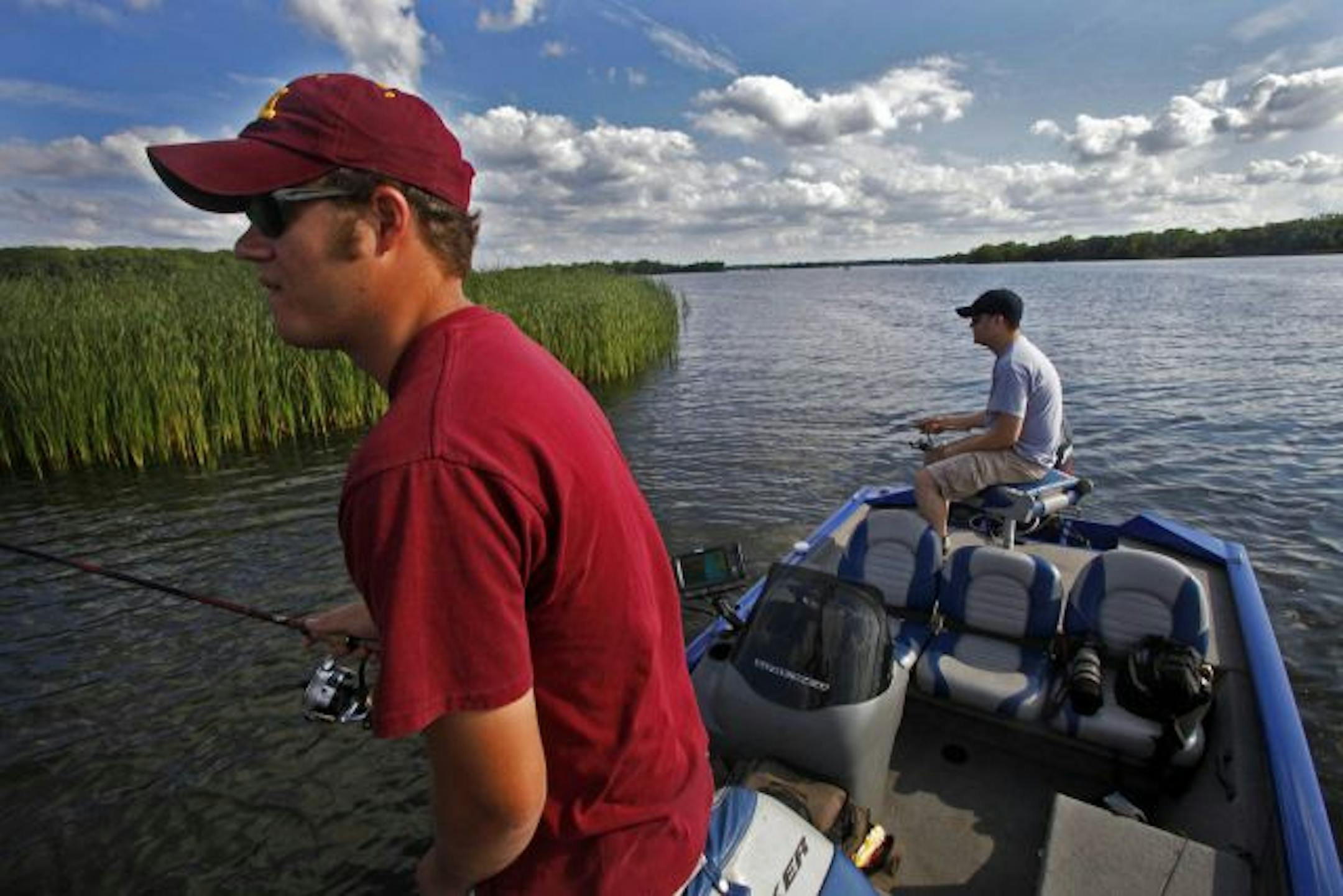
Eric Sanft, left, and Andy Stakston sought bass on a busy Sunday at Bald Eagle Lake. They had a rough go at it, as a local bass tournament had been held there that morning.
Eric Sanft, left, and Andy Stakston sought bass on a busy Sunday at Bald Eagle Lake. They had a rough go at it, as a local bass tournament had been held there that morning. (Dml - Minneapolis Star Tribune/The Minnesota Star Tribune)
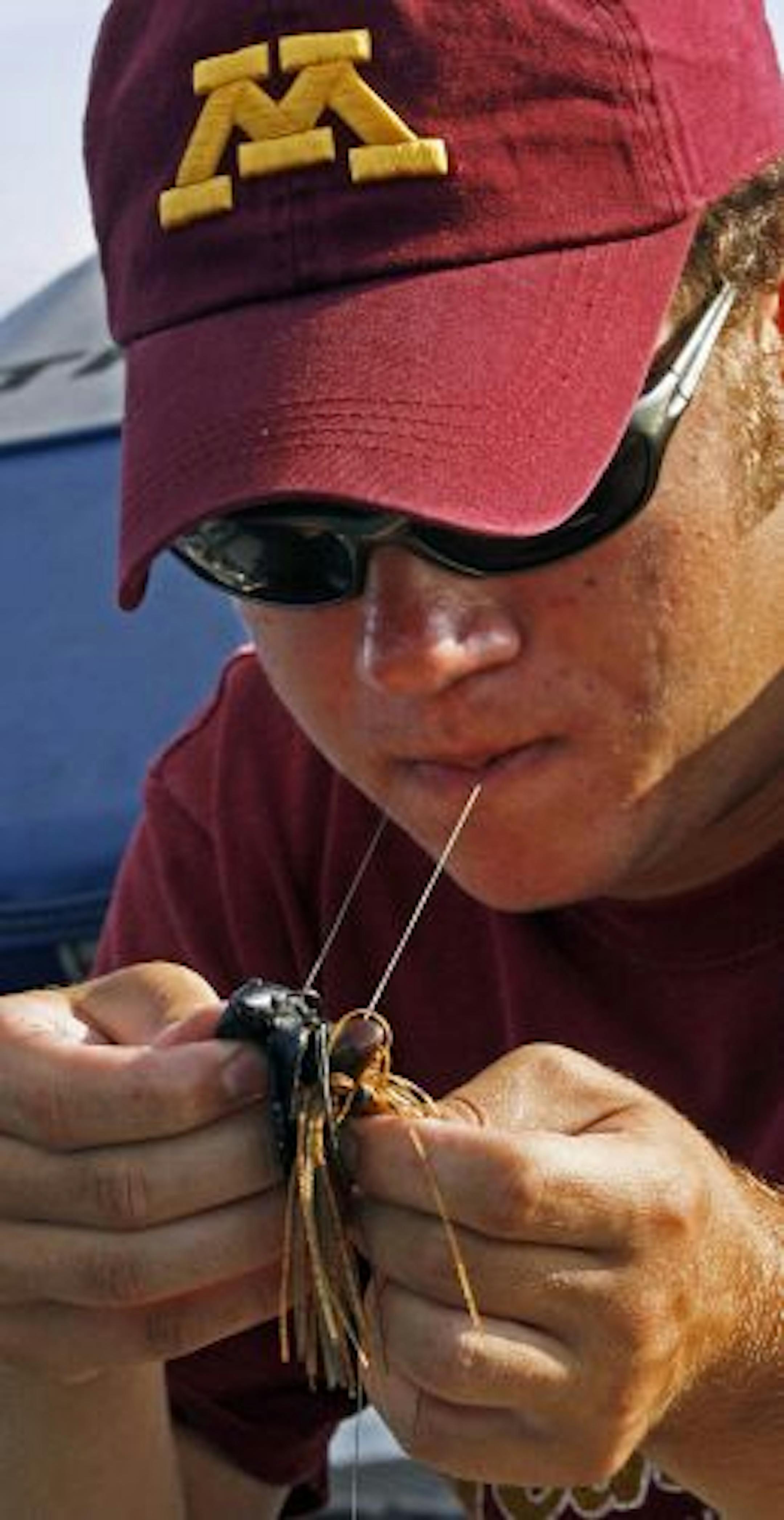
Eric Sanft tied a bass jig onto his line.
Eric Sanft tied a bass jig onto his line. (Dml - Minneapolis Star Tribune/The Minnesota Star Tribune)
about the writer

about the writer

ALEX ROBINSON, Star Tribune