
A curious find on Mars: It's like Earth

A rock examined by Curiosity proves to hold surprises about the planet's diversity of minerals.

Los Angeles Times
October 13, 2012 at 9:45PM
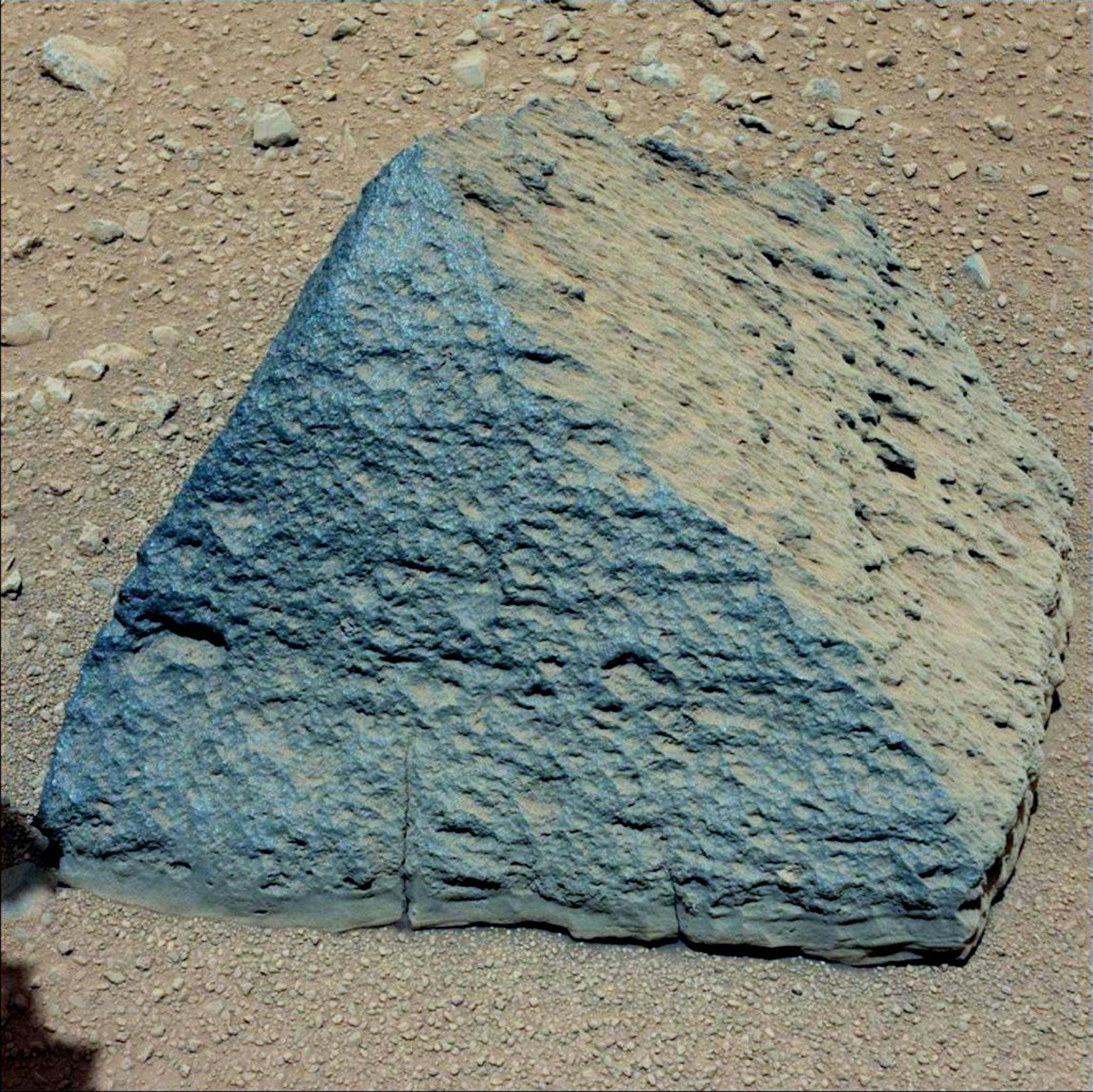
"Jake Matijevic" -- a pyramid-shaped chunk of rock that's proved to be a surprise, even to NASA.
"Jake Matijevic" -- a pyramid-shaped chunk of rock that's proved to be a surprise, even to NASA. (NASA/The Minnesota Star Tribune)

The more Curiosity gets to know Mars, the more it seems like a big red Earth. Curiosity recently examined what appeared to be an ancient riverbed and conglomerate rocks similar to those at home.

Now comes "Jake Matijevic" -- a pyramid-shaped chunk of rock that's proved to be a surprise, even to NASA.

The space agency says that Jake, named for a legendary NASA engineer, is unique -- unlike any rocks examined before on Mars. And that's saying something. Previous rovers have examined hundreds of Martian rocks.

When Curiosity team members picked Jake, they were just hoping for a "simple and uniform" rock that would help them compare results from two chemistry instruments.

Jake was the first rock analyzed by the rover's arm-mounted Alpha Particle X-Ray Spectrometer; it was about the 30th on this mission examined by the Chemistry and Camera (ChemCam) instrument.

Hoping for 'a simple plot'

"It's a strength of Curiosity to have instruments that use different techniques to get at the same answers," Ashwin Vasavada, Curiosity deputy project scientist, said. "But it's also a challenge for the science team, like trying to understand the plot of a story when one person saw the movie and another read the book. We were hoping that Jake M. had a simple plot."

But NASA got more than it expected. The rock was diverse, surprisingly so. "Our laser instrument saw a slightly different composition at every point it analyzed," Vasavada said.

Although there was "broad agreement between it and another spectrometer that the robotic arm held against the rock, there also are some discrepancies yet to be understood. The differences between the two instruments are telling us that the rock contains a diversity of minerals down to the finest scales."

'A good match'

The results so far reveal a good match, Vasavada said, for a type of Earth rock. "We see a composition that is a good match to a rare but widespread rock type on Earth, one that forms deep inside the Earth as magma moves around and partially crystallizes, leaving basalts that are rich in alkali elements like potassium," he said.

He stressed that scientists can't be certain Jake formed in the same way as rocks on Earth.

"Like many aspects of planetary exploration," the scientist noted, "we use the long history of Earth studies to form our best ideas to explain Mars."

Curiosity is spending about three weeks at Rocknest, the patch of dirt where it recently made its first scoop.

After that, the rover team will direct Curiosity 100 yards to the east to do some rock drilling as the pursuit of information on possible previous microbial life on Mars continues.

about the writer

about the writer

AMY HUBBARD

More from No Section

See More
FILE -- A rent deposit slot at an apartment complex in Tucker, Ga., on July 21, 2020. As an eviction crisis has seemed increasingly likely this summer, everyone in the housing market has made the same plea to Washington: Send money — lots of it — that would keep renters in their homes and landlords afloat. (Melissa Golden/The New York Times) ORG XMIT: XNYT58
Melissa Golden/The New York Times

It’s too soon to tell how much the immigration crackdown is to blame.