

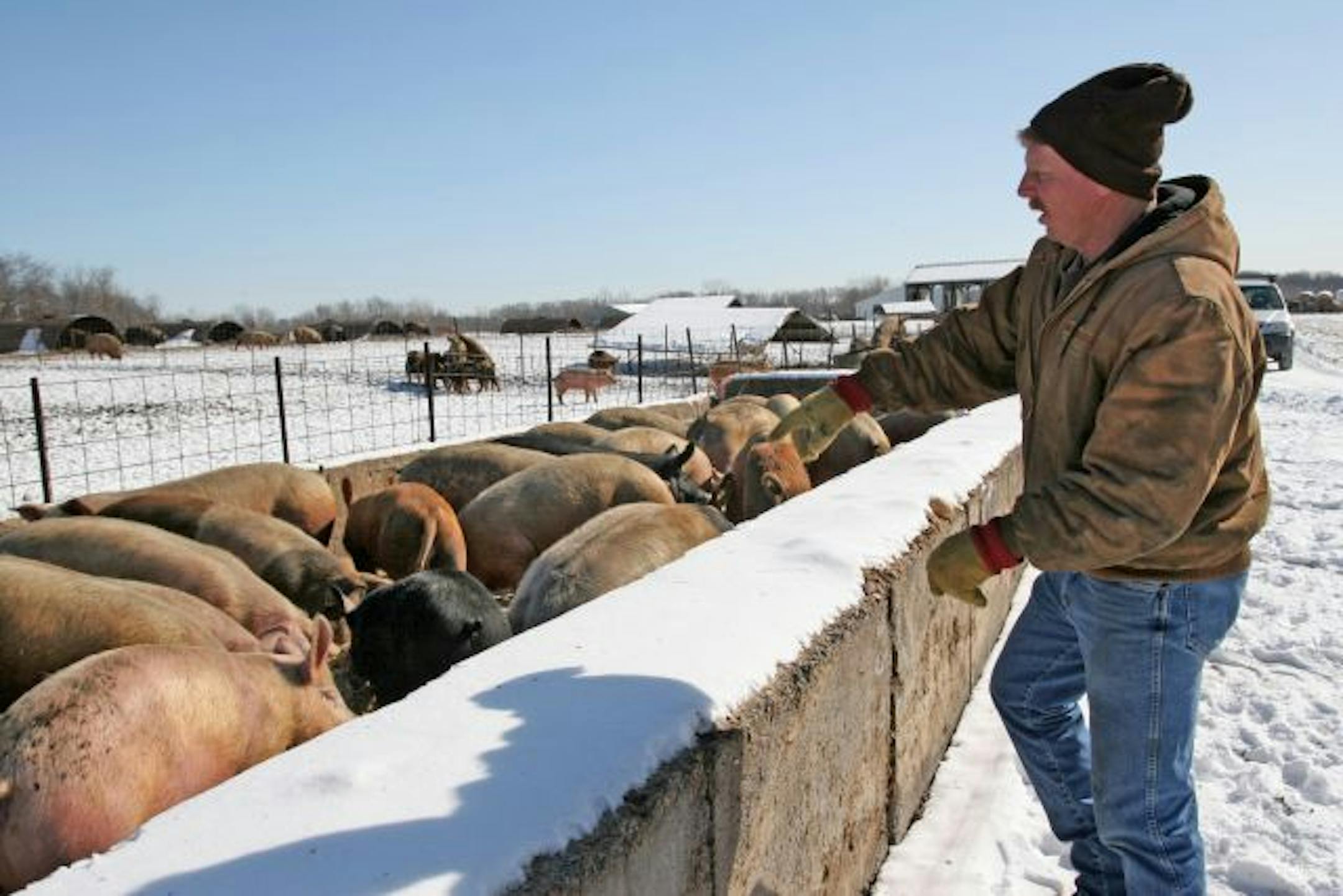
Your trash might be someone's treasure; to Pete Barthold's hogs, it's a feast. These days, though, there is more competition at the trough.
Barthold collects food waste from Twin Cities-area restaurants, groceries and institutions and feeds it to his nearly 2,000 hogs on two farms near St. Francis.
But he and other organics recyclers say a Hennepin County program undercuts them by favoring compost operations. They claim they're losing clients they've served for years.
The county's organics program, launched in 2005, was meant to bump the county's recycling levels from mid-40 percent levels to a state-required 50 percent, said Carl Michaud, the county's environmental services director. The idea was to structure a program inexpensive and convenient enough to encourage more organics recycling.
Under the program, garbage haulers pick up organic waste and haul it to a transfer station, where they pay the same $15 per-ton tip fee they'd pay for any other recyclable waste. The county pays the costs of hauling and disposing of the waste, usually $25 to $35 a ton. The waste then is turned into compost by two companies, Specialized Environmental Technologies in Rosemount and R.W. Farms in Chanhassen. In 2008, the county spent $41,097 in contracts with the two composters, Specialized Environmental Technologies in Rosemount, and R.W. Farms in Chanhassen.
The county program costs restaurants and other generators of organic waste less than half than Barthold's average $35-per-ton fee for hauling and processing the waste -- and those customers don't have to sort out food-soiled paper and biodegradable plastics.
"Those subsidies will slowly dissolve me," he said. He fears that other counties will copy the program.
Four companies -- Barthold Recycling, Second Harvest North, Second Harvest Central and Endres Processing -- have met with Hennepin County environmental staff but have been unsuccessful in their attempts to have the subsidies removed or broadened to include them.


