

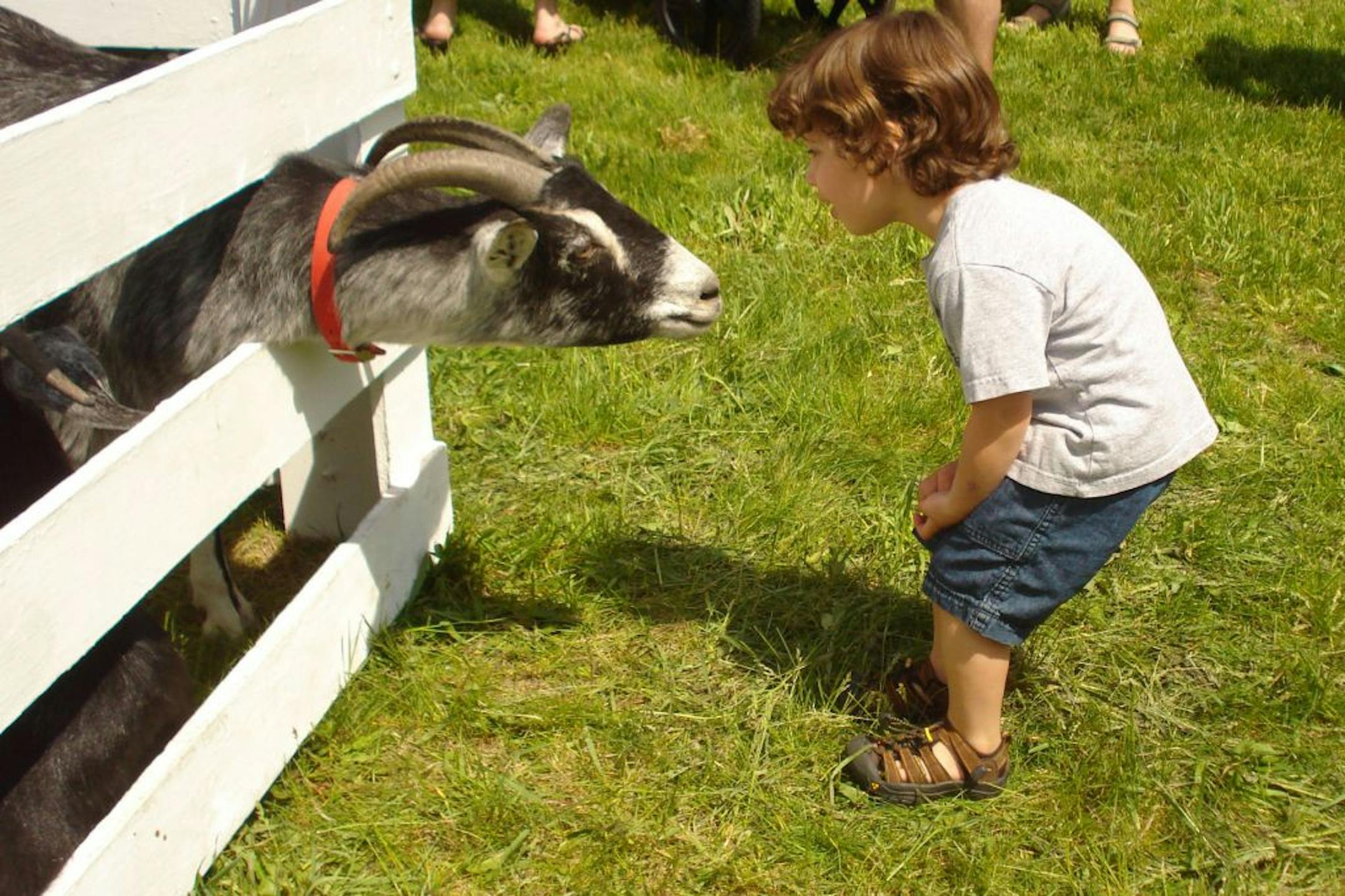
Who knew old-fashioned chores could be so much fun? Last year, when a group of kids at Holz Farm finished a game early, volunteer Norm Peterson of Eagan asked if they wanted to play another game or pick rocks in the field. To his surprise, they picked the latter.
"They did so well, we threw them back in the field for the next group," he said.
The Holz farmstead, which dates back to the 1800s, holds its annual spring festival May 20, where visitors can plant by hand, eat bread baked in a wood stove, watch a blacksmithing or beekeeping demonstration, and otherwise immerse themselves in farm life circa 1940.
A trip up the gravel drive shaded by a huge 200-year-old oak -- "The second biggest in Eagan," volunteer Linda Klein of Eagan pointed out -- brings visitors to a charming 100-year-old yellow farmhouse, which sits on a hill surrounded by farm buildings: a granary, a smokehouse, a corncrib, sheds, a hay barn and other outbuildings.
Like many in the first half of the 1900s, owners Ella and Otto Holz operated a varied and sustainable farm. They grew corn, hay, and oats for livestock and raised hogs to provide meat. They kept a huge vegetable garden and grew strawberries, raspberries and apples. They sold milk, bartered eggs and, like other farmers in Eagan, the onion capital of the United States in the '30s and '40s, they grew onions to sell.
The couple died three weeks apart in their 80s. Without any children to inherit the farm, nieces and nephews had planned to sell it to a developer when Eagan city officials stepped in to acquire it in 1995. Now volunteers keep up the farmhouse, officially listed on the National Register of Historic Places in 2007. While the grounds are always open and kids visit for summer youth camps, the farmhouse only opens to the public three times a year during the spring festival, the fall harvest and the holiday celebration.
During the spring festival, in the kitchen, with its pantry, wood-burning stove, icebox and old crank telephone, volunteers bake bread and churn butter by hand. The main floor contains artifacts, including a pump organ and a vintage Philco radio, a heavy mohair sofa and chair, and a treadle sewing machine with flowered cloth feed sacks stacked up for making dresses.
"We try to keep everything as '40s as we can," Klein said.


