
A 19th century idea flows again

A pair of natural Mississippi River waterfalls could be re-created where they once flowed around an island near historic Main Street in downtown Minneapolis.

December 9, 2010 at 5:58AM
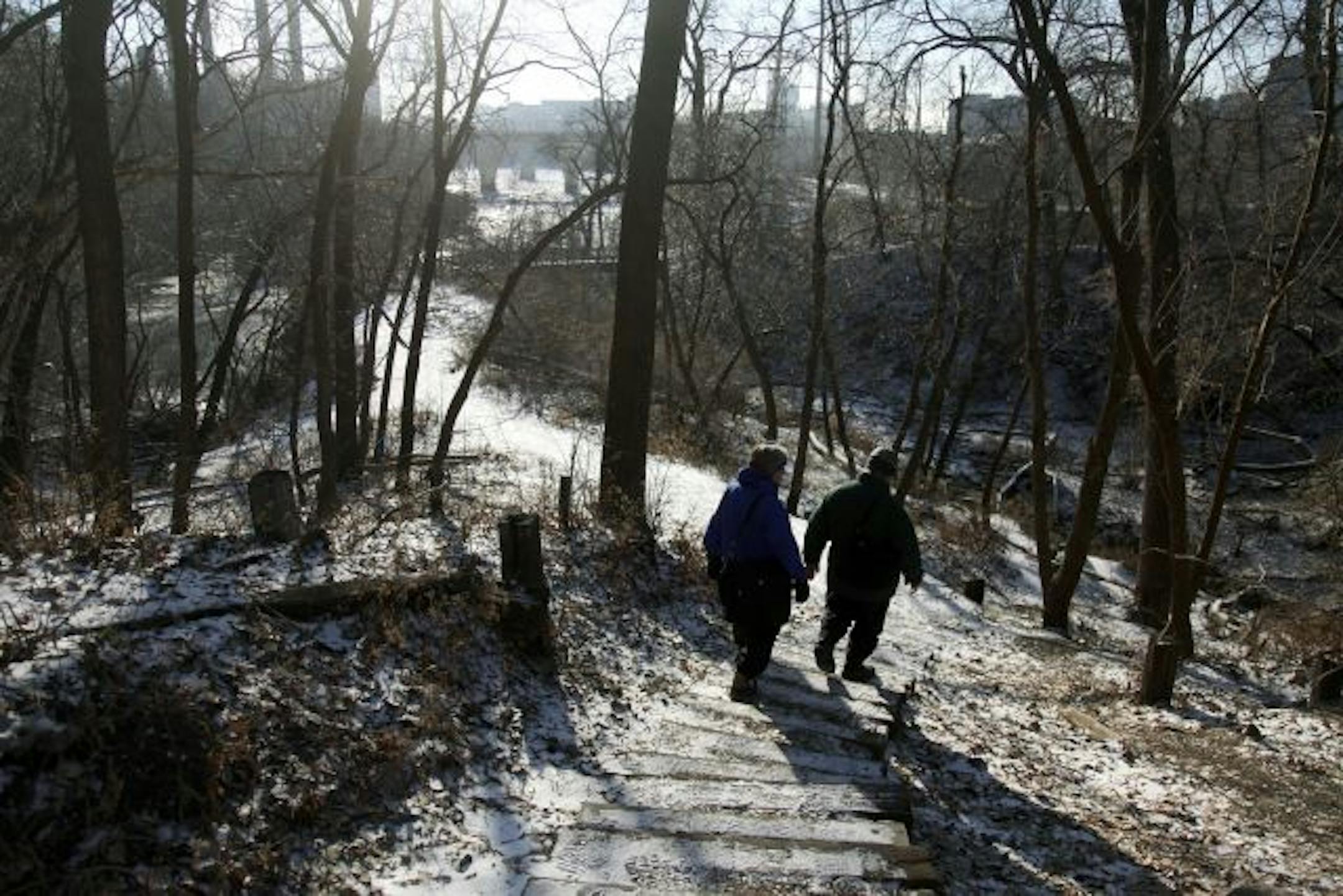
Cordelia Pierson, executive director of the Minneapolis Riverfront Corp., left, and David Wiggins, manager for the Mississippi National River and Recreation Area, gave a tour of the area where St. Anthony Falls once tumbled between Hennepin Island and the Mississippi River's east bank.
Cordelia Pierson, executive director of the Minneapolis Riverfront Corp., left, and David Wiggins, manager for the Mississippi National River and Recreation Area, gave a tour of the area where St. Anthony Falls once tumbled between Hennepin Island and the Mississippi River’s east bank. (Star Tribune/The Minnesota Star Tribune)

St. Anthony Falls in downtown Minneapolis seems impressive, but it's only half what it used to be.

Before the 1880s, the falls extended all the way across the Mississippi River, tumbling over huge limestone blocks.

But part of the river was diverted and impounded to power sawmills, flour mills and electric plants, especially on the east bank near historic Main Street.

Now the Minneapolis Park and Recreation Board and other partners are considering a $1 million plan to restore two waterfalls as part of a larger effort to improve surrounding parkland. They will present a consultant's plan for the project at a public meeting Thursday evening at Mill City Museum.

"It'll bring back some of what was there naturally, and it would add an extra attraction and enhancement for visitors to the park," said Park Board project manager Nick Eoloff.

He's talking about picturesque Pillsbury Park, marked by bridges and trails tucked along the river's edge. It's most visible from the east end of the Stone Arch Bridge.

The park's entrance is a steep wooden stairway across from the historic Pillsbury A Mill on Main Street. With limited access, the park has few visitors. The stairs are closed in winter for safety reasons.

That could change if the falls are partly restored and the park gets a makeover.

Two falls in a pocket of nature

The idea is to pipe river water to a pair of holding pools, and allow the water to cascade over two limestone cliffs where it once flowed naturally but at greater volumes.

"Having water coming over natural limestone, this would be more like a Minnehaha Falls feeling," said Cordelia Pierson, executive director of the Minneapolis Riverfront Corp. The falls would drop 25 to 30 feet, she said, and flow through channels that now carry storm water, water from natural springs and overflow from the nearby Xcel Energy hydroelectric plant.

"It's an exceptional pocket of nature in the city," said Pierson. She pointed out fox and rabbit tracks in the snow on a recent visit. She said visitors can see beaver, ducks, otter, muskrat, eagles and other wildlife. The water already supports crayfish, mussels and various fish, she said, and restoring waterfalls would add oxygen to the water and improve the environment even more.

It also would restore an appreciation of the area's history, said National Park Service Ranger David Wiggins.

The area once was a portage area for Indians to get around the falls, Wiggins said, and a major tourist attraction for European settlers.

The settlers and tourists came to see the falls, as well as numerous caves and natural springs that honeycomb the bluffs. The area is loaded with man-made tunnels, pipes and tailraces that routed water through the city's first mills and power plants, then back out to the river.

Businesses spread from the bluff onto Hennepin Island, impounding water and blocking channels that once flowed around the island.

Today the upper island hosts Xcel Energy's hydropower plant and the University of Minnesota's St. Anthony Falls Lab. Pillsbury Park is on the lower part of the island.

"Over the years the origin of why all this was here was sort of lost to memory," Wiggins said. "Restoring the area will give a boost to the idea that the city is here because of the river and because of the waterfall."

Bigger park redesign afoot?

Moving forward will not necessarily be easy. Separately, the park board is hosting a design competition for future development of the upper river. Eoloff said the board will likely want to see those ideas in early February before it takes up the waterfalls restoration proposal. Any re-creation of waterfalls, if approved by the board, would face questions about the area's geology and historic preservation of ruins, Eoloff said.

Pierson said restoring the falls could be a springboard to redesign of the park. That would involve cleaning out invasive overgrowth, rebuilding eroded trails, improving access, and possibly connecting trails on the lower and upper parts of the island.

Financing would likely require a mix of public and private funds and cooperation of several agencies, she said. This approach has been successful before with other important riverfront projects, she said.

"This would let people get down to touch the water, and would be one of the few places you can do that in the central riverfront area," she said. "This is a gem."

Thursday's public information meeting also includes a screening of a new film showing historic tunnels beneath Main Street. The meeting begins at 6:30 p.m. at Mill City Museum, 704 2nd Street S. in Minneapolis.

Tom Meersman • 612-673-7388

about the writer

about the writer

Tom Meersman

Reporter

See Moreicon

More from No Section

See More
FILE -- A rent deposit slot at an apartment complex in Tucker, Ga., on July 21, 2020. As an eviction crisis has seemed increasingly likely this summer, everyone in the housing market has made the same plea to Washington: Send money — lots of it — that would keep renters in their homes and landlords afloat. (Melissa Golden/The New York Times) ORG XMIT: XNYT58
Melissa Golden/The New York Times

It’s too soon to tell how much the immigration crackdown is to blame.