

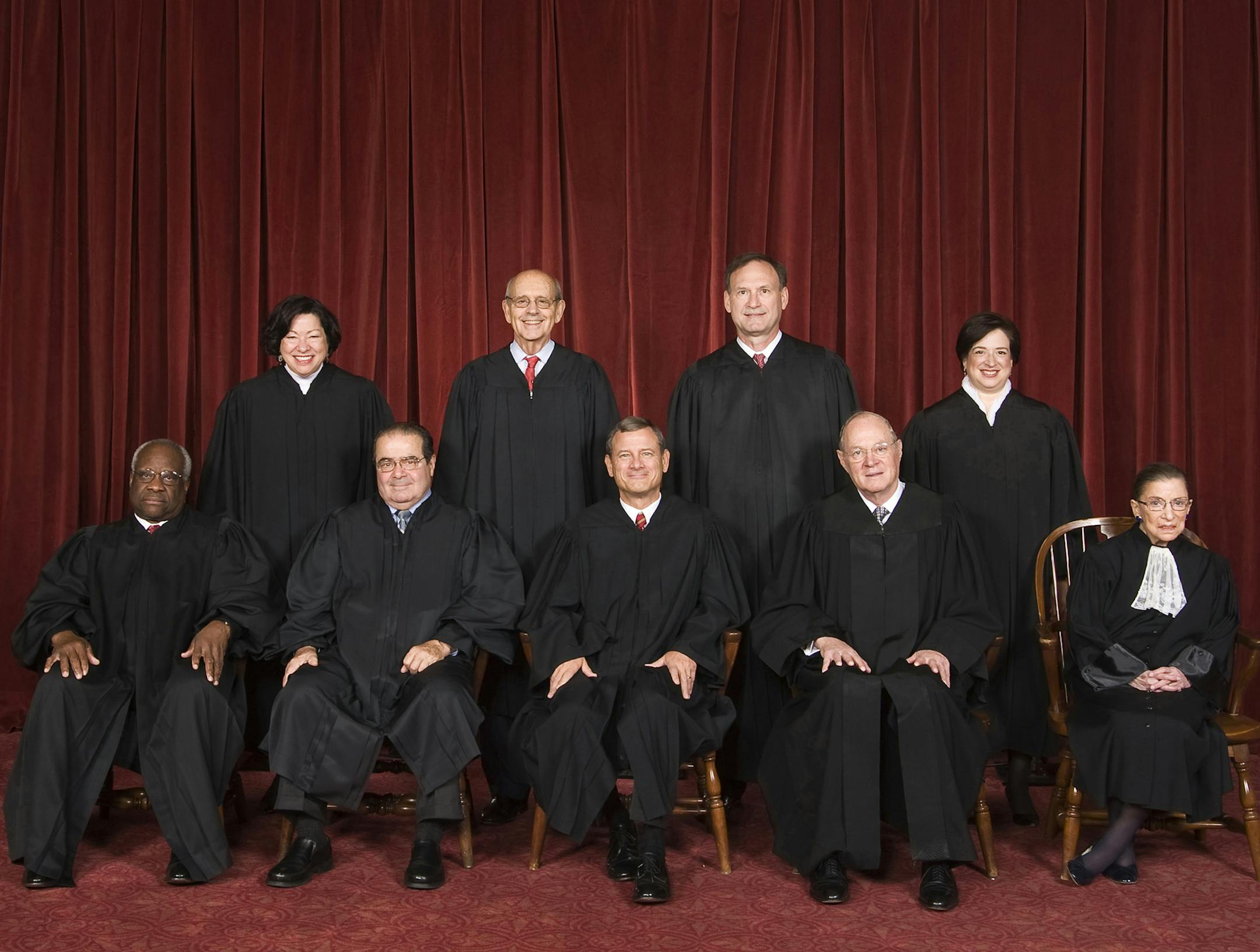
For years, particularly since the 2000 election, talk about the Supreme Court has centered on its bitter 5-4 divisions. Yet it is worth reflecting on a remarkable achievement: The court has agreed unanimously in more than 66 percent of its cases this term, and that figure will hold even if Monday's remaining two cases, on the Affordable Care Act's contraceptive coverage and on public-sector unions, are not unanimous.
The last time this happened was 1940.
The justices' ability to cross partisan divides and find common ground in their bottom-line judgments in roughly two-thirds of their cases — including the two decisions handed down Thursday, restricting the president's ability to issue recess appointments during brief breaks in the Senate's work and striking down a Massachusetts ban on protests near abortion clinics — should remind us that, even in this hyperpartisan age, there is a difference between law and politics.
Unanimity is important because it signals that the justices can rise above their differences and interpret the law without partisanship. The best illustration of this in the modern era is Brown vs. Board of Education, the 1954 case in which the court unanimously declared racial segregation in education to be unconstitutional. When the justices forge common ground, it signals to the nation the deep-seated roots of what the court has said and contributes to stability in the fabric of the law.
The court has not always valued consensus so highly. At the nation's founding, the justices each wrote separate opinions, leaving lawyers — and indeed the nation — to guess what the court was actually saying as a whole. It took Chief Justice John Marshall's leadership, at the start of the 19th century, to bring the court together and establish the practice of writing a single opinion for the court. Marshall was not above using hard and soft persuasion, going so far as to invite his colleagues to live together in a Washington boardinghouse, where they bonded and discussed cases over Madeira.
Disagreement on the court in that century was rare, with dissents occurring only about 10 percent of the time. Chief Justice William H. Taft, in the first decades of the 20th century, presided over the apogee of concurrence. He reportedly talked his colleagues out of more than 200 dissenting votes with his formidable political skills.
The modern era has been something of a disaster for unanimity. Chief Justice Earl Warren was able to achieve unanimity only 36.1 percent of the time, Chief Justice Warren E. Burger a scant 35.8 percent. One of Chief Justice William H. Rehnquist's final public acts was to express exasperation at the fractured court. In 2005, on the final day of his final term, a frail Rehnquist described his last majority opinion by first outlining his views, then the three concurrences filed, then the three dissents filed, and then joking, "I didn't know we had that many people on our court."
Compare all that to what Chief Justice John Roberts achieved this year with his colleagues.


