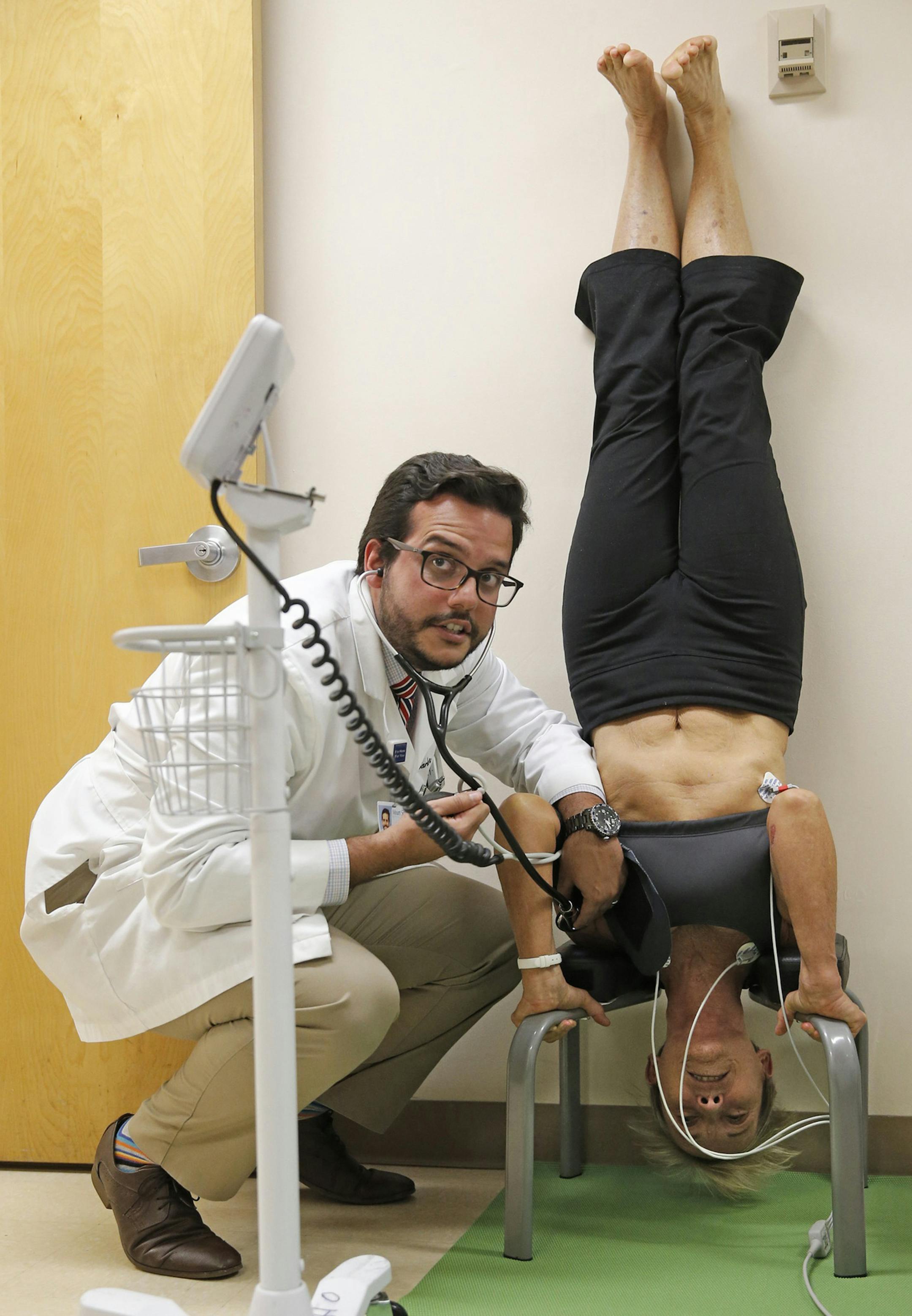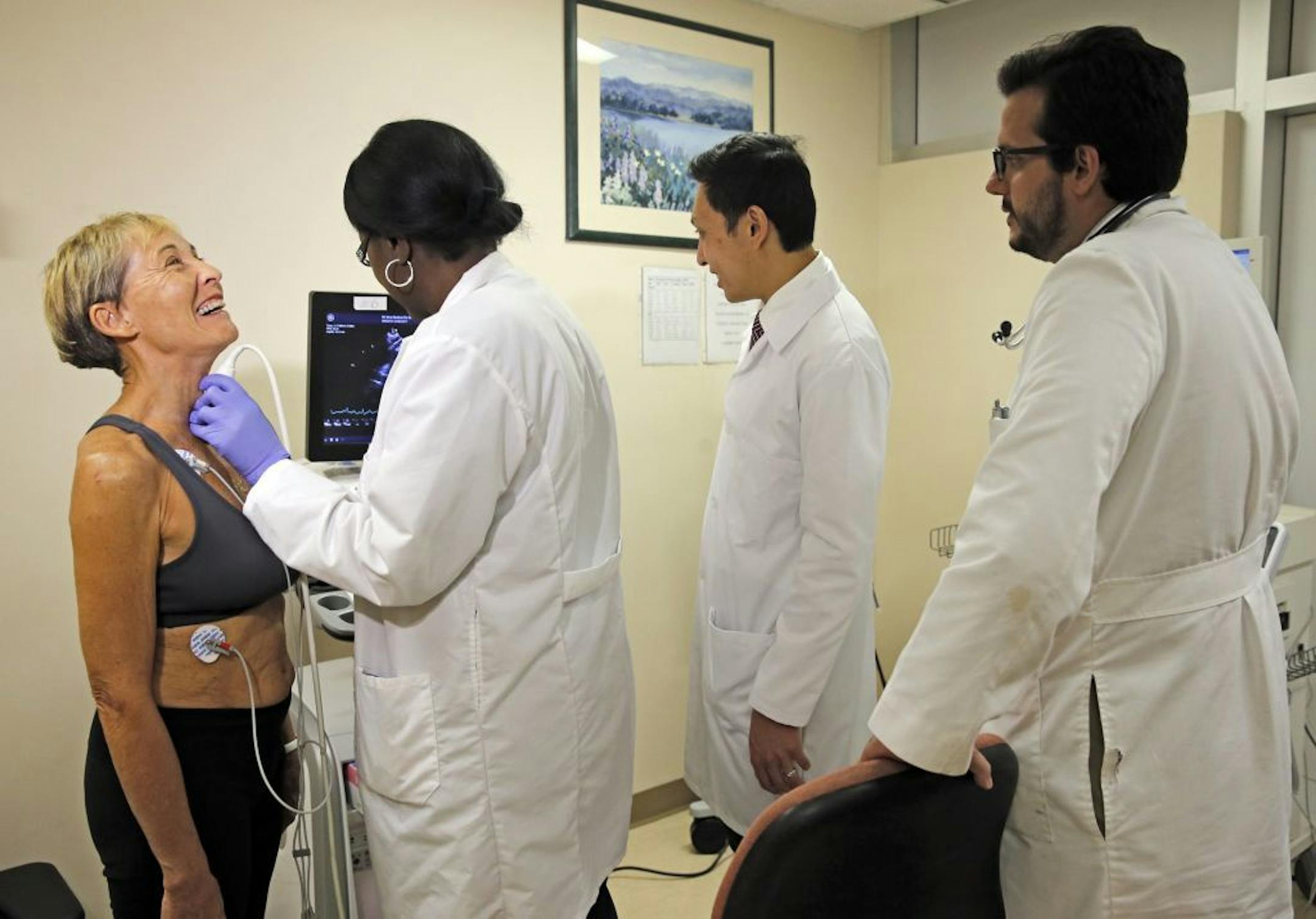
MIAMI BEACH, Fla. – The room was buzzing with doctors, an ultrasound technologist and a yoga instructor. The two cardiologists were huddled in the center checking the heart rate and blood pressure. And there, against the wall near the door, the patient, Sally Mertens, quietly stood on her head.
The hope: Mertens' headstands will deliver promising medical clues about the effects inversion yoga poses have on cardiovascular patients.
Mertens, 74, a devoted yogi the last 15 years, has been diagnosed with a thoracic aortic aneurysm — a weakening in the aorta, the major artery that carries blood from the heart to the body. A rupture can be life-threatening.
But with little research available, Mertens' doctors didn't know whether inverted or upside-down moves pose a risk. That could soon change.
"The major complication we worry about is tears in the walls of the aorta, which could lead to a medical emergency called an aortic dissection. We are hoping to get information including blood pressure when she goes into a pose, what happens to her heart rate and also what happens to the size of her aorta," said Dr. Jeffrey Lin, a cardiologist at Mount Sinai Medical Center in Miami Beach.
And that's how Mertens came to be in the hospital's Echo Lab in a modified headstand. She was hooked up to an echocardiogram, blood pressure cuff on her arm, yoga instructor Edwin Bergman by her side.
"I would love to be approved to go to the next level," she said. "I would love to be told that I can stand on my head and it not be a problem."
Mertens retired 14 years ago as an economic development executive, then embraced the practice. "I retired early at 60, and yoga was No. 1 on my list," she said.