

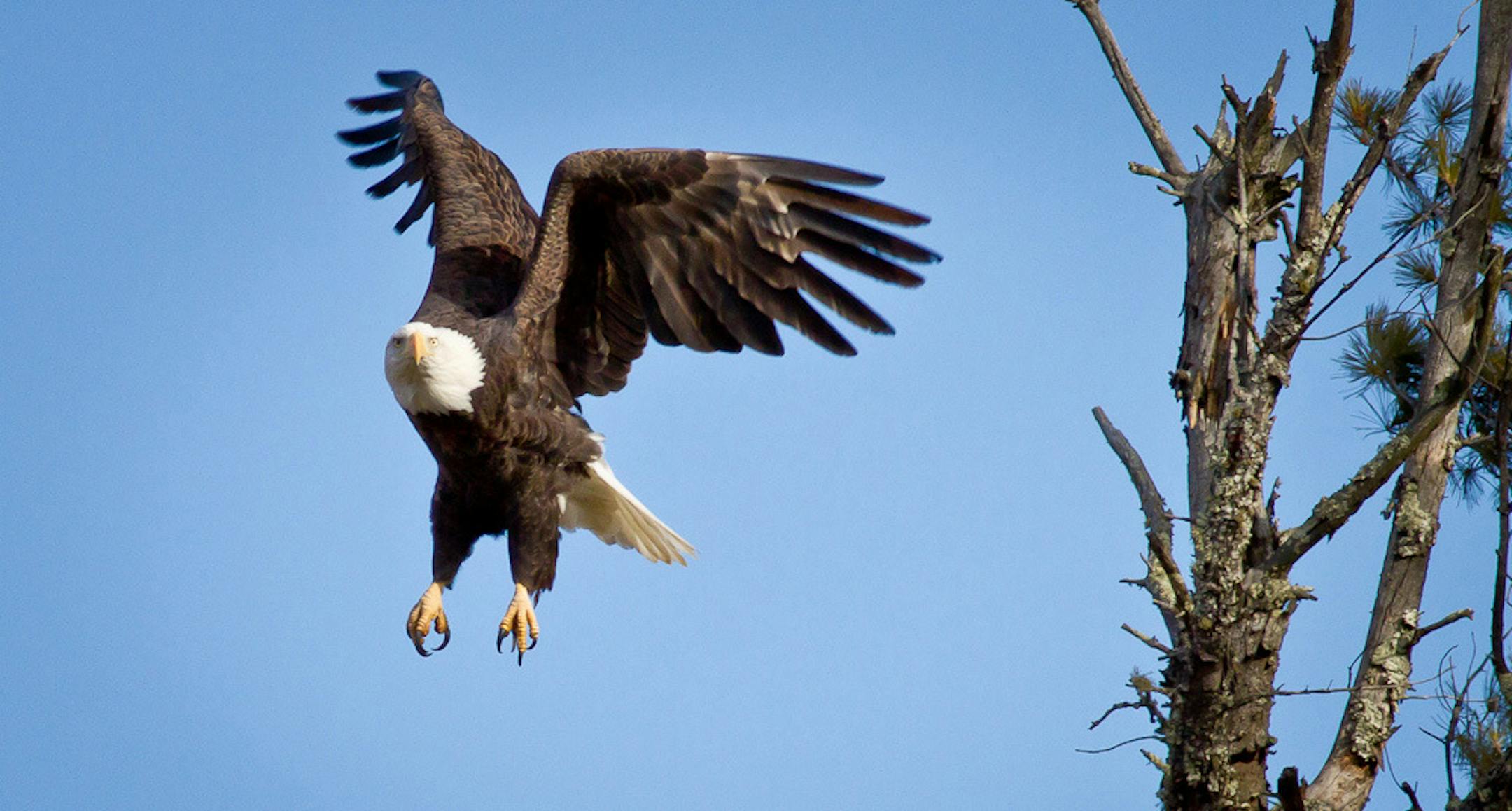
Lee Grim has an infectious enthusiasm for bald eagles that helps explain the research he's conducted on the iconic raptor in Voyageurs National Park since the early 1970s. When he speaks on the topic, his voice hits another level and the insights cascade off his tongue in rapid succession.
"This is spiritual for me," said Grim, 75, a retired biology professor at Rainy River Community College in International Falls, about his work summer after summer for the National Park Service (NPS). "To work at a national park and peek in on a certain population for 40-plus years (and) to watch that small population and track its recovery and repopulate an area — well, it's just thrilling to be a part of."
Grim's reference was to a new study published in January in the Journal of Applied Ecology. Conducted by researchers from the park service, U.S. Geological Survey and the University of Wisconsin in Madison, it asked a simple question: Can protecting individual bald eagle nests have a broader effect on the overall population in Voyageurs? After all, the logical (though unproven) assumption was that minimizing human disturbance for endangered birds and their nests would help them reproduce and perhaps even thrive.
The short answer is that managing individual nests works — and that's where Grim's field research came into play. For more than four decades, Grim surveyed the bald eagle population in the 218,000-acre national park. To reduce time and disturbance, the surveys were flown in a two-person seaplane beginning in April and through July. Grim documented, among other things, the birds he saw in nests, the location of the nests, and the birds' breeding success. In 1989, eaglet banding began, as did blood tests and feather analysis, to determine their overall health.
"You can get a lot of information from blood work, from genetics to immune system health and the presence of environmental contaminants," Grim said. "Early on, we found some high level of PCBs and DDT. That's in large part what caused the bald eagle population to plummet in the states."
Beginning in 1991, park officials sequestered an average of nine eagles nests per year, using warning signs to deter boaters, campers and hikers. Through 2004, a 400-meter radius exclusion zone was maintained, after which research showed it only needed to be 200. (Grim said, all told, there are 80-85 eagles nests in Voyageurs.)
By combining more than 40 years of Grim's data of managed and unmanaged nest sites, researchers developed an elaborate scientific model that looked at both nests (related to occupancy, success, reproductive output and more) and the overall eagle population (using statistics on abundance and growth).
The research found that the bald eagle breeding population in Voyageurs rose from fewer than 10 pairs in late 1970s to 48 pairs by 2016. The research suggested individual nest protection increased breeding pairs by 38 percent; several other factors accounted for the rest of the increase.


