

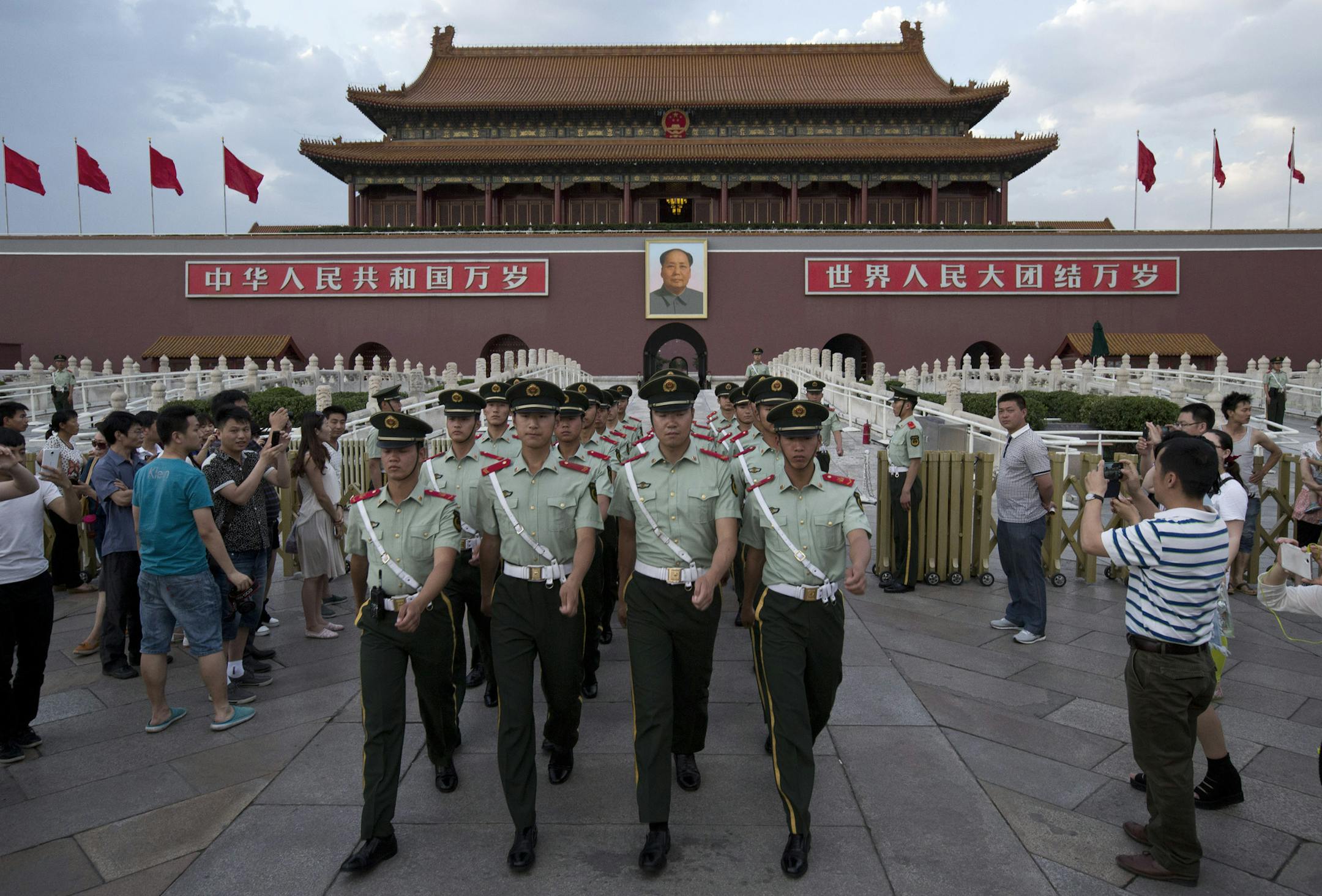
'I have tried very hard not to inject myself into China's internal affairs," wrote President George H.W. Bush to his Chinese counterpart, Deng Xiaoping, soon after Chinese troops gunned down hundreds, perhaps thousands, of demonstrators in and around Tiananmen Square on June 4, 1989. "But I ask you as well to remember the principles on which my young country was founded — freedom of speech, freedom of assemblage, freedom from arbitrary authority. It is reverence for those principles which inevitably affects the way Americans view and react to events in other countries."
This February, 25 years after that massacre, Gary Locke, the outgoing U.S. ambassador to China, gave a final speech before exiting the country.
"The U.S. is deeply concerned," said Locke, "over the recent pattern of harassment, arrests, prosecutions of good-government advocates, of public interest lawyers, of activists, Internet journalists, religious leaders. … The United States calls on China to guarantee peaceful activists the protections and freedoms to which they're entitled under China's international human rights commitments."
And so it goes. China remains an authoritarian, one-party state whose leaders see domestic activists and international human rights laws as threats to their sovereignty.
To Beijing's credit, it has overseen economic development on a scale that is unparalleled in world history. Through three decades of double-digit annual growth, about half a billion Chinese citizens have pulled themselves out of poverty. This growth has been the envy of the developing world, but it has not been accompanied by a concomitant extension of political and civil liberties.
Recent examples abound. In a closed trial in January, a judge sentenced democracy advocate Xu Zhiyong to four years in prison for "gathering a crowd to disrupt public order." When Xu tried to read his concluding statement, the judge silenced him after 10 minutes and called his words "irrelevant." One month later, teacher Ilham Tohti was detained and charged with inciting Uighur separatism, and dissident Cao Shunli died in custody after being denied medical treatment. In March, leaders of the Hong Kong journalism community were physically assaulted following demonstrations against Beijing's mounting media strictures.
In stark contrast to 1989, Beijing's reach now extends far beyond China's borders. The nation's rulers have embarked on a multifront effort to undermine the international human rights regime. Beijing uses its considerable diplomatic power and economic leverage to block resolutions in multilateral forums and to weaken the United Nations Human Rights Council.
The latter endeavor became much easier in November when China won a council seat alongside such perennial violators as Russia, Saudi Arabia, Vietnam and Cuba. China now routinely wins far more votes on the council than the United States, due in no small measure to Beijing's prodding of its African and Middle Eastern clients.


