

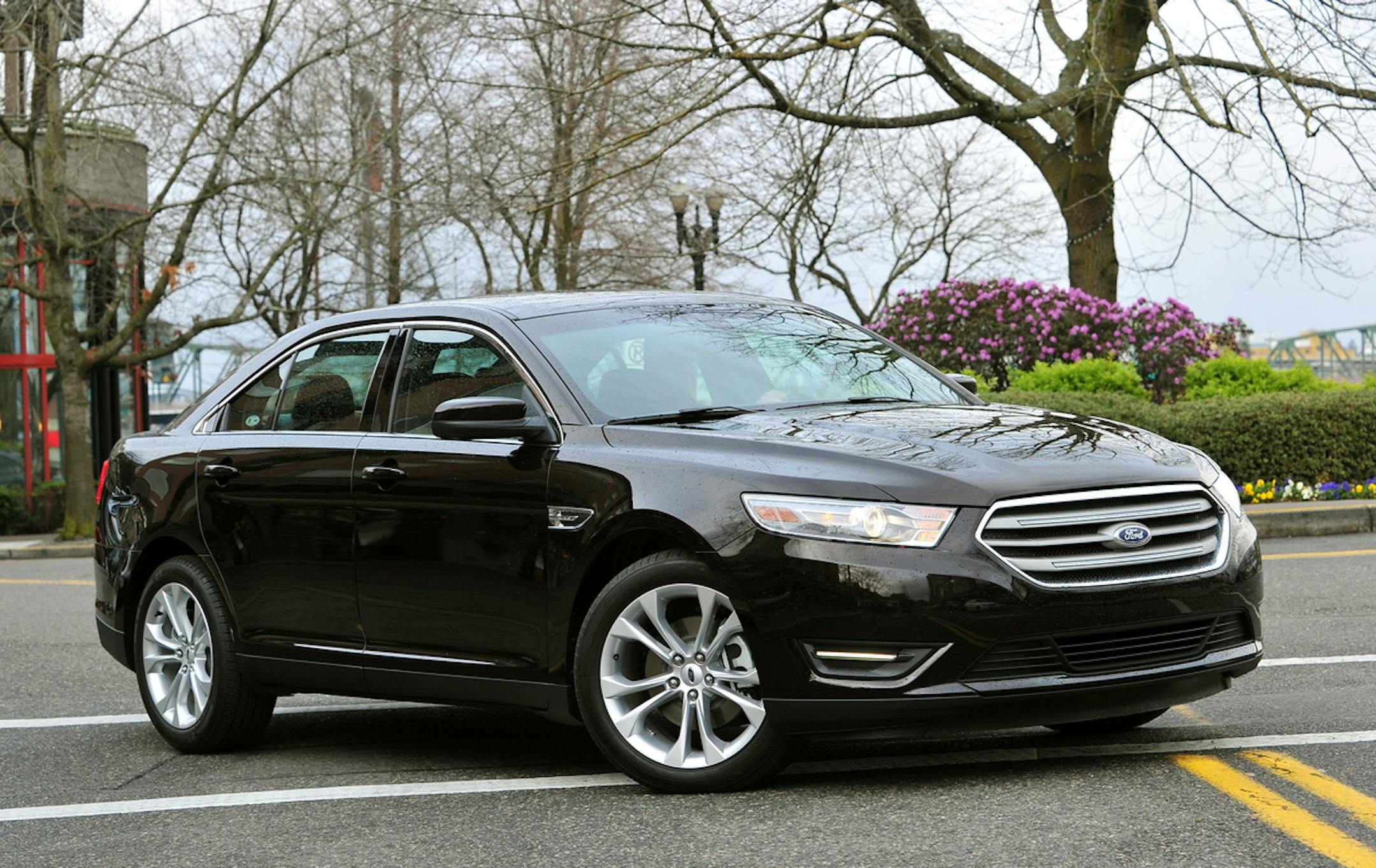
BETHLEHEM, N.H. - In an engineering move that pursues the delicious -- if elusive -- goal of having one's cake and eating it, too, Ford is offering the 2013 Taurus family sedan with a fuel-efficient turbocharged four-cylinder engine. In doing so, Ford is going unconventional with its most conventional vehicle, a large sedan with a curb weight of almost 2 tons.Not radically unconventional, mind you: small engines are arriving in big cars from many makers, and Ford even offered a four-cylinder in the original Taurus of 1986, when gas seemed cheap at a pump price of less than $1 a gallon.
The goal in 2013, of course, is to provide full-size accommodations with something closer to pint-size fuel economy. It is a tactic that makes the Taurus, with a combined city-highway rating of 26 mpg, the country's most fuel-efficient large traditional sedan, according to the Environmental Protection Agency. In second place is the 2013 Toyota Avalon, with a combined rating of 24 mpg; that car has a 3.5-liter V6.
In recent years the once-popular Taurus -- it was the United States' best-selling car five years running and peaked at more than 400,000 in sales twice in the 1990s -- has had a troubled on-again, off-again existence. When its popularity dimmed to near invisibility, it was replaced by the 2005 Five Hundred. But the Five Hundredwas so disappointing that Ford -- in what some saw as desperation -- renamed it Taurus for the 2008 model year.
The base engine in the new Taurus is a 3.5-liter V6 built in Lima, Ohio, and rated at 288 horsepower. In a reversal of the norm, the extra-cost option is a smaller engine, the 240-horsepower 2-liter EcoBoost four-cylinder built in Spain. It costs $995.
The EcoBoost 4 is a relatively advanced engine, using not just a turbocharger but also direct injection of gasoline into the combustion chamber, a design intended to provide more power and better fuel economy. Its torque output of 270 pound-feet tops the V6 engine's 254, and it reaches that peak 1,000 rpm sooner. Both the 2.0 EcoBoost and the V6 engines are paired with attentive and effective six-speed automatic transmissions.
The EcoBoost label, incidentally, simply means it is part of a family of Ford engines in various sizes, all sharing turbocharging, direct injection and a higher price.
To Ford's credit, the 2.0 EcoBoost is a stand-alone option on the Taurus and is available on even the least expensive version, the SE. That model has a starting price of $27,395 with the V6, and adding the EcoBoost engine option inflates the window sticker to $28,390.
With the 2.0 EcoBoost, the Taurus is rated at 22 mpg in town and 32 mpg on the highway. That is 3 mpg better than the standard V6 in both types of driving.

