
1968: The year the world turned

A new History Center exhibit shows how those tumultuous 12 months shook the nation. We asked some Minnesotans who lived through 1968 to reflect on that year.

October 13, 2011 at 6:24PM
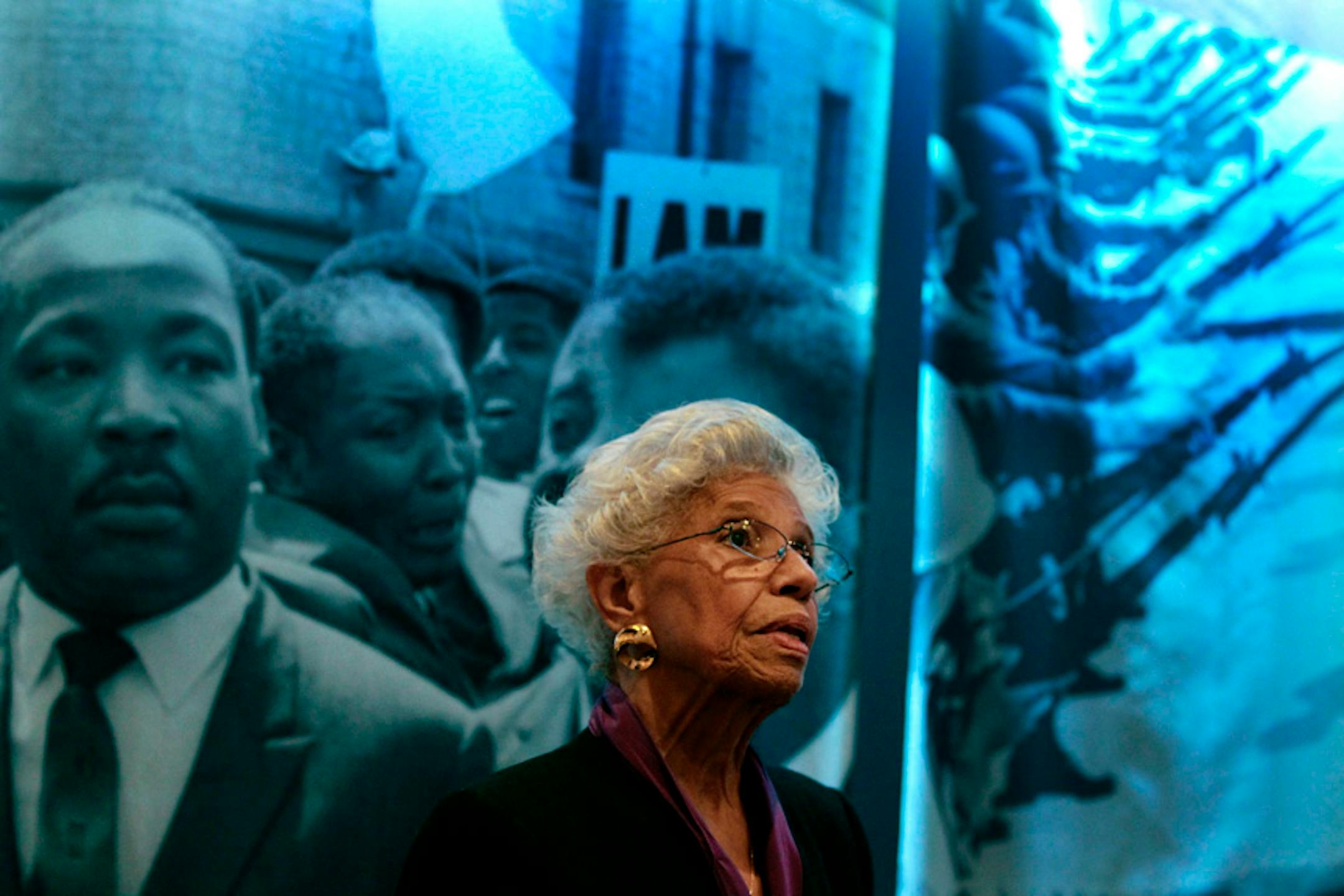
Civil rights activist Josie Johnson stood in front of a "1968" display about the Rev. Martin Luther King
Civil rights activist Josie Johnson stood in front of a “1968” display about the Rev. Martin Luther King (Margaret Andrews — Star Tribune/The Minnesota Star Tribune)

In 1968, lots of people believed they could change the world -- and tried to

More than 40 years on, it seems like ancient history to Americans who haven't yet reached middle age. But as a new exhibit at the Minnesota History Center proves in living, psychedelic color, that year crystallized an intense period of political and cultural change in the United States, marked by dramatic ideological clashes.

It was the year before Woodstock, the year after the first Super Bowl. More Americans died in Vietnam than in any other year of that war. Robert Kennedy and the Rev. Martin Luther King Jr. were assassinated. College students staged sit-ins and urban riots broke out across the country. The American Indian Movement was founded in Minneapolis. Amid all the grief and rage, "Laugh-In" debuted on TV, "2001: A Space Odyssey" premiered in movie theaters and "Hair" opened on Broadway.

More than a year, 1968 represents a fiery idealism that seems naive by modern sensibilities. But it was also the first time that a "youthquake" was the most powerful cultural force in a nation that has remained youth-focused ever since.

With "The 1968 Exhibit" set to open Friday in St. Paul, we asked several Minnesotans who lived through that year for their reflections. For all the divisiveness they witnessed -- between establishment and anti-establishment, black and white, parents and children -- some say it has nothing on the current state of the union. Others note positive changes that are taken for granted today. For example, 1968 was the year Yale decided to admit a new kind of student: women.

GEORGE AND CHARLIE PILLSBURY

Father and son

In 1968, Republican George Pillsbury was thinking about getting into politics, but hadn't yet been elected as state senator from Orono. His oldest son, Charlie, who had campaigned door to door for Eisenhower with his mother, Sally, when he was a tot, was now a student at Yale, drawn to a growing antiwar sentiment on campus. His roommate, cartoonist Garry Trudeau, based the character of Mike Doonesbury in part on Charlie.

A businessman and heir to the Pillsbury milling fortune, George was a Marine in World War II and was at odds, at first, with his son's antiwar stance. Still, he said, there weren't a lot of heated arguments around the dinner table. "We agreed to disagree," he said.

"My dad is of a generation that trusted the experts to know what was right," Charlie said. "I didn't think the experts were right this time, and as it turned out, they weren't."

Friction of a different sort developed after Charlie skipped his college hockey banquet to campaign for Sen. Eugene McCarthy, who was challenging fellow Minnesotan Hubert Humphrey for the Democratic presidential nomination. Four years earlier, McCarthy had fought off a challenge from Charlie's uncle, Wheelock Whitney.

A few years later, Charlie's name was on a flier alongside Yippie leader Jerry Rubin's, advertising an antiwar event. George was then facing competition for conservative votes, and told Charlie the Pillsbury name couldn't be associated. "We compromised," Charlie said. "I took my name off my flier, but I still gave the speech." The younger Pillsbury is still putting that negotiating skill set to use, as volunteer director of an international-dispute settlement nonprofit called Mediators Without Borders.

Josie Johnson

Civil rights activist

Johnson, who had been politically active since she was a teenager, was an aide to then-Minneapolis Mayor Art Naftalin in 1968, acting as a liaison between the city and the African-American community. Three years later, she became the first black woman named to the University of Minnesota Board of Regents.

"After the assassination of Dr. King, there was a good deal of trouble on Plymouth Avenue on the North Side, fires and disturbances," she said. "My husband and I went to the Way, a community center where the Fourth Precinct police station is now, to bring young black people together to talk about history and keep them off the streets.

"Unlike a lot of cities, Minneapolis hadn't known that kind of [racially charged] trauma before, but instead of destroying our city, it opened people's eyes, and then it opened doors. Without trying to sound too complimentary, I think people were really trying to find ways to come together, to find common ground, which isn't how it is now.

"We are still a country that is basically racist. I believe we have a society that is not looking at how to work together, that is so fearful of having black leadership, a black president, that they would rather see this country go down than see him succeed. That is very scary to me."

RALPH DONAIS

Vietnam veteran

In the late 1960s, Donais experienced an unusual form of Minnesota Nice. Unlike in Chicago and California, people at Minneapolis/St. Paul airport did not spit on him.

"We were an open target because they made all the military travel in uniform," said Donais, a Marine who did two stints in Vietnam. "We were considered baby killers and everything else back then. There was nothing about helping the people of another country."

Donais, who retired as the corps' avionics chief in 1994, said "the news media painting a bad picture of the military" roused not only students but average Americans. "We went [to Vietnam] because our leaders decided we should go," he said.

Donais, who lives in the Elk River house of his youth, was heartened by the nation's unity after 9/11, and the warm receptions troops often get at airports from their fellow citizens. But he's not confident that the war in Afghanistan will turn out any better than Vietnam did.

CAROL CONNOLLY

Peace activist

In 1968, Connolly remembers getting pushed through a plate-glass window -- while pregnant -- along with a crush of other protesters at the infamously contentious Democratic Convention in Chicago. Luckily, she wasn't seriously hurt.

Now poet laureate of St. Paul, Connolly was then married to her first husband, attorney John Connolly, who was the state chair for the McCarthy campaign. "We organized the precinct caucuses; every nun in the state turned out," she recalled. "Humphrey was lost in the dust" -- temporarily, as it would turn out. (He won the Democratic nomination but lost the election to Richard Nixon.)

"I remember a young Marine back from the war handed something to Gene and said, 'Thanks for all you're doing to end the war,' before walking away," she said. "Gene looked down and it was the guy's war medal."

Connolly was also busy raising her six kids: "I tried using the rhythm method," she said. "It didn't work." A few years later, after giving birth to an eighth child who died, Connolly wanted to get a tubal ligation, "but in those days the husband had to sign off on that." John, a staunch Catholic, was initially reluctant, but eventually agreed after consulting with medical professionals.

ALAN PAGE

Minnesota Supreme Court justice

It was a time of disconnection for Page, who in 1967 had begun a Hall of Fame career with the Minnesota Vikings. The assassinations of King and Kennedy, racial turmoil and roiling world affairs made it a "very wrenching and very difficult year."

"The flip side was my first child, my daughter Nina, was born at the end of 1967." He stayed focused enough on the field to make the Pro Bowl, but "you'd go out on a Sunday afternoon with the idea of playing a football game while all around you, people were dealing with real problems."

The disconnect remains, he said: "On the personal scale, things couldn't be better. ... [But] we're in two different wars. Things haven't gotten better in the Middle East. We still have issues with poverty. We still have issues with race.

"You start off life and get to be a twenty-something and hope that when you're gone you've left the world a better place. And it's not clear to me that my generation will be successful at that. ... I'm still hopeful but, boy, some days you just wonder."

MARLON DAVIDSON AND DON KNUDSON

Same-sex couple

In 1960s Minnesota, most gays and lesbians were in the closet. But Davidson and Knudson, who have been a couple since meeting in Bemidji in 1953, say they were open about their relationship on St. Paul's Ramsey Hill, where they joined the neighborhood association.

Knudson is an artist, Davidson a retired public-school art teacher. Davidson said he doesn't recall feeling too affected by discrimination. "Maybe we were lucky, but our attitude was, we're just as good as anyone else and if you don't like it, go away," he said. "Maybe that confidence helped." They didn't consider themselves activists, either. Instead, "we raised people's awareness by living like everyone else around us."

He and Knudson, who returned to Bemidji many years ago, wouldn't get married, even if they could. "It should be there for those who want it, but we consider marriage a religious ceremony," he said. "We'd jump at a civil union, though."

TOM SWAIN

Chief of staff for then-Gov. Elmer Anderson

The Vietnam War truly hit home for Swain.

During the Tet offensive early in 1968, his son-in-law, Marine Major Patrick P. Murray, didn't return from an air mission. Swain, now 90, joined an organization with an unwieldy name but a clear mission: the National League of Families of American Prisoners and Missing in Southeast Asia.

Getting involved came naturally, being the governor's chief of staff, and he went to the Paris Peace Talks that summer with five wives of MIA/POW troops. But as with tens of thousands of other American families, closure was a long time coming.

"He came home in pieces," Swain said. "We actually buried him three times. There was no resolution for most people until they emptied the prisons in 1973. Years later, they indicated the Vietnamese had sent in various body parts and there was clear evidence that some of those remains were his. We pulled the casket at Fort Snelling and put something else in there, and later there was another burial ceremony with his co-pilot at Arlington."

In 1968, Swain's family was still hopeful, both for good news personally and about the future in general. Now? Not so much.

"Compared to today, almost any year was more hopeful," he said. "The old politics generally was, when issues come up you must be willing to compromise. Today, both with the far right and the far left but more with the far right, compromise is forbidden. This is so disheartening and so disillusioning. It gives me great qualms about what kind of country we are leaving my grandchildren."

BILL TILTON

St. Paul attorney and former student activist

1968 "was really a great time to be young," Tilton said. "I was a shy, middle-class white boy who joined a fraternity and was sort of an airhead. Then civil rights and the anti-war movement turned me around into a serious guy. We looked down our noses at the South then for its segregation, but there were only 80-some black students on the U of M campus that year, including the athletes," he said.

In his recollection, activists of the day saw themselves as all part of one big movement, "including free speech, ecology, feminism," he said. "And the music and the lifestyle were all morphed together with the revolution."

So did they make a difference? "You can be cynical and focus only on the anti-war movement, and say no, because we recently invaded another country based on smoke and mirrors. But look at all these other things that happened as a result of actions taken back then. Environmental protection, Title Nine, women's college dorms having the same hours and rules as men's -- these ideas were radical then. My daughters have grown up in a world where their eyes glaze over when I try to tell them about it. That's success."

SUZANNE WEIL

Former performing-arts coordinator at Walker Art Center

Weil worked at the Walker under standard-setting director Martin Friedman, who was in large part responsible for putting Minneapolis on the map in the New York-centric modern art scene. On her first day in late 1968, "I watched the wrecking ball hit the old building's Moorish facade," she said. "We staged events all over the city for awhile; Garrison Keillor read his Nixon poems at the library's planetarium."

Weil booked many top music acts in those days, including jazz/funk trumpeter Miles Davis, who played the Walker/Guthrie a few times in the late 1960s and early '70s.

"The audiences at Miles' shows, including some of the old Vikings players -- great big guys who would come striding in wearing their wolf coats -- were very concerned about appearing hip," she said. "When Miles would play 45 minutes straight, sometimes with his back to the audience, then go off stage without a word, no one knew whether it was intermission or what. I would invariably get a call the next day from someone who felt cheated for what the tickets cost for only 40 minutes. My stock answer was, if you paid by the hour, you got cheated; if by the note, you got your money's worth."

WILLIE MURPHY

Minneapolis musician

For Murphy, 1968 "was quite a heady time," in more ways than one. The young musician and cohort Spider John Koerner "were flying around with loads of money in our pockets and playing places like Sausalito, Boston, Ann Arbor." They opened for the Byrds, Jefferson Airplane and a new artist named James Taylor.

Back home, Murphy played often at the Triangle Bar but characterized the West Bank neighborhood as "a fad. The original hippie neighborhood was 26th & Nicollet," where a store called Psychedelia "had a barber chair, and you'd get high and people would spin you around."

Nearby, another "head shop" called the Electric Fetus opened that year. Murphy recalled a promotion where "the first 100 people who showed up without any clothes would get a free album. That was quite the thing back then. I remember Will Donicht's band played nude at a park on the West Bank."

Murphy called himself, then and now, "a flaming hippie," but is dismayed that the 1960s counterculture produced such a backlash. "Grace Lee Boggs, a philosopher from Detroit, says there was a revolution in the '60s and we've been living in the counter-revolution ever since. The right wing had a wakeup call; capitalism had a wake-up call. And they don't back off at all.

"We basically thought we were changing the world or would change the world, but, as they say, the other guys have more money, more power. To me thinking about that is not an exercise in pleasant nostalgia."

bward@startribune.com • 612-673-7643

about the writer

about the writer

Star Tribune Staff writers